

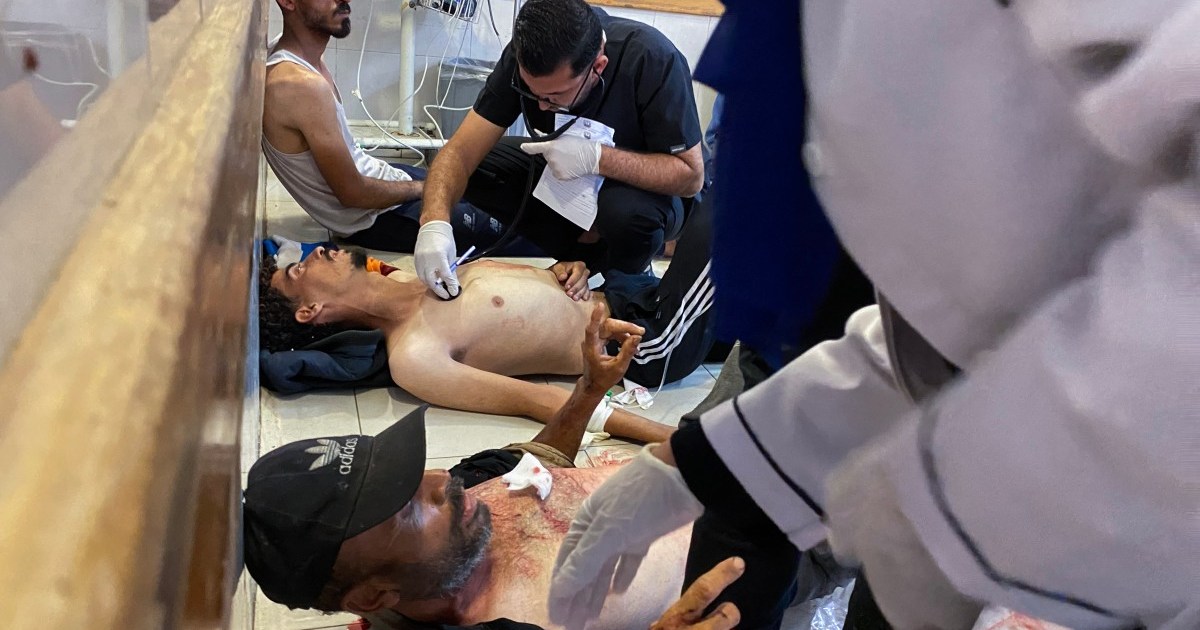
It was my childhood dream to study medicine. I wanted to be a doctor to help people. I never imagined that I would study medicine not in a university, but in a hospital; not from textbooks, but from raw experience.
After I finished my BA in English last year, I decided to enrol in the medical faculty of al-Azhar University. I started my studies at the end of June. With all universities in Gaza destroyed, we, medical students, are forced to watch lectures on our mobile phones and read medical books under the light of our mobile phones’ flashlights.
Part of our training is to receive lectures from older medical students, who the genocidal war has forced into practice prematurely.
My first such lecture was by a fifth-year medical student called Dr Khaled at Al-Aqsa Martyrs Hospital in Deir el-Balah.
Al-Aqsa looks nothing like a normal hospital. There are no spacious white rooms or privacy for the patients. The corridor is the room, patients lie on beds or the floor, and their groans echo throughout the building.
Due to the overcrowding, we have to take our lectures in a caravan in the hospital yard.
“I’ll teach you what I learned not from lectures,” Dr Khaled began, “but from days when medicine was [something] you had to invent.”
He started with basics: check breathing, open the airway, and perform cardiopulmonary resuscitation (CPR). But soon, the lesson shifted into something no normal syllabus would have: how to save a life with nothing.
Dr Khaled told us about a recent case: a young man pulled from beneath the rubble – legs shattered, head bleeding. The standard protocol is to immobilise the neck with a stabiliser before moving the patient.
But there was no stabiliser. No splint. No nothing.
So Dr Khaled did what no medical textbook would teach: he sat on the ground, cradled the man’s head between his knees, and held it perfectly still for 20 minutes until equipment arrived.
“That day,” he said, “I wasn’t a student. I was the brace. I was the tool.”
While the supervising doctor was preparing the operating room, Dr Khaled did not move, even when his muscles began aching, because that was all he could do to prevent further injury.
This story was not the only one we heard from Dr Khaled about improvised medical solutions.
There was one which was particularly painful to hear.
A woman in her early thirties was brought into the hospital with a deep pelvic injury. Her flesh was torn. She needed urgent surgery. But first, the wound had to be sterilised.
There was no Betadine. No alcohol. No clean tools. Only chlorine.
Yes, chlorine. The same chemical that burns the skin and stings the eyes.
She was unconscious. There was no alternative. They poured the chlorine in.
Dr Khaled told us this story with a voice that trembled with guilt.
“We used chlorine,” he said, not looking at us. “Not because we didn’t know better. But because there was nothing else.”
We were shocked by what we heard, but perhaps not surprised. Many of us had heard stories of desperate measures doctors in Gaza had had to take. Many of us had seen the gut-wrenching video of Dr Hani Bseiso operating on his niece on a dining table.
Last year, Dr Hani, an orthopaedic surgeon from al-Shifa Medical Complex, found himself in an impossible situation when his 17-year-old niece, Ahed, was injured in an Israeli air strike. They were trapped in their apartment building in Gaza City, unable to move, as the Israeli army had besieged the area.
Ahed’s leg was mangled beyond repair and she was bleeding. Dr Hani did not have much choice.
There was no anaesthesia. No surgical instruments. Only a kitchen knife, a pot with a little water, and a plastic bag.
Ahed lay on the dining table, her face pale and eyes half-closed, while her uncle – his own eyes brimming with tears – prepared to amputate her leg. The moment was captured on video.
“Look,” he cried, voice breaking, “I am amputating her leg without anaesthesia! Where is the mercy? Where is humanity?”
He worked quickly, hands trembling but precise, his surgical training colliding with the raw horror of the moment.
This scene has been repeated countless times across Gaza, as even young children have had to go through amputations without anaesthesia. And we, as medical students, are learning that this could be our reality; that we, too, may have to operate on a relative or a child while watching and hearing their unbearable pain.
But perhaps the hardest lesson we are learning is when not to treat – when the wounds are beyond saving and resources must be spent on those who still have a chance of survival. In other countries, this is a theoretical ethical discussion. Here, it is a decision we need to learn how to make because we may soon have to make it ourselves.
Dr Khaled told us: “In medical school, they teach you to save everyone. In Gaza, you learn you can’t – and you have to live with that.”
This is what it means to be a doctor in Gaza today: to carry the inhuman weight of knowing you cannot save everyone and to keep going; to develop a superhuman level of emotional endurance to absorb loss after loss without breaking and without losing one’s own humanity.
These people continue to treat and teach, even when they are exhausted, even when they are starving.
One day, midway through a trauma lecture, our instructor, Dr Ahmad, stopped mid-sentence, leaned on the table, and sat down. He whispered, “I just need a minute. My sugar’s low.”
We all knew he hadn’t eaten since the previous day. The war is not only depleting medicine – it is consuming the very bodies and minds of those who try to heal others. And we, the students, are learning in real time that medicine here is not just about knowledge and skills. It is about surviving long enough to use them.
Being a doctor in Gaza means reinventing medicine every day with what is available to you, treating without tools, resuscitating without equipment, and bandaging with your own body.
It is not just a crisis of resources. It is a moral test.
And in that test, the wounds run deep – through flesh, through dignity, through hope itself.
The views expressed in this article are the author’s own and do not necessarily reflect Al Jazeera’s editorial stance.
