

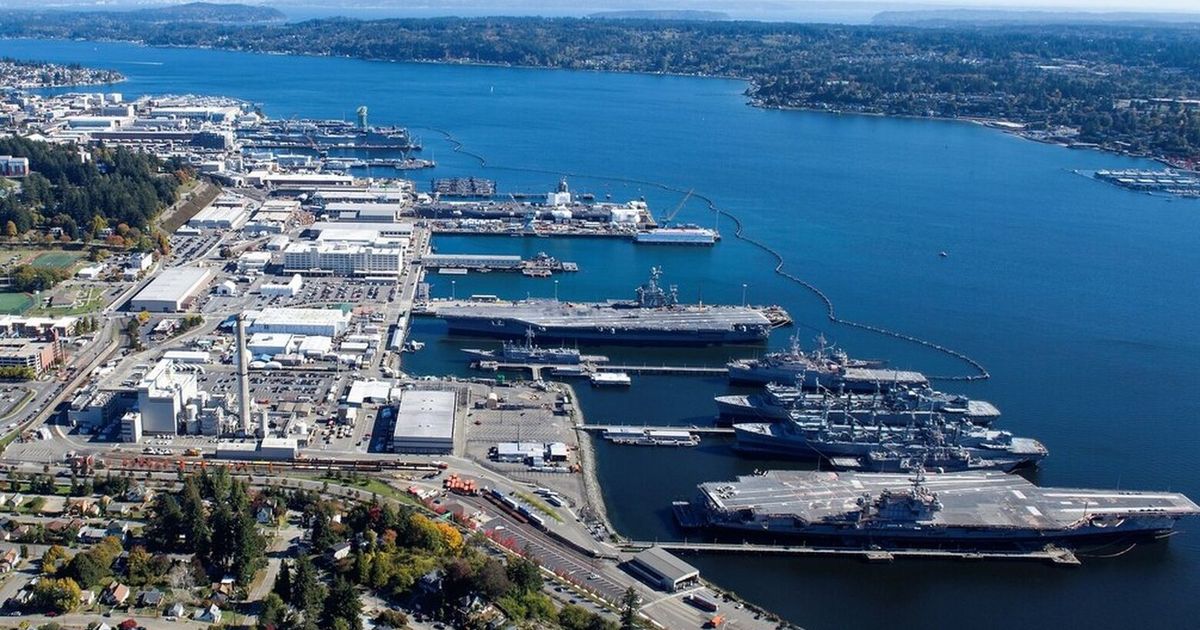
The largest construction project in U.S. Navy history is about to get underway 15 miles west of downtown Seattle. Chances are good few Washingtonians have heard of it.
Little fanfare so far has greeted a long-planned overhaul of the Puget Sound Naval Shipyard in Bremerton, which maintains the nation’s nuclear-powered aircraft carriers and submarines. The Navy’s modern fleet needs a new dry dock, where vessels can be pulled out of the saltwater for repairs and upgrades.
When the warship is a nearly 1,100-foot-long floating airport, that dry dock must be supersized to accommodate it. That work won’t come cheap nor easy: Contracts for completion of the dock could reach an eye-popping $30 billion. And the amount of concrete necessary for the project could build a four-lane highway from Seattle to Spokane, with some left over, project managers have said.
The massive public works project matters to Washington state for three main reasons. First, it’s an acknowledgment by the Navy that Puget Sound will remain a strategic home port and national security hub for decades to come. Yes, the military under the Trump administration is subject to the capricious whims of a transactional and vainglorious president. The Navy’s vision here, by contrast, is the long game. The dock, when finished, will be the only one capable in the entire Pacific of serving the USS John F. Kennedy, the Navy’s newest carrier and one that its leaders plan to home port in Bremerton in 2029.
The dry dock’s construction will ensure that sailors serving their country, and the local defense workforce supporting them, have the tools and equipment to operate a critical national security mission safely and successfully.
Naval Base Kitsap isn’t just home to the shipyard, after all. At Bangor, on Hood Canal, the Navy maintains more than half of the country’s ballistic missile submarine fleet, as well as covert action submarines known as the Seawolf Class. And a little-known installation at Keyport builds torpedoes and is home to the Navy’s first-ever squadron of underwater drones.
Second, that commitment from Navy leadership includes developing new infrastructure that upholds Washington state’s environmental values. Excavating, dredging and placing 817,000 cubic yards of concrete does not come without a cost to the marine environment. In response, the Navy this year signed an agreement with the Suquamish Tribe, whose treaty rights will be disturbed by the dock’s construction. Navy officials have committed up to $88.5 million to build a new shellfish hatchery and protect marine life on the peninsula. The Navy is also restoring other nearby nearshore habitat and is currently taking comments through Oct. 19 at its Environmental Impact Statement website.
And third, the project will economically stimulate the peninsula in ways few ever have. The peninsula’s work force will surge by more than 1,000 to design and construct the dock and surrounding infrastructure. Policymakers should ask: How could that work benefit and buttress the wider Puget Sound economy? It could, for example, induce leaders to invest in more educational opportunities in the skilled trades. Boosting that essential workforce could also aid the region’s maritime, aerospace and clean-tech sectors — and, as good paying union jobs, the entire region’s economy.
The Navy has maintained and homeported a good chunk of its strategic fleet on the Kitsap Peninsula for much of its 135-year history there. As a mammoth construction project gets underway, the Navy has made the bet that some of its most critical national security assets will remain home in Puget Sound for another century or more. For local leaders, that’s a signal of longevity that should be unmistakable.
