

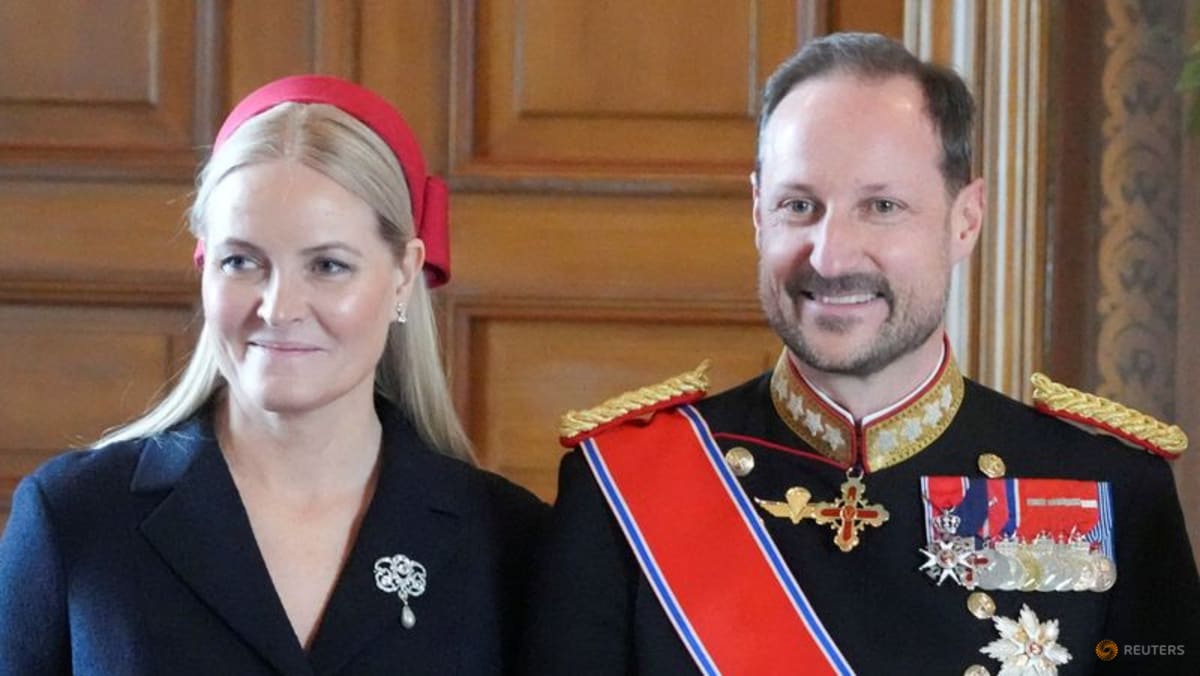
“LIVING QUITE A WILD LIFE”
Norway’s new queen was born Mette-Marit Tjessem Hoiby in Kristiansand on Aug 19, 1973, the daughter of a journalist father and a mother who worked as a bank clerk. The couple divorced when she was a child and she lived with her mother and her siblings.
Of her partying years, Mette-Marit told journalists in 2001: “At that time, it was important for me to live against what was accepted. That also led to me living quite a wild life.”
“I was in an environment where things were tested and we crossed boundaries,” she added.
She married her prince that year and initially struggled to adapt to her position. But “with time she found herself more at home in the role, and became more herself”, Trond Noren Isaksen, a historian and author of several books on the Norwegian monarchy, told Reuters.
Her strengths lay in “her great personal warmth” and her ability to connect with people, he added.
She became just Mette-Marit – the royal family does not use surnames.
Between 2000 and 2002, she studied ethics at the University of Oslo and in 2003 took courses at London’s School of Oriental and African Studies, focusing on international development, HIV/AIDS and refugee issues.
She went on to focus on literature – promoting Norwegian authors such as Karl Ove Knausgaard abroad and encouraging children to read.
She settled into the life of a royal spouse: acting as patron to several charities, attending events, raising her children – her first-born, Magnus Borg Hoiby, and the children she had with Haakon, Ingrid Alexandra, next in line for the throne, and Sverre Magnus.
Abroad she campaigned on global health issues, focusing on women’s empowerment and reproductive health, and acted as a goodwill ambassador for the UN’s programme on HIV/AIDS.
That work brought her into further contact with high society donors and fundraisers and other international jet-setters, including an introduction to convicted US sex offender Jeffrey Epstein.
