

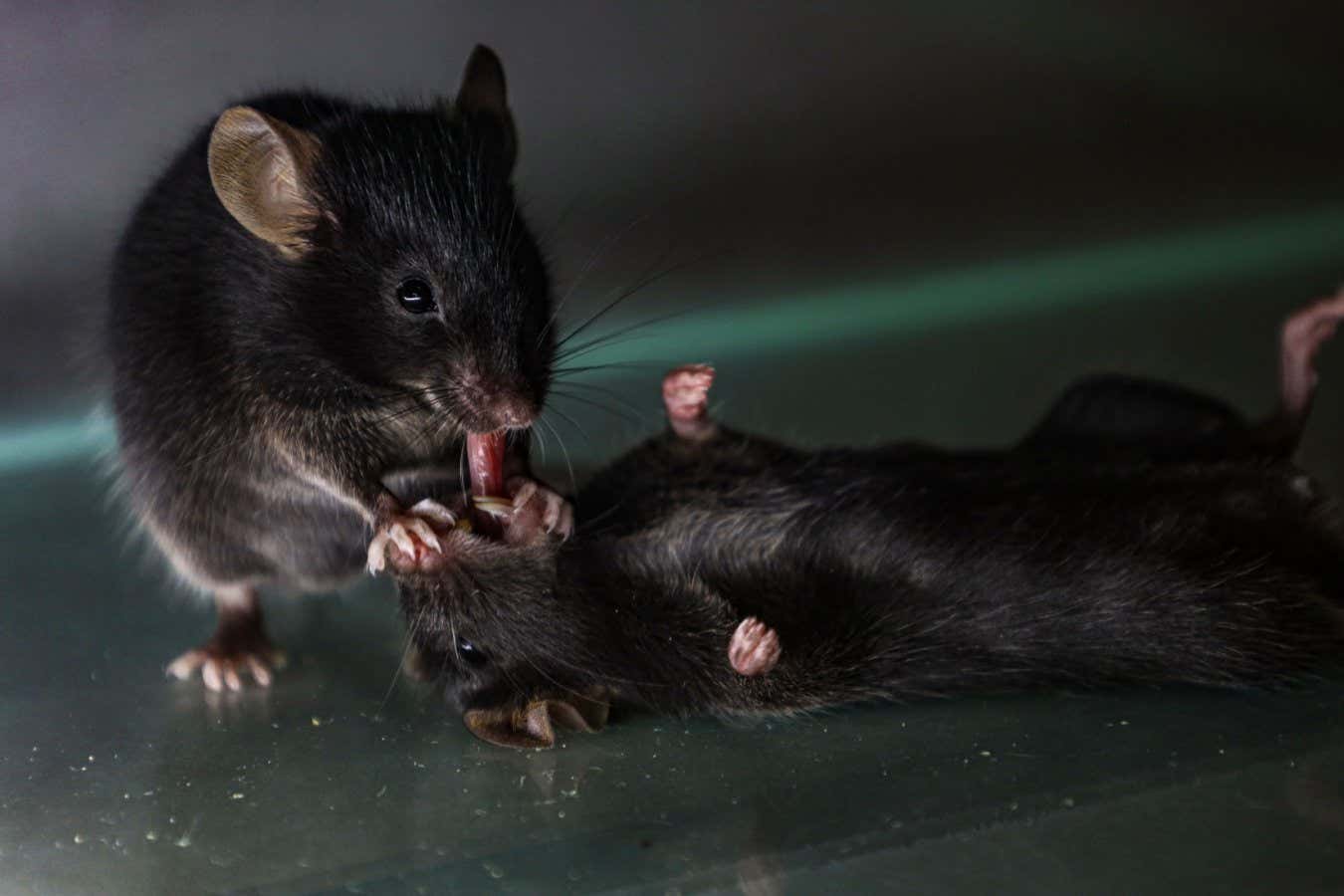
A mouse tends to an unconscious peer by pulling its tongue
Wenjian Sun et al. 2025
When they find another mouse unconscious, some mice seemingly try to revive their companion by pawing at them, biting and even pulling their tongue aside to clear their airways. The finding hints that caregiving behaviour might be more common in the animal kingdom than we thought.
There are rare reports of large, social mammals trying to help incapacitated members of their species, such as wild chimpanzees touching and licking wounded peers, dolphins attempting to push a distressed pod mate to the surface so it can breathe and elephants rendering assistance to ailing relatives.
Now, Li Zhang at the University of Southern California (USC) and his colleagues have filmed what happened when they presented laboratory mice with a familiar cage mate that was either active or anaesthetised and unresponsive.
Over a series of tests, on average the animals devoted about 47 per cent of a 13-minute observation window to interacting with the unconscious partner, showing three sorts of behaviour.
“They start with sniffing, and then grooming, and then with a very intensive or physical interaction,” says Zhang. “They really open the mouth of this animal and pull out its tongue.”
These more physical interactions also involved licking the eyes and biting the mouth area. After focusing on the mouth, the mice pulled on the tongue of their unresponsive partner in more than 50 per cent of cases.
In a separate test, researchers gently placed a non-toxic plastic ball in the mouth of the unconscious mouse. In 80 per cent of cases, the helping mice successfully removed the object.
“If we extended the observation window, maybe the success rate could be even higher,” says team member Huizhong Tao, also at USC.
Mice that were attended to woke up and started walking again faster than uncared for mice, and once their charge had responded by moving, the carer mice slowed and then stopped their caregiving behaviour.
The carer mice also spent more time tending to unconscious mice if they were familiar with them than if they hadn’t previously met.
The recuperative behaviour isn’t an analogue of cardiopulmonary resuscitation, or CPR, which requires specialist training, says Zhang. It is more like using strong smelling salts or a slap to wake someone or performing basic first aid to ensure an unconscious person can breathe. Positioning an anaesthetised patient’s tongue so it doesn’t block their airway is also important during surgery, he says.
Zhang and his colleagues found that the behaviours were driven by oxytocin-releasing neurons in the amygdala and hypothalamus regions of the brain. The hormone oxytocin is involved in other caring behaviours across a wide range of vertebrate species.
Similar behaviour is reported in laboratory mice in an accompanying research paper by another team and was also described by a third team last month.
“I have never observed these types of behaviours when we run experiments in the lab, but we never placed a recovering animal with a partner until they were fully awake,” says Cristina Márquez at the Center for Neuroscience and Cell Biology in Coimbra, Portugal. “The fact that three independent laboratories have observed similar behaviours indicates that this is a robust finding. However, we should be really careful about anthropomorphising too much what we observe in non-human species or attributing intentions that go beyond what is observed.”
Zhang and his colleagues think the behaviour is innate rather than learned, partly because all the tested animals were just 2 to 3 months old and hadn’t seen this behaviour or anaesthetised cage mates before.
He suggests that such instinctive behaviour plays a part in enhancing group cohesion and may be more widely present among social animals than we have seen so far.
Seeing this behaviour in wild mice might be hard, says Márquez. “Mice are prey animals that often do not live in big groups, thus usually they will hide quite well from us humans. But [the fact] that we don’t see it does not mean that they don’t do it.”
Topics:
