

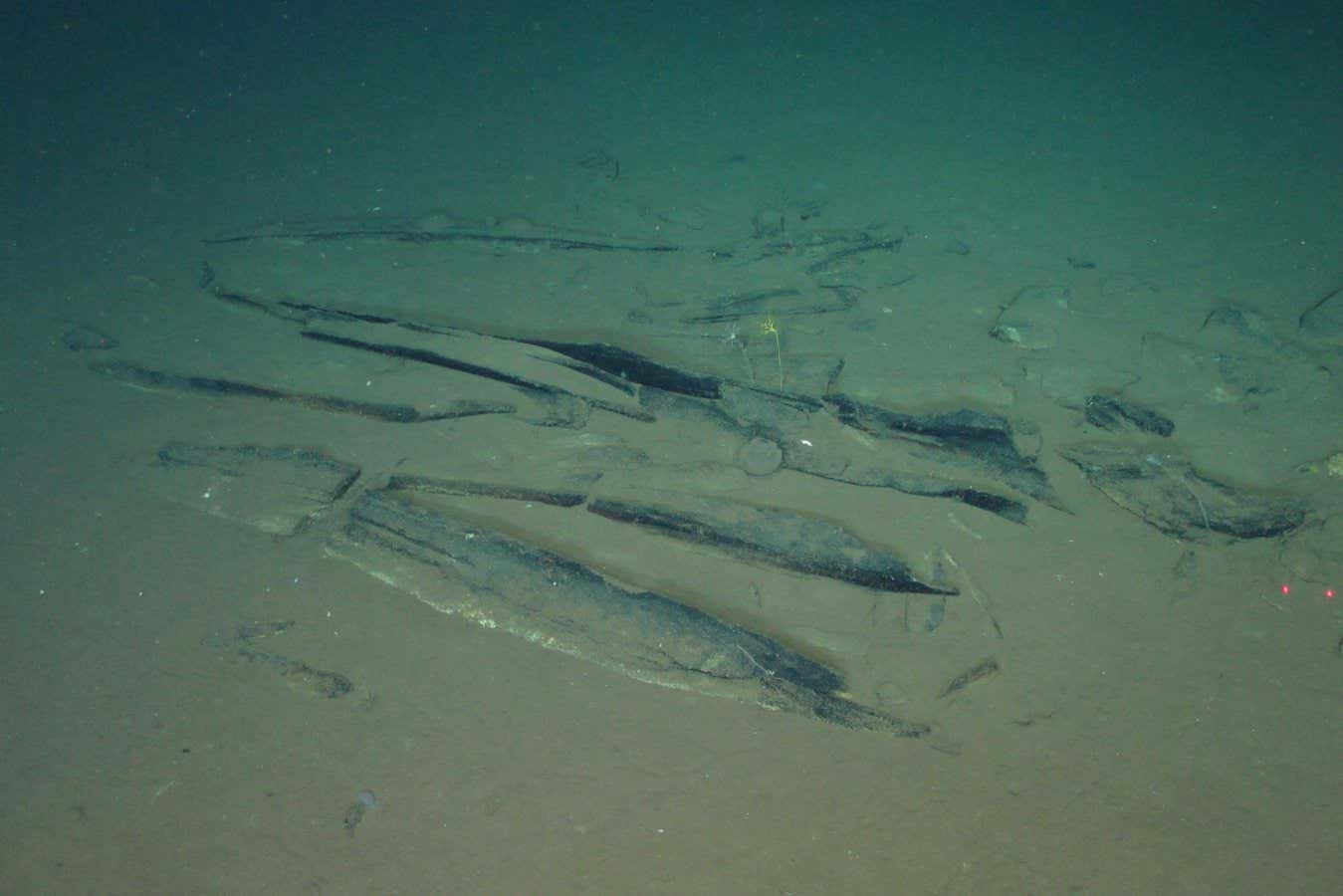
Fossils including possible baleen-whale ribs found at a depth of 5656 metres in the Indian Ocean
Global TREnD, IDSSE
The world’s deepest known whale graveyard has been discovered in the southern Indian Ocean at a depth of 7 kilometres. The remains found there include a new species of extinct beaked whale and other fossils that are over 5 million years old.
In early 2023, Peng Zhou at the Chinese Academy of Sciences and his colleagues undertook 32 dives in a crewed submersible along 1200 kilometres of the seafloor, in an area known as the Diamantina Zone.
The expedition was part of the Global Hadal Exploration Programme, an effort led by Chinese scientists to explore all the deepest parts of the planet’s oceans, which range from 6000 to 11,000 metres below the surface. At these depths there is no light, and life must survive on what falls from the surface or generate its own energy from chemicals – known as chemosynthesis.
The first fossil whales were found at a depth of 7002 metres in a part of the Diamantina Zone known as the Dordrecht Deep, which is over 1100 kilometres south-west of Perth, Western Australia.
“With the sub’s powerful lighting system, we could see tens of metres around us on the otherwise pitch-dark seafloor,” says Zhou. What they saw was “a little scary, but also incredibly fascinating”, he says.
The researchers estimated there were up to 760 individual whales per square kilometre, including both ancient and recent carcasses, constituting what they have called a “whale necropolis” and a “deep-sea fossil megasite”.
The recently fallen carcasses, which included a 5-metre long Antarctic minke whale (Balaenoptera bonaerensis), provide food to a thriving ecosystem of invertebrates – such as bone-eating worms and brittle stars – many thought to be new species, found in densities of up to 2800 individuals per square metre.
“It felt profoundly special,” says Zhou. “We were looking at the final resting place of millions of whales – some over 5 million years old – a deep time archive of evolution and deep-sea life. It was humbling and awe-inspiring, and we treated the site with the respect it deserves.”

The manipulator arm of the submersible Fendouzhe collected whale fossil bones on the deep seafloor
Global TREnD, IDSSE
Altogether, the team found 485 active whale-fall and fossil-whale sites during their expedition. Using the submersible’s robotic arms, they collected 43 fossil specimens that were dated to between 120,000 and 5.26 million years old.
Among the younger fossils, most were beaked whales belonging to two living species, Andrews’ beaked whale (Mesoplodon bowdoini) and the strap-toothed whale (Mesoplodon layardii).
So far, the team has formally described one new species, named Pterocetus diamantinae. However, they also collected several fragmentary specimens that may include further species that are unknown to science, says team member Giovanni Bianucci at the University of Pisa, Italy.
Xiaotong Peng at the Chinese Academy of Sciences, another team member, says there are a number of factors that mean the whales have been so well preserved. Most of these fossils are beaked whales’ rostra, or snouts. “They’re hyper dense, almost like bone armour, which makes them physically resistant to degradation and less palatable to bone borers,” says Peng.
Only about 0.05 to 0.55 millimetres of sediment has been deposited per thousand years, over the past 5 million years in this region, and many of these bones are coated with ferromanganese oxides, which effectively seals them off from the surrounding environment.
“So it’s really a combination of bone density, slow burial, and mineral coatings that has allowed these bones to escape being eaten for over 5 million years,” says Peng.
The team believes that a number of factors have led to such a concentration of whale deaths in the Diamantina Zone, including a whale migration route passing through the area and a V-shaped topography that funnels the carcasses to the trench floor.
Culum Brown at Macquarie University in Sydney, Australia, who was not part of the study, described the find as an “amazing discovery”. “The density of the whale-fall remains is incredible,” he says.
Topics:
