

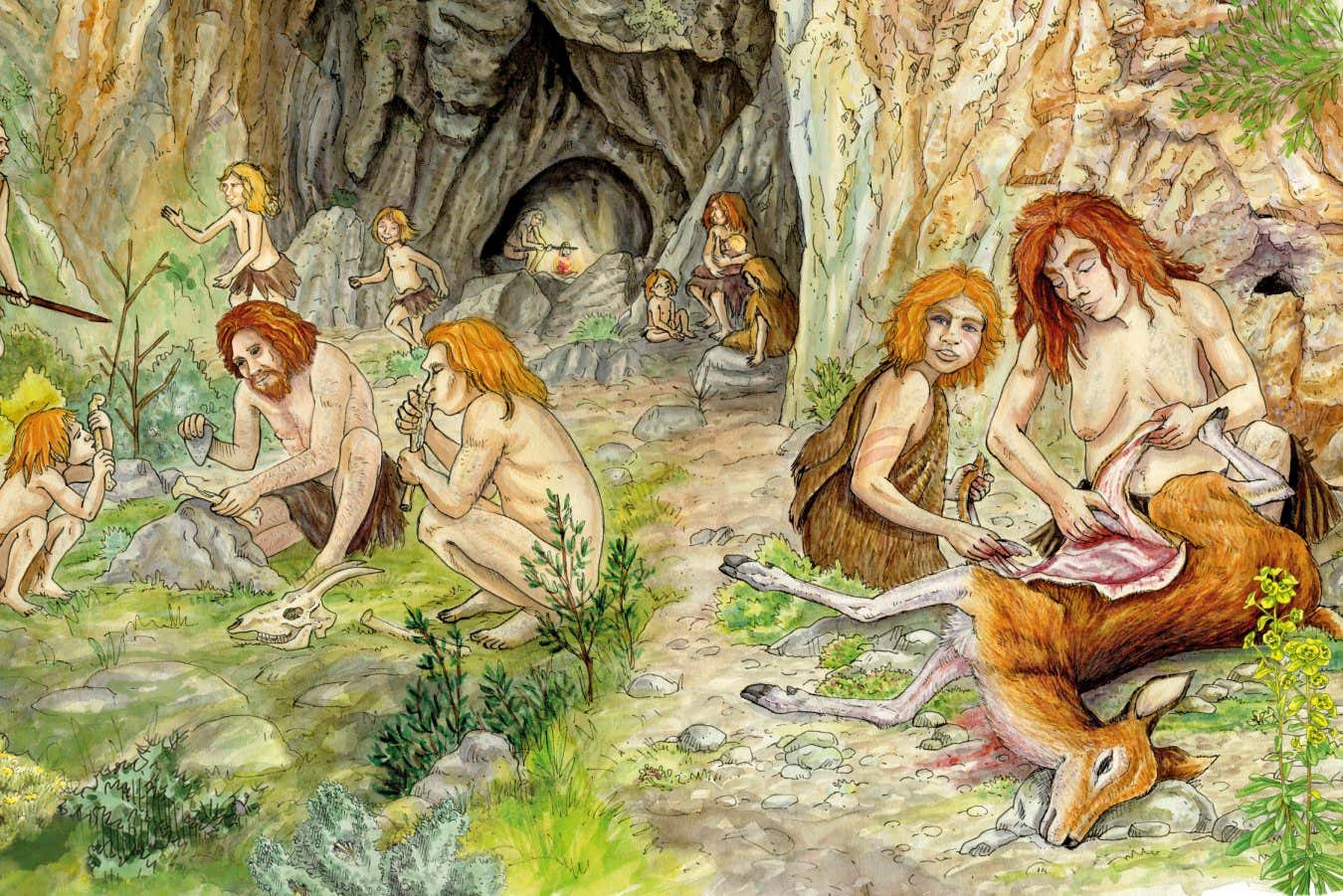
An illustration of a Neanderthal group preparing food
LUIS MONTANYA/MARTA MONTANYA/SCIENCE PHOTO LIBRARY
Neanderthals may have had traditional ways of preparing food that were particular to each group. Discoveries from two caves in what is now northern Israel suggest that the residents there butchered the same kinds of prey in their own distinctive ways.
Modern humans, or Homo sapiens, weren’t the first hominins to prepare and cook food. There is evidence that Neanderthals, for example, which inhabited Europe and Asia until about 40,000 years ago, used flint knives to butcher what they caught, cooked a wide range of animals and spiced up their menu with wild herbs.
To learn more about Neanderthal food culture, Anaëlle Jallon at the Hebrew University of Jerusalem and her colleagues examined evidence at the caves of Amud and Kebara in northern Israel.
These sites, which are just some 70 kilometres apart, provide a unique opportunity to examine local cultural differences. Stone tools, food remains and hearths found at each site reveal that Neanderthals occupied both caves, probably during winters, during the same time period.
“You find the same species of animals to hunt and it’s more or less the same landscape,” says Jallon. “It will be the same kind of weather, and Neanderthals at both ate mostly gazelles and some fallow deer that they complemented with a few bigger animals like boar or aurochs.”
There are a few differences, though. For example, bones reveal that a greater amount of large prey was hunted at Kebara, and more kills were carried back to that cave to be butchered.
Jallon and her colleagues used microscopes to inspect bones from layers of sediment at the two sites from between 50,000 and 60,000 years ago, examining the cuts slashed in them with stone tools.
They found that even though the flint tools used were similar at both sites, the patterns of cuts were different. “The cuts tend to be more variable in their width and depth in Kebara, and in Amud they are more concentrated in big clusters and they overlap each other more often,” says Jallon.
To assess if the differences could be down to butchering different prey, the researchers also looked specifically at long bones from gazelles found at both sites. These had the same differences.
“We are talking about two groups who live very close and, let’s say, both cutting up some beef – but in one site they seem to be cutting closer to the bone, getting all the meat off,” says Ceren Kabukcu at the University of Liverpool, UK.
Previous research that looked at cut marks on bones from more recent societies suggests that the kind of variation seen in Neanderthal butchery isn’t down to a lack of expertise, but to a difference in technique.
Jallon thinks the contrast is best explained by deliberate butchery choices. It could be that Neanderthals at Amud made their meat harder to process by, for example, drying it or letting it hang before cooking, she says, which would have meant they needed more cuts to get through it or a larger team of people to butcher the meat.
“In behaviour that is as opportunistic as butchering, you would expect to find the most efficient way to butcher something to get the most out of it, but apparently, it was more determined by social or cultural factors,” says Jallon. “It could be due to group organisation or practices that are learned and transmitted from generation to generation.”
“The fact that there might be differences and some nuance on how technology is used in daily life is not entirely shocking,” says Kabukcu. “I think as this question is investigated, we might see more and more nuance at several sites of the Middle Palaeolithic.”
It isn’t known whether the caves were occupied at the same time or if disparate groups might have been in contact with each other. “It is a possibility that it was at the same exact time, but it’s also possible it was hundreds of years apart or more. We don’t have the resolution to know that,” says Jallon.
But she also says that the pattern of very clustered cut marks found in Amud is similar in the oldest layer and in the younger layers, so she says the cave might have been used by returning groups that maintained the same butchery traditions for centuries.
Topics:
