

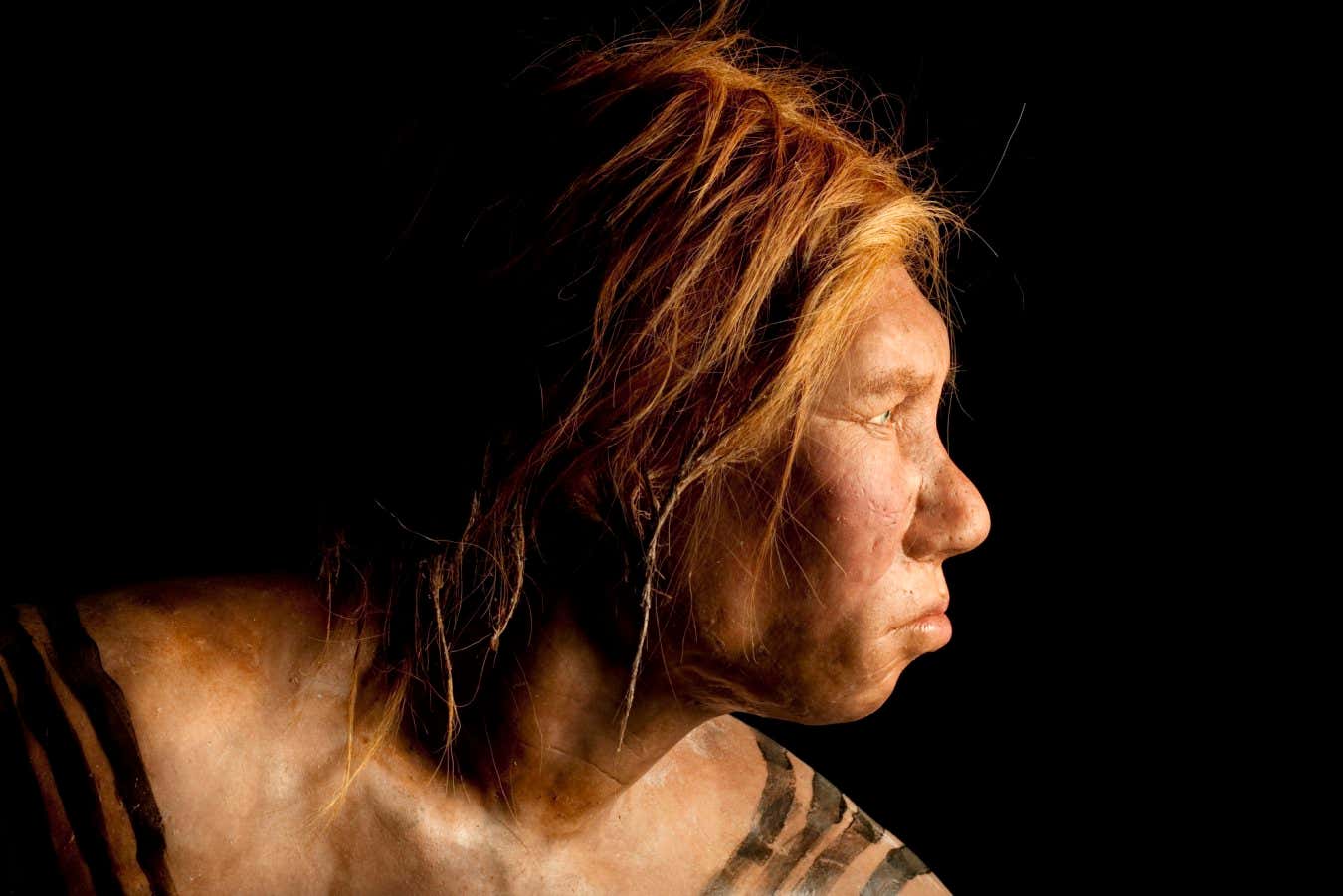
A model of a Neanderthal woman
Joe McNally/Getty
Modern humans may indeed have wiped out Neanderthals – but not through war or murder alone. A new study suggests that when the two species interbred, a slow-acting genetic incompatibility increased the risk of pregnancy failure in hybrid mothers. A similar mismatch between mothers and fetuses may also help explain a subset of pregnancies that fail today.
We know from genetic studies that there was sustained interbreeding between Homo sapiens and Neanderthals between approximately 50,000 and 45,000 years ago. The Neanderthals went extinct around 41,000 years ago, but some of their DNA has persisted in modern humans with non-African ancestry, making up around 1 to 2 per cent of the genome.
But mysteriously, none of the mitochondrial DNA in modern humans is derived from Neanderthals. This form of DNA is carried by egg cells but not sperm, so it is always inherited from the mother.
Patrick Eppenberger at the University of Zurich, Switzerland, and his colleagues have proposed a possible explanation for this. They suggest that women with Neanderthal and H. sapiens parents would have had a higher risk of pregnancy failure because of a mismatch between their genes and those of their fetus.
Neanderthals and H. sapiens had different versions of PIEZO1, a gene critical to oxygen transport in the blood. The researchers analysed modern human and Neanderthal DNA and modelled the differences in the PIEZO1 protein to understand how the two variants would have interacted. They also studied human red blood cells in the lab, using a chemical treatment to simulate the effect of the Neanderthal variant.
They found that the Neanderthal variant, V1, results in red blood cells that bind oxygen more strongly compared with the H. sapiens variant, V2. V1 is dominant, so a person who inherited both V1 and V2 would have red blood cells with this high oxygen affinity.
This means that a fetus resulting from Neanderthals and H. sapiens interbreeding could have developed healthily in either a Neanderthal or H. sapiens mother. But according to the study, problems would have arisen in the next generation. A hybrid mother with V1 and V2 carrying a fetus with two copies of V2 would have had higher oxygen affinity than her fetus, so she would deliver less oxygen across the placenta. This might impair the growth of the fetus and increase the risk of pregnancy loss.
Eppenberger and his colleagues declined to be interviewed, but in a paper they argue that this incompatibility would have led to the Neanderthal population experiencing a drain on its reproductive output. “Over millennia of coexistence, even low levels of gene flow from modern humans into Neanderthal populations could have introduced a gradual reproductive disadvantage, compounding over generations,” they write.
It wouldn’t be such a problem for the H. sapiens population because it was much larger, the team suggests. Neanderthal DNA could spread through the population via fathers, but the V1 variant would quickly be eliminated by natural selection. This could explain why Neanderthal nuclear DNA persisted in modern humans, while mitochondrial DNA, inherited only through mothers, didn’t.
Although not derived from Neanderthal DNA, the researchers also note that some mutations in PIEZO1 with a similar effect do occur today, and could cause some cases of unexplained pregnancy loss through a similar mismatch between mother and fetus.
Sally Wasef at the Queensland University of Technology in Brisbane, Australia, says the discovery of the delayed, second-generation incompatibility is a “good insight”. “Even a minor hit to reproduction can push small groups below replacement, which can start a slide in numbers and, in fragile settings, an extinction spiral,” she says.
“That being said, I would treat this finding as one piece of the puzzle rather than the whole story,” she says. “The effect is likely to be modest and to add to other ecological and social pressures.”
Laurits Skov at the University of Copenhagen in Denmark says there were probably multiple factors involved in the Neanderthals’ demise, including changes in climate, the arrival of modern humans, the small community size of Neanderthals, the introduction of new diseases and genetic incompatibilities.
Skov also says he would be surprised if this difference in oxygen affinity were determined by a single mutation in the PIEZO1 gene, as the researchers suggest.
“I think more work is needed to conclusively say what the impact of this particular mutation is – and what happens when the mother and fetus have different configurations,” he says. “Or what role, if any, did this mutation play in the extinction of Neanderthals.”
Embark on a captivating journey through time as you explore key Neanderthal and Upper Palaeolithic sites of southern France, from Bordeaux to Montpellier, with New Scientist’s Kate Douglas. Topics:
Neanderthals, ancient humans and cave art: France
