

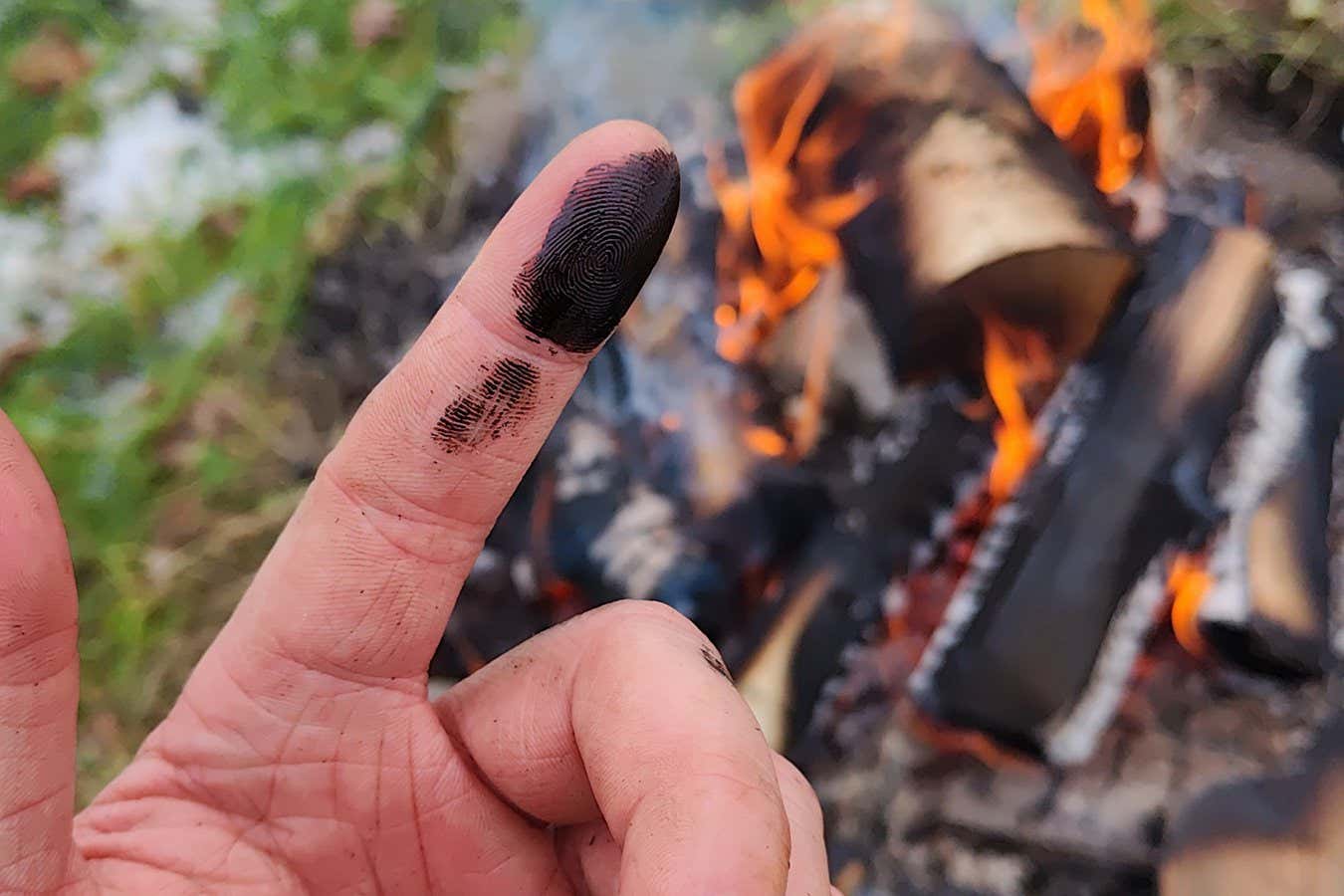
Viscous tar made from birch bark can be used as both an adhesive and antibiotic
Tjaark Siemssen, CC-BY 4.0
Neanderthals may have used tar made from tree bark as an antiseptic to treat wounds. Modern-day experiments with birch tar show that it has antibiotic properties, regardless of how it is made, hinting that Neanderthals could have discovered its medicinal uses.
The finding adds to a growing body of evidence suggesting that Neanderthals used medicinal plants to treat injuries and diseases.
“Birch tar as a substance has been known for quite a while from the late Pleistocene, specifically from Neanderthal sites across Europe,” says Tjaark Siemssen at the University of Oxford.
“It’s pretty clear that it’s been used as an adhesive,” says Siemssen, for instance, to attach sharpened stone heads onto wooden spears. However, he says that may not have been its only use. In some Indigenous communities in recent centuries, birch tar has been applied as a medicinal ointment. Among the Mi’kmaq communities of eastern Canada, it is called maskwio’mi and is used as a broad-spectrum antibiotic.
To find out if the birch tar produced by Neanderthals might have had similar properties, Siemssen and his colleagues collected bark from downy birch (Betula pubescens) and silver birch (Betula pendula) on public land in Germany. They tried three methods of producing birch tar.
In the “raised structure” method, they dug a small hole and placed a container at the bottom. Above this, they piled up birch bark and encased this in clay. They lit a fire atop this pile and, after 2 hours, they collected the birch tar that had dripped down into the container.
The second method was much simpler and may have been the first one tried by Neanderthals. The team burned small amounts of birch bark under a fireproof stone, causing birch tar to condense onto the stone. This “condensation” method produced much smaller amounts.
Finally, for comparison, the researchers tried the modern method used by the Mi’kmaq communities. They heated the birch bark in a sealed metal tin, with holes pierced through the bottom to allow the tar to drip out.
All the birch tars were tested for antimicrobial activities. All but one were effective against Staphylococcus aureus, a bacterium often found in skin infections. The most powerful was the one produced from silver birch using the raised structure method. The only one that didn’t block S. aureus was the one made from downy birch using the condensation method.
The experiment indicates that birch tar consistently has antimicrobial properties, even when made using low-tech methods that would have been available to Neanderthals, says Siemssen. While the Neanderthals did use it as an adhesive, “reducing the use case to just one single thing, when it has so many different purposes, is potentially quite misleading”, he says.
“I appreciate that the authors have identified some medicinal value in the birch bark,” says Karen Hardy at the University of Glasgow in the UK. However, Hardy points out that many plants have medicinal properties without the need for processing. “Obtaining birch bark pitch is a complex, time-consuming procedure,” she says. “I think that to demonstrate their argument that it was deliberately manufactured for its medicinal properties, they would need to demonstrate its superior or unique value.”
Previous research has identified other evidence of Neanderthals using medicinal plants. One Neanderthal with a dental abscess seems to have eaten plants with painkilling and anti-inflammatory properties. Hardy and her colleagues have found evidence of Neanderthals eating yarrow and camomile: plants that have medicinal uses but no nutritional value.
New Scientist regularly reports on the many amazing sites worldwide, that have changed the way we think about the dawn of species and civilisations. Why not visit them yourself? Topics:
Discovery Tours: Archaeology, human origins and palaeontology
