

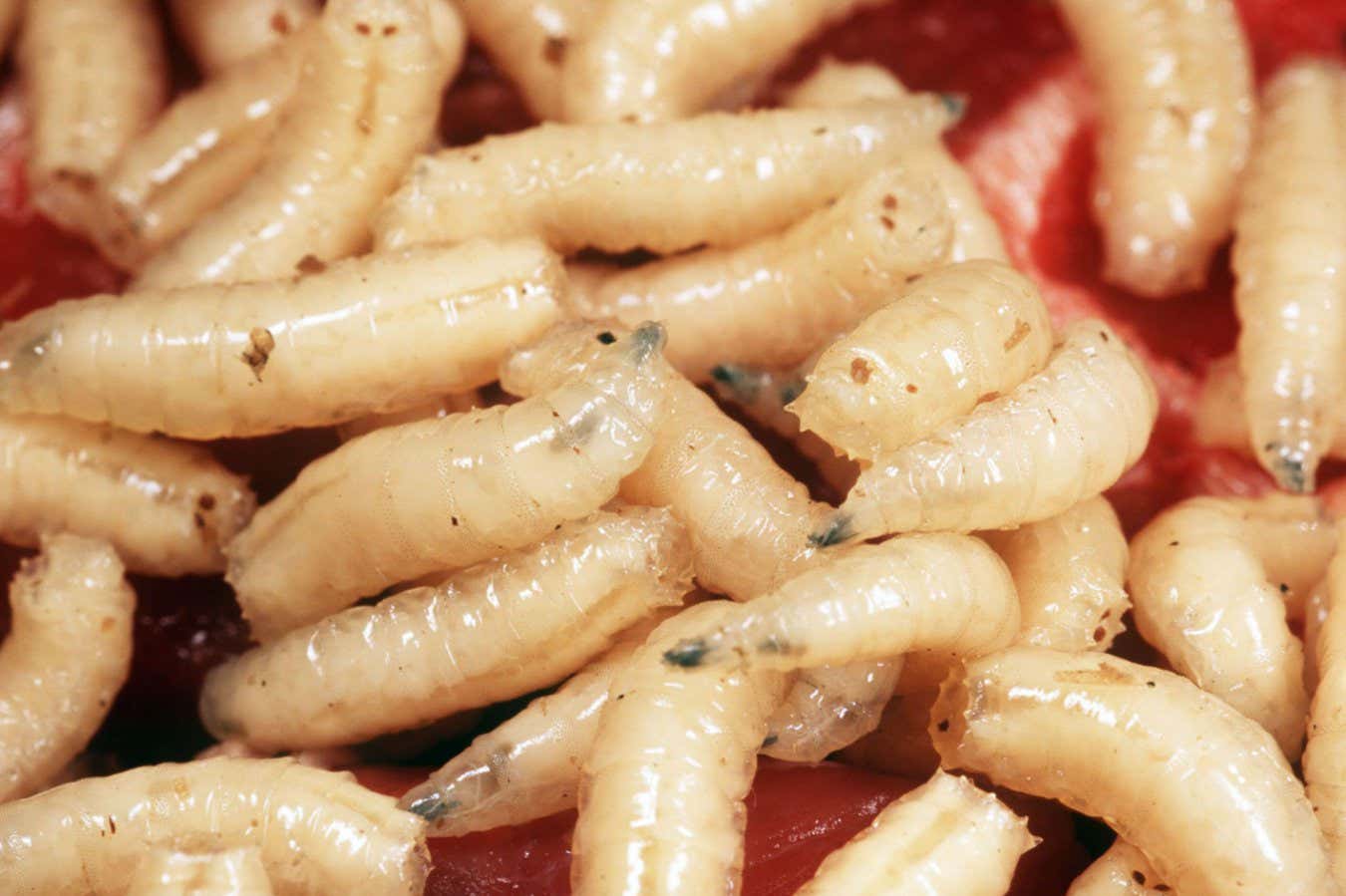
Maggots in rotting meat could have been an important part of ancient diets
Chronicle/Alamy
Neanderthals may not have been the hyper-carnivores we thought they were. It has been claimed, based on the nitrogen isotope ratios in their bones, that our ancient relatives ate little besides meat. But these ratios can also be explained by a more balanced omnivorous diet that included a lot of maggots, as well as plant-based food.
“Masses of maggots are these easily scoopable, collectible, nutrient-rich resource,” says Melanie Beasley at Purdue University, Indiana.
There is lots of evidence that they were routinely eaten in many societies in the past, and they are still consumed in some places today, she says. Some reindeer hunters regard certain maggots as a treat that they actively cultivate, for instance, while casu martzu, a cheese that contains live maggots, is a delicacy in Sardinia.
Nitrogen has two stable isotopes, nitrogen-14 and nitrogen-15. The lighter isotope is more likely to be lost from living organisms than the heavy one, so, as matter moves up food chains, the ratio of nitrogen-15 to nitrogen-14 increases.
Looking at the isotope ratios in collagen inside fossil bones can therefore tell us about the diet of those animals, with carnivores having higher ratios than herbivores. But when researchers started looking at the ratios in the bones of Neanderthals, they found something surprising: even higher ratios than those seen in lions and hyenas. “So there became this narrative that Neanderthals were these hyper-carnivores very focused on big game hunting,” says Beasley.
But many researchers don’t buy this idea. For one thing, the bones of Homo sapiens living in prehistoric times have similar ratios – and these humans couldn’t have survived on lean meat alone. “It’s actually physically not possible,” says Beasley. “You’ll die of what early explorers called ‘rabbit starvation’.”
The issue is that if a person’s diet is too rich in protein, their body can’t mop up all the toxic breakdown products, such as ammonia.
There is also now plenty of direct evidence that Neanderthals did eat plants, too, for instance from studies of their dental calculus. So why were their nitrogen-15 ratios so high?
Back in 2017, John Speth at the University of Michigan suggested it could be because Neanderthals stored meat and ate it later in a rotten state. As meat rots, gases like ammonia are given off, which should result in nitrogen-15 enrichment.
At the time, Beasley was applying to do research at the “body farm” at the University of Tennessee where human cadavers are studied as they decay to help with crime scene analysis. She realised she could test Speth’s idea alongside the forensic research – and while she was at it, she also looked at the maggots in the bodies.
Together with Speth and Julie Lesnik at Wayne State University, Michigan, Beasley found that nitrogen isotope ratios do increase as muscle tissue rots, but only by a modest amount. There is, however, a much bigger jump seen in the maggots of various kinds feeding on the corpses.
These are just initial results, but they show that eating a diet very high in meat isn’t the only possible explanation for the isotope ratios in Neanderthals and ancient Homo sapiens, says Beasley. She thinks those ratios are probably due to a combination of factors – the storage, processing and cooking of meat, as well as the consumption of maggots.
“This is an exciting new study, and I think it goes a long way toward making sense of the strange results that have come out of isotope studies in Neanderthals and other Stone Age hominins over the last couple of decades,” says Herman Pontzer at Duke University in North Carolina.
“I find the evidence here pretty convincing, that consumption of maggots and similar larvae explains the ‘hyper-carnivore’ signal we’ve been seeing in previous fossil isotope work,” he says.
The work also adds to the evidence that a so-called palaeo diet should include rotten meat and maggots, says Beasley. “All the people who want to go true ‘palaeo’, they need to start thinking about fermenting their meat and letting the flies access them.”
Embark on a captivating journey through time as you explore key Neanderthal and Upper Palaeolithic sites of southern France, from Bordeaux to Montpellier, with New Scientist’s Kate Douglas. Topics:
Neanderthals, ancient humans and cave art: France
