

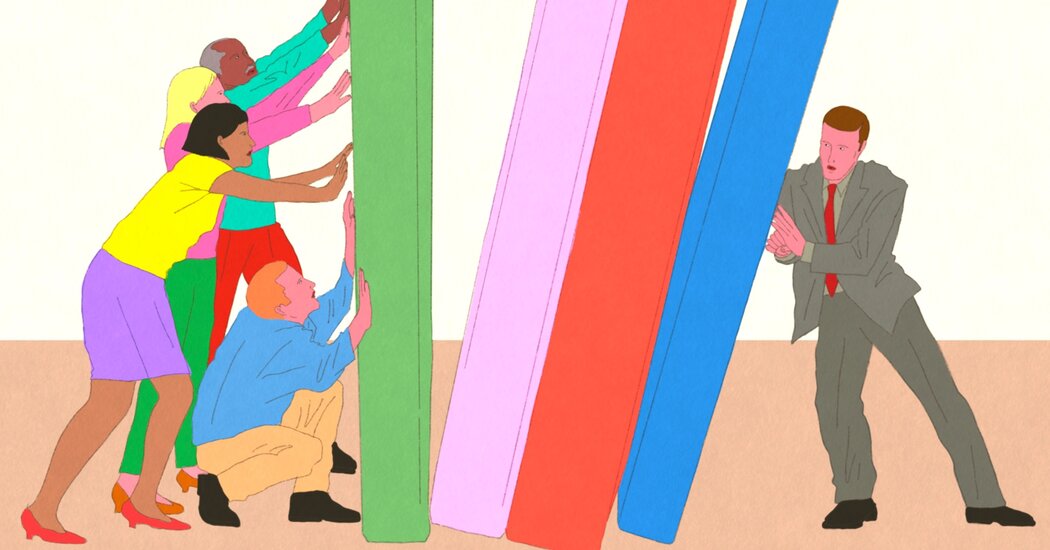
Leaders of American higher education have largely reacted to the Trump administration’s rhetorical and financial assaults by locking down in a defensive crouch. That is understandable given the administration’s view of universities, which JD Vance once called “hostile institutions,” and its apparent admiration of the Hungarian strongman Viktor Orban’s takeover of higher education. But there will be scant room for American higher education to tell its story of opportunity, transformation and discovery as long as colleges and universities deny what many of us know but few will say: Our critics have a point.
I worked in Democratic politics before my second career in higher education. Many ideas commonly espoused on the academic left would have been considered bizarre in the Democratic mainstream, assuming they could be understood at all. As a sector, higher education is considerably left of the American public, a perspective often expressed in language that is less offensive than it is incomprehensible.
We decry state censorship while ignoring a comparable threat to free expression on campuses: the crushing pressure inside many colleges and universities to conform with dominant political views. This pressure is hardly new. But the outrage emanating from campuses about Trump administration policies places our lack of self-awareness about longstanding dynamics within higher education in sharper relief.
That does not mean government interference in higher education is the answer, especially if it is surgically targeted to impose policies outside the jurisdiction of federal law. Still less does it justify using law enforcement to detain and threaten to deport foreign students in cases where there are vague charges or no charges at all.
But the fact that a physician recommends an imprudent treatment does not mean the underlying diagnosis is wrong. The portrait of college campuses as places suffused with one-sided ideology may be a caricature. But a caricature is an exaggerated portrait of something real. Recognizing that underlying reality would better position colleges and universities to defend our independence.
Colleges and universities are right to invoke academic freedom as an essential bulwark against government interference. But it is difficult not to greet this opportunistic defense of academic freedom cynically when it is voiced by those who have been indifferent or antagonistic to it when it has been cited by their political adversaries. Many of those who seek the protection of academic freedom today once denounced it as a tool of oppression. Likewise, few sounded this alarm when universities canceled conservative speakers.
That is different, to be sure, from the state enforcing conformity. But Alexis de Tocqueville argued that social pressure to conform with dominant opinion exceeded the power of even absolute monarchs. John Stuart Mill, a progressive hero, observed that the “moral coercion of public opinion” was a powerful tool of censorship. Universities should resist ideological manipulation when it comes from the state. But we must confront the fact that the culture of prevailing political opinion on campuses is also complicit in limiting free expression.
A recent study sponsored by the American Association of Colleges and Universities and the American Association of University Professors purported to show strong the strength of scholars’ commitment to free speech. In the survey, professors reported feeling pressure from administrators and policymakers to align with conservative views. But they also disclosed, perhaps inadvertently, how much they exert pressure from the opposite direction on their peers.
One question asked whether professors who hold a range of views should be allowed to teach undergraduates. While more than 80 percent of those surveyed would apparently tolerate a teacher who believes in a right to abortion “with no exceptions or limits,” those numbers dropped precipitously when conservative views were tested. For example, only about six in 10 said that someone who believes that “efforts to redress racial inequalities represent anti-White racism or disadvantage White individuals” should be allowed to teach undergraduates.
The contrast between those views of liberal and conservative professors, both of which are stated in cartoonish extremes, is striking regardless of what one thinks of the views being expressed. The question says nothing about whether the professors in question should be allowed to teach classes that pertain to civil rights. Yet almost 40 percent of professors surveyed seemingly oppose allowing someone espousing that view to teach undergraduates at all. By sitting on hiring and tenure committees, these scholars help regulate access to their profession. Far from defending academic freedom, their views resemble those of the Athenian jury that condemned Socrates so he could not corrupt the youth.
The reality is that for the vast majority of college courses, it should not matter what a faculty member thinks of current events because they are, or should be, irrelevant to the classroom. There is neither conservative chemistry nor progressive calculus. The same is true of honest efforts to reflect on great works of literature or philosophy.
Yet in the survey, nearly 55 percent of faculty members said they discuss climate change in their courses despite it not being a required topic. Climate change is an important issue. It should be discussed freely in courses to which it is relevant. But the claim that it is relevant to classes taught by so many college teachers is doubtful, which makes it probable that, in the name of academic freedom, many faculty members are violating one of its core tenets: the responsibility not to abuse the authority of the classroom by introducing extraneous material.
Taken together, those survey results suggest that some of the most intense pressure to conform to political orthodoxy comes from within the academy. The solution is neither more regulation nor more denial. It is sitting in front of us: Colleges and universities should retreat from politics and renew our core mission of teaching, learning and discovery.
That is easily said, of course. But faculties have immense powers of self-governance. Neither academic administrators nor elected officials should regulate what is taught in college classrooms. But members of faculties can formally recommit to what the principle of academic freedom has long required: not only tolerating but also encouraging different perspectives. Even those disciplines in which contemporary controversies may seem more relevant — such as my own field, political science — serve students better by focusing on enduring ideas rather than transient events.
College administrators have a role to play in campus policies outside the classroom. Defending academic freedom requires neutral policies that do not favor the expression of certain views and the suppression of others.
Similarly, campus policies must clearly indicate, and consistently enforce, the idea that college campuses are not political conventions. They are places where dissenting views deserve an elevated degree of respectful and scholarly engagement.
None of this requires a retreat from the moral imperative to ensure that any student who seeks a college education is a full and welcomed citizen of an academic community. It does require a recognition that there are reasonable differences about how to achieve that goal. This understanding of academic freedom is rooted in the virtues associated with teaching and learning: the humility to know one’s own views may be wrong, the courage to challenge consensus opinions and the charity to assume that those whose ideas trouble us are our allies in pursuing truth.
Those virtues are the essence of higher education’s power to lift generations from poverty and to develop and maintain open minds. The institutions that most emphasize them — smaller colleges and universities where research is important but teaching is paramount — are the most vulnerable to threats to withhold public funds.
Colleges and universities have a compelling story to tell. But we will have neither an audience for that story — nor the moral authority to tell it — until we are as fearless about examining ourselves as we are about decrying interference from beyond our walls.
Greg Weiner is the president of Assumption University and the author of “Madison’s Metronome: The Constitution, Majority Rule, and the Tempo of American Politics”; before becoming a political scientist, he was a senior aide to Senator Bob Kerrey, Democrat of Nebraska.
The Times is committed to publishing a diversity of letters to the editor. We’d like to hear what you think about this or any of our articles. Here are some tips. And here’s our email: letters@nytimes.com.
Follow the New York Times Opinion section on Facebook, Instagram, TikTok, Bluesky, WhatsApp and Threads.
