

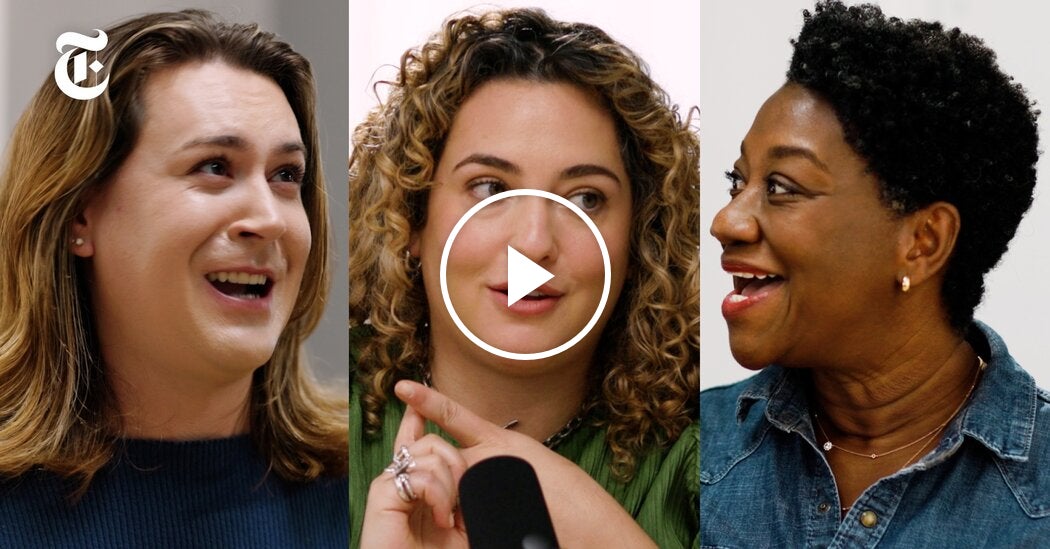
I think we solved everything. Oh, God. That was the promise at the beginning of this, we would solve everything. Lately, I’ve been feeling overwhelmed. I read headline after headline, and I just feel helpless. $1.8 billion. What the president calls an anti weaponisation fund to compensate Trump allies. The U.S. Supreme Court today struck down one of Louisiana’s majority Black Congressional districts. Some economists say businesses are now replacing entry level jobs with artificial intelligence. And even if you go to protests, even if you go to the ballot box, it just still feels small in the face of these challenges to more deeply understand where we are and how to move through it. I sat down with my colleague, columnist Tressie McMillan Cottom, and New York magazine writer Brock Colyar. Tressie, Brock, thank you so much for being here with me today. It’s a real pleasure. Happy to do it. So I really want to talk about feelings today, how we’re feeling about politics. I think it’s genuinely important. But before that, I want a few numbers just to ground us in the reality of this conversation. According to the most recent Harvard Youth Poll, one of the most defining shifts among young people is a loss of perceived agency. Half of them feel like people like them have no say in the government. There’s a feeling that what they do has no impact on what happens next. And that feeling, that lack of agency in the face of the world is really what I want to talk about, how it affects us, how we move through it. Here are just a few things that have happened in the past few weeks. Trump created a $1.8 billion slush fund to benefit the Jan. 6 rioters. The Supreme Court gutted the Voting Rights Act. We’re still at war with Iran. How do you react. How do you feel when you read these headlines and how do you process these emotions. How are you feeling. I mean, I just left lunch with two people and I asked them how they were feeling, and I feel like the word I hear most often is numb. I think sometimes, during the first administration, I was almost more emotionally worked up, even though it wasn’t nearly as bad as now. Like you had to just get used to this man being omnipresent in our lives. And now we’ve been dealing with Trump for so many years that it just doesn’t feel, I don’t know. I rarely react to anything with too much for feeling. I think when ICE was taking over Minneapolis, that felt really intense for me for whatever reason. But everything else, you just read it and. Why do you think that the ICE raids in Minneapolis felt particularly activating to you. I mean, this sounds horrible, but there was a sense that it could happen. It could impact your life soon. We’re in New York. The question was, is he coming to our city next. Is he going to that city next? There was something kind of like –– I’m really just worried about myself and how my life is impacted in that fear. But it just felt like, oh, he’s literally taking over a city. And that’s freaky. I don’t spend a lot of time reflecting on what Donald Trump is doing, or I really try not to. I have tried to limit my exposure to exactly what you just did. That weekly roundup I have. I subscribe to some services that will give me a brief on the day, on the week, and that helps me not spiral out into the details of all of the intersecting global scale crises that seem to be ongoing in our lives. To Brock’s point, Trump 1.0, I think, felt different than the current administration, in part because it felt like an anomaly that. If we could just solve for X, meaning Donald Trump and also X in the sense of the former Twitter.com. If we could just solve for X, we could get back to regular life. I think part of what has happened is the slow acclimation to the reality that this is regular life, that there is not necessarily a going back, right. I think part of that is due to the fact that there is no idyllic past that we can escape into. I think we are accepting that whatever is to happen next, it will be new and it will be different now. Different can be good, but different can also be bad, and I think the paralysis is about not knowing which it will be. Does this extend to the people around you, to other people around you, or feeling about the world and the news the way that you’re describing. And no. I occupy a really interesting place, professionally and personally on the professional side. So I would say among if I’m honest, my better educated, better inoculated friends, the ones who are going to feel the least amount of crisis and instability in their lives because they are highly educated, they are high income earners. They’re solidly middle class and in the middle of their lives. And so they’re settled, tend to have the most anxiety, which I think is interesting. Then there’s this other part of my life that is a broader cross-section of people about class and race and region across this country. But that are they seem more pragmatic about what is before them. And I think that pragmatism helps give them a sense of agency. Interestingly enough, I think it is a sense that you have to get to a level of acceptance before you can act. And so in that part of my life where there are people organizing in their local communities or even just understanding what the politics are in their local area. A lot of people in my lives have rededicated themselves to understanding local politics and civics and what is possible. Those people in my life right now are actually doing a little bit better, and I think there is a lesson in there. There’s a certain type of work that exhausts us. That is overwhelming. And then there is a type of work that refuels you that makes a lot of sense, and I want to drill down on that. Like, can you say even more explicitly why it’s the people who are materially the most comfortable and perhaps the most protected from these existential threats impacting their daily lives imminently. Who are the most anxious. Oh, yeah. We really struggle in American discourse with understanding status and status anxiety and how much our sense of well-being is tied to knowing my place in the world. And especially if you have been groomed to perform well in that system, to go to the right schools, to pick the right profession, to marry the right partner, to make the good, proper decisions. They were supposed to be some good right proper outcome to all of that. And for a long time, we’ve been able to assume that all of that outcome was a consequence of our individual decisions. I think some people are experiencing, for some of them the first time, the realization that there are some things that are bigger than our own individual choices, that you could do everything right and things still may not come out positively. I also think that there is a fear that this moment is going to ask something of us. So again, some of the paralysis is about not knowing what to do. Some of the paralysis is about knowing exactly what needs to be done and understanding that is going to take some sacrifice. I think the larger backdrop of everybody’s anxiety is the political moment, but the political moment itself is a reflection. I think, of us dealing with the anxiety of climate crisis and just massive global changes. We are going to have to change the way we live. That’s just the truth of the matter. And for some people, that will be a greater sacrifice than for other people. And I think paralysis can be a way to try to hold off the inevitable decision making that has to come, which is O.K, how are we going to live different. And how is the American way of life. How do we redefine it. And then consequently, what will be my place in it. That makes a lot of sense. And my father’s side of the family were Polish Jews. My entire father’s side of the family were in concentration camps. My grandparents were the only ones who survived. And I grew up thinking like, one day I too will be tested. One day there will be this dramatic moral battle where I will have an opportunity to be tested and to be good. And I thought about that a lot as a child growing up in the ’90s. And I feel like now I’m in this space where I’m like, oh, but is this what it looks like. It’s so slow, it’s so incremental. It’s so unclear to me how I act in this moment. And I think that’s part of what I’ve been struggling with Yeah. I think also when it comes to personal responsibility, especially for young people this generation that was like maybe graduated high school or college during Covid and now and Covid was the big test of that personal responsibility. Am I going to mask and care for my community. But so many young people are questioning the vaccines. And I think for this generation that all these states didn’t make the best decisions when it came to opening or closing schools. And they feel like, oh, I kind of did my part in what was it for. And it didn’t help me. And it just all seems to have been wasted or something. It does make a lot of sense, and it’s one of the things I’ve been thinking about is we live in such an individualized society that it feels like we must be able to do an individual action that is going to be big enough bold enough that it will have the kind of impact that we want to see on the world. And I’m curious where you think about individual action versus collective organizing, and how you see the interplay between our generally individualized society and actual organizing and activism. When I see that Harvard youth poll and I speak to college students all the time in my capacity as a professor, there is a sense that why do I delay my gratification today if there is no social payoff. And the reality is, they are right. No one is telling them what the new thing will be. And I think some of the overwhelm and the association and paralysis that we see in something like that poll is as much about the fact that we have not socialized them to this moment. That’s really interesting. I think that as a millennial and as a queer millennial, it was really easy for me to believe it gets better. There will be progress. There will be social progress in the world. My life as a gay person between 16 and now has become so much more possible. I can imagine getting married. I can imagine having kids in a way that when I was a teenager seemed so far away and it happened so quickly. And I think part of what’s happening now is this backlash, whiplash, this feeling of oh, we kept believing that things would get better. But actually, why would we think that. It’s entirely possible for things to simply get worse. I wonder how you think about that through the lens of your queer. I think in some ways every generation thinks that the things that are happening to them are unique to them. But then you have this generation where they’re actually like things are happening to them that have never happened, pandemic, the onslaught of –– I mean, talk about this kind of paralysis. It kind of feels like with AI, we’re in that moment right before the pandemic where we were all talking about it, but we really didn’t know what the effects were going to be. So what are we going to do. It feels like we’re in a very similar moment with that now 10 years ago it felt like Gen Z, these young people, they were going to save everything. The kids are going to be all right Yeah, the Parkland survivors were rallying around gun violence and Greta Thunberg and the Sunrise Movement were talking about environmentalism. And all of that seems to have gone away. We don’t really have this idea anymore that young people are going to save us. We think of them as these kind of jobless, lost creatures stuck on their phone with no ability to do anything. And is that accurate in your experience. Like is the apathy described in that poll something that you actually see in the world. I think so, I mean, I don’t think, again, what we’re circling around here is, what do we do. And yeah, what do you do to get really tactile about it. What are you going to recycle. You’re going to quit buying from Amazon. You’re going to nobody’s going to give up their social media to protest the tech companies Yeah, yeah. I think that there is a feeling of like the majority of Americans want stricter gun control laws. Many Americans want abortion access. And yet, even though there’s majority opinion on these issues, they haven’t moved towards that opinion. And they can feel it can feel so frustrating to be like, what do we have to do to make this happen. Tressie I’m curious because you teach and you’re with students all the time. Is this apathy that we’re describing something that you see. No and then there’s also a lot of self-selection here. Let me be fair. If the students who find me usually are the ones who are really struggling to feel agentic. And so that will skew my perception just a little bit. I take this apathy I think, is a little bit more complex. What I see on the ground is a divestment from our political system, from electoral politics, from retail politics that have operated as usual for all of young people’s lives with very little material effect. And in fact, the only material consequences most young people can see to political action has been on the side of reclaiming rights, taking away people’s citizenship right, making the world less pluralistic and less equal. And so in that sense, I’m not sure that that’s apathy as much as it is an accurate assessment of their political reality. Which, to your point is, none of us believe in this thing, and yet there doesn’t seem to be anything that we can do about it. So I separate out the accurate assessment or diagnosis of the political problem, from whether or not young people feel like they can do something. We have just come off of the last three years of. Really maybe not a historical high, but a historical moment a lot of young people organizing, a lot of young activists. And what happened to most of them is surveillance, stigmatization, expulsion. Some of their lives have now been marked, or they certainly have the feeling that their lives have been marked over the life course precisely because they tried to do the type of agentic action that we’re asking them to do. And then we come and we say, well, do you feel like you have control over your life. I don’t know that it’s so much apathy as a reality that some of us are far removed from. I don’t know. It’s funny, I think young people when it comes to protesting these. Obviously the pro-Palestine protest on campuses got a lot of media attention. And to your point, those students were punished for it. I think that they were also held to strange standards by adults and the left and media who wanted their politics to be perfect and their politics were. Inherently flawed in many cases, but they were held to different standards. But I think because of that yeah, what is a protest going to do. I also think that young people. Have sometimes they have trouble focusing these kinds of public demonstrations. I was at a Pride march last year and everybody started chanting and against A.O.C. and it was just so strange. And you look at these Palestine protests and you see the L.G.B.T.Q. flags which become this dog whistle for the right. And I find that unfair. But I’m also like, we should focus this. Why are their pride flags like, what are we doing here. What is the goal. What are we really organizing around. They’re a little scatterbrained. I think that young people protesting are a little scattered. Which of course, leads us to talking about the No Kings protest, which has been a historically large protest in this country. And yet I know that sometimes I feel like is that effective. And I mean, I was an activist as a teenager. I believed very strongly in the power of protest. And I think that sometimes now it can feel like, well, we’re making the largest protest in U.S. history. That protest has a very clear organizing idea. There are no kings in America. It’s easy to get people to rally around that. And yet that protest skews much older. And I’m curious. I’m curious your thoughts about this. Yeah, I don’t want to completely characterize young people’s activism and organizing as the only form of organizing that does not have a clear articulation. I think that’s just an American problem. Even when we have to your point about No Kings rallies of clear, unifying message on the ground looks just as complicated. The same thing where people’s messages are speaking past each other, I wouldn’t know how to both pack the court and get the government out of my life. And yet you’ll see both signs right at one of these massive demonstrations. To some degree, that’s just the function of trying to do a massive spectacle, right. You’re going to a big tent will bring people who have internal contradictions, and that is not unique to young people’s organizing. I think part of it, is that the way we’ve cover some of the more middle age middle class, if I’m frank, the more holdover from the 1960s ideal of protesting, the way we cover them does not get into those contradictions nearly as much as we get into young people’s organizing to your point, I think we hold them to unfair standards. And part, I think, because we kind of resent them for living in this little bubble of like a socialist utopia, which is what college is. And so we’re a little resentful of that, and we think that our organizing is more practical and material. And frankly, I’m not sure that it is, but it is very important, I think, for us to acknowledge or to really come to accept that in the 21st century, what has happened with the corporate capture of the surveillance infrastructure that this country has built and is continuing to build. One of the reasons why I think Minnesota was a flashpoint was because we saw materially, I think for many of us the first time, what that surveillance dragnet looks like. And some of the fear that yes, this might happen in my community was, I think, also a fear that oh, they can turn that on me in an instant. And yes, they will. And we don’t yet know how to deal with that. And I think until we get to that place, I think we’re going to feel a little politically neutered. I think that’s really wise. Around the No Kings protest, Erica Chenoweth has introduced this idea that if you have 3.5 percent of the people in the streets, the government has to listen. And the No Kings protests have had 2 percent of the population. There’s other research now showing that more than peaceful protest, economic disruption and boycotts might be more effective than political, peaceful political protests and marches. And how do we think about civic engagement in a world where perhaps the old models of what we think of as useful need to change a little bit in terms of what could actually affect change in the country. Yeah, I think the marches and the spectacle still matters. I think the issue here is that it cannot be the only form of engagement. And to your point, economic boycotts, which I’m going to define pretty broadly because I think there’s the big level where we look at something like the Target boycott, or you can look at the boycott of CBS in response to censorship. That holds a lot of promise. But there are a range of others, and the question is how comfortable Americans are with being truly disruptive. And I think a lot in this moment about finding the points of friction in the system. You don’t have to have a perfect politics. You don’t have to have a perfect march. But I do think we need a better analysis of if we do aim our disruption at economic boycott at the system, where can we be the most disruptive in a way that will force right politicians or the electoral process to listen to people’s will. That has become a little more complicated, a little bit more textured. But I do think it is both still possible, and I think it is the only immediate way forward. It also makes me think just thinking in my lifetime, the most successful political economic boycott I’ve ever seen is the right’s boycotting of Bud Light over partnering with Dylan Mulvaney. Exactly that’s a great one. And that Bud Light never recovered. And I think the left is almost too big tent, too divided, too scatterbrained and too complacent to do that to a company. I mean, I did part of a large part of what I want to talk about has to do with comfort, the amount of comfort that Americans have that stops them from taking risks. And I really want to talk to you about that dress, because I know you’ve thought about it a lot. And also, no, I see you over there. What you got. I was just going to say, for me, sometimes it’s as simple as O.K, I’m not going to boycott Amazon because the prices have been jacked up at all the grocery stores. And this is easiest way to get toothpaste cheap. And that’s comfort. And that’s where the conversation ends for me. And people I know. Absolutely yeah. No, the contradiction there. That’s exactly I think what I would say. So we’ve got these different nested problems. And I think within that, there is a common thread. And one of them in the American context is this other contradiction, which is people are anxious, they’re angry. I keep thinking that one of the most underreported stories of This moment is just how angry people are, and groups of people who have not historically been angry, and that anger being unreported, misunderstood is part of our challenge in this moment. At the same time, Americans are not nearly as desperately poor or economically vulnerable as we probably would need to be for a mass social movement to happen, one that certainly would question the basis of American political life or American capitalism or what have you. And so people are angry, but their anger doesn’t always match their economic desperation. Now we’ve got a permanent minority underclass in this country who are always economically distressed, always economically desperate. But that’s not who our politics is aimed at. I go out to marches, and I just asked this of someone recently who is part of an organizing apparatus for one of the national organizing movements. And I said, yeah, how many poor people do you think are going to show up for your march. And that’s the question for me, because if the question is about how much comfort makes it difficult for middle class people and economically secure people to feel politically agentic and to act, the question is, well, then where are the people who are desperate enough to act. And are we speaking to them. Are we organizing with them and for them. That’s one of the things that I saw happen in Minnesota, by the way, and that we don’t really talk about nearly as much as I think we talk about the spectacle of violence, but the specter of how desperately anxious and afraid people were in their everyday lives broke through in the organizing that happened in Minnesota because of decades, by the way of them learning how to do that. And that kind of work has to happen. But I don’t necessarily see that work in touching on so many different things. I mean, I think that our comfort is materially met to such a high degree by the subsidization of things like Amazon. And yet we’re so under met in terms of what government should be providing to its citizens in terms of health, in terms of education, in terms of being protected from corporate malfeasance or from environmental hazards. And to me, maybe part of why we’re not fighting against this more has to do with this idea of the American dream, with the idea that everyone believes I will be the one who will be the exception. I will be the one who strikes it rich, and that keeps people from acting on the anger of something that’s actually impossible, if you ask me, that is the crux of the problem. I think it’s even goes back to what is happening with young adults. Young adults are at the forefront of what I call our mobility promise. They’re the ones who are showing up with their little coupon. I got a degree. Give me my mobility. But one of the reasons why I think young people are feeling overwhelmed and maybe paralyzed or certainly disaffected in the political and economic system is because they’re the ones standing there going, this was the deal, right. That’s that infrastructure of mobility. The reality is, though, that infrastructure mobility is collapsing for all of us. That to a certain extent, yes, our material needs are met, but there is a loss of the sense that it will get better if not for us, then with our children. That the American dream that we talk about the suburban house, maybe a car these days, maybe more of a bike, and that your kids will go to a good school, that there will be a good job, you’ll have health care and benefits and dignified work. I think we forget how that in and of itself was an historical anomaly for the United States of America, and we forget it because we were encouraged to forget it, that everything is always going to get better. One of the reasons why I think that we’re experiencing this political paralysis right now is because there’s nothing to appeal to. Yes, right now I show up and I go, oh, can I get my coupon, too. Oh, I don’t train an L.L.M. That doesn’t have the same gusto for vision and a collective future that the American dream had, and no one’s giving us a new one. I hate to say this. Not that he is an example of the American dream, but I sometimes wonder for people on the right and I’ve heard this from people on the right before, this is why they like Donald Trump in this moment. It feels like the American dream has been lost. And here is this man who, through any means necessary, whether fair or otherwise, got himself to the top and lives lavishly. And I think that they find that an admirable quality in him, even when it’s not fair. Like he did it. He achieved that dream. It’s aspirational. Yeah I will agree with you. There’s a sense that yeah, you got a little lucky, but that yes, he had been willing to scratch and claw his way to the top, and that at least feels aspirational. I’m going to be fair with you. My own politics are on the other side, but I don’t know too many people on my side who have an equally aspirational vision of the future. And I certainly don’t know too many people doing a good job of selling that aspirational vision to people. There’s nothing I really want to talk about that we haven’t touched on yet, which is what would happen if we allowed ourselves to mourn the American dream. What would happen if we thought about what’s happening in our politics now. From the left, through the lens of grief. One of the producers for this show has been writing beautifully about grief since her father died in the past year, and a friend of hers reached out saying, I really want to talk to you about grief. When they got together to talk, the grief that her friend wanted to talk about was the grief about a country. And I think that grieving the future that you thought you would see in a country is a really important step for us to be able to take. I’m curious what your thoughts are on that. I strongly agree. I think so much, actually, of our long political hangover in the political nihilism that developed was a direct response to how poorly we responded to the need for collective grief during and after the onset of Covid and Covid shutdowns. We did not create a cultural space for us to mourn everything that was lost during Covid, and not just the massive amount of death and sickness and our own vulnerability. But we really did lose a sense of opportunity, of progress, of social progress. And because we did not deal with that, I think a lot of us were able to be peeled off by a politics of nihilism or nostalgic nihilism, which I would say Donald Trump is very good at selling, because it is not so much that he is going to make America great again. It is that he will do whatever is necessary to falsely inflate the sense that we once again have a 1950s economy, even though it is not real in any material sense. That’s so beautifully said. I mean, I think I’m curious how you feel, Brock, about grief. Is it something is grief something that young people talk about when they talk about their future I don’t think so. Again, I feel like it’s so much more. I think young people are so kind of Black pilled and so nihilistic in a way that yeah, there’s almost no time for emotions. It’s like almost things just have to get done. Now it’s really every man for himself, I think. I wonder if you can speak a little bit more about the actual political utility of grief and what might exist on the other side. Well, grief, if we think about it like at the individual level, for any of us who have ever experienced of profound loss, you are changed after it. There’s no going back, right. You lose your parents have lost them. You are a new person after they die. I think that is similar for what kind of needs to happen collectively. I think part of the reason why we would struggle with coming up with a vision, a hopeful vision of the future that doesn’t reproduce the contradictions of the past is that we have not grieved that we’re going to have to be something different. Does not mean we will be worse off. But it is going to be different. You are different after grief. We are different after Covid. We are different after a 9/11. There is a before and an after when that kind of cultural rupture happens. And if you do not name it, the same thing that happens when you try to ignore the fact that you’ve had a tremendous loss in your personal life happens. It spills over into everything. So the challenge, I think, in our moment is that if you don’t deal with the grief, there actually isn’t much positive that you can say about the future, because you’ll still be talking about a past that has really already gone in the five stages of grief. The final one is acceptance, but I think there’s someone else who added a sixth one, which is meaning, which is taking the meaning of what was lost and allowing it to change you. And I’m wondering if there’s a way to use that framework to think about how we also integrate optimism for the future, this is going to make me sound like a Boomer, but I feel like so much of young people’s again, going back to this nihilism, it’s not just politics. It’s like everything feel. It’s not just their careers. They also can’t date, they’re not having sex. They’re not having fun. It all feels awful. And as Boomer as this sounds like, I do feel like it’s about getting off your phone and into your community. It is the encroachment of tech also that has ruined all of this about their lives. And just by getting out and talking to people, and maybe that’s a part of the grief process, actually having conversations with people that in real life. Then you can start to gin up a positive vision for the future, even if you still feel a little helpless. I mean, I think that’s very true. You can’t grieve alone. And you have to be able to spend time with your friends, create art, do things you feel are meaningful, maybe even go to protests and dance in the street even if you don’t think it’s going to do anything. Have sex Yeah I feel so weird saying it because. But because I agree. And I tell people all the time, I have not publicly responded to this idea of how worried we are that young people are not having sex and not drinking anymore, and not doing it because you sound weird when you’re old and you’re like, worried about young people’s sex lives. But I do think it is an indication of this larger thing, which is really we distill it to these behaviors. But what we’re really talking about is a profound structural loneliness, an atomization of the self. I tell people if young people were drinking less but doing something else more, I wouldn’t care. But I think that what has happened is that they’re doing they’re drinking less, but also going out less, but also socializing less, also relating less. And so I actually don’t think that putting the phones away is a small thing. Increasingly we talk about tech today, we act like it’s just the internet and it’s just a phone. If you haven’t noticed, technology is your government right now. And so it is not a small thing. I actually think that putting away the phone could be easily as disruptive as one of those economic boycotts we are talking about because this not only disrupts something, but it creates a space for some New things to happen. And if young people are the future to engage in a cliché, then where are they taking us. Like, is it these young people who are moving away from both political parties. Is that going to maybe move us more towards ranked choice voting. The end of the electoral college, the end of the two party system, or some other form of change that we can’t yet conceive of. Do we first have to get young people to put down their phones. Do we have to get all of ourselves to put down our phones before we can have any kind of change. I would also like to get my mother put down in front. So before we get into a generational warfare, I think we all need to put on the phones to be fair. But yeah. I sometimes worry that it’s only going to get worse because I think what the generation who’s kind of entering into the marketplace now, people who are just a few years younger than them, I think they feel that isolation more deeply. I feel like their politics are also slightly more conservative. I think the Gen Alpha will only make all of this more complicated Yeah the thing about not dealing with the reality of the world that’s in front of us, which is what so much of politics is inviting us to do right now is that it does tend to make people crave conservatism more, because what you really want is you want certainty and you want security. And I think one of the mistakes of not articulating a hopeful vision for the hopeful, pragmatic vision of the future is that we are ceding ground on your safety and security. The only way for you to be safe and secure is to retreat into a politics of conservatism. Small “c” conservatism. Which is O.K if I can’t date anymore because swiping is killed. Romantic love, I can at least live in a socially conservative structure that will prod us into marriage. Or I may feel alone, but at least this thing will like. It was socially shame all of us into going to church. It will give me something bigger than myself to force us out of our isolation. There is, however, another path. People are living it every day. It is what God is excited about Minnesota. It’s what has us excited about Mamdani. There is something that is just as hopeful. That is just as pro-human as conservatism offers you, that does that without building it on other people being excised from the future. The problem we have is that we do not sell it that way, because I fundamentally believe we don’t believe in it enough. That way we have to believe that something is better and possible and that we are building it. We do have something better than a small “c” conservative politics to offer people. There is a future where the government can work for you as surely as a megachurch works for you. And we can do that. And it’s not necessarily hard, but it isn’t easy either. Beautiful. Tressie, Brock, thank you so much for talking about this with me today. Thanks for having me. I think we solved everything. Oh, God, that was the promise. At the beginning of this, we would solve everything.
