

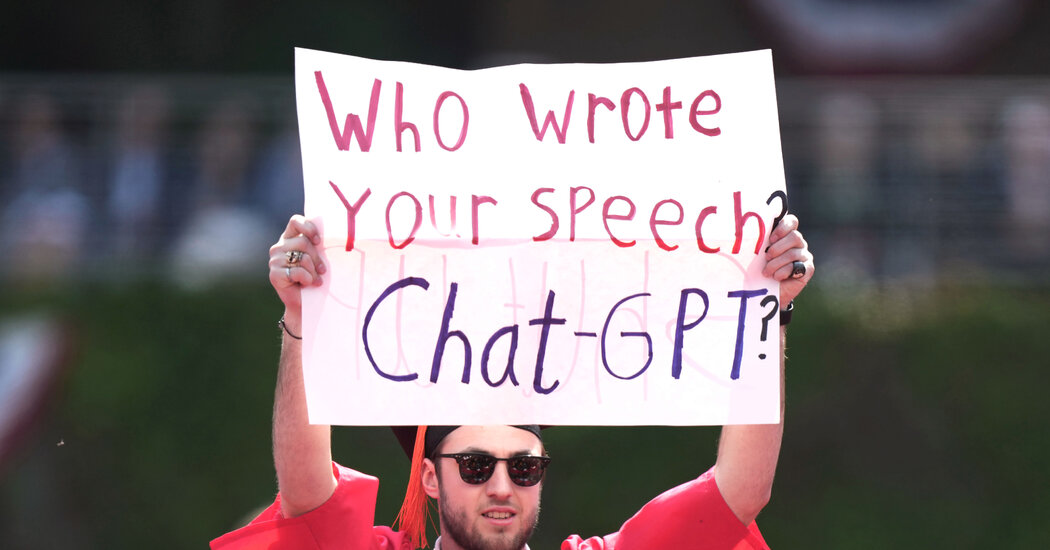
When Eric Schmidt, the former chief executive of Google, started talking about artificial intelligence during a commencement speech at the University of Arizona on Friday, the graduates erupted in boos. “A.I. is going to touch everything,” said Schmidt, as his stadium-sized audience roared its disapproval. “Whatever path you choose, A.I. will become part of how work is done.” Maybe he meant this as a promise of opportunity, but the students seemed to hear it as a threat — or a curse.
Something similar happened at the University of Central Florida a week earlier, when the real estate executive Gloria Caulfield described A.I. as “the next Industrial Revolution.” Listeners booed, and someone shouted, “A.I. sucks!” Caulfield appeared to be caught off guard, but she shouldn’t have been, because evidence of a ferocious backlash against A.I., especially among young people, is everywhere.
One recent report found that only 18 percent of Gen Z-ers feel hopeful about A.I., and almost half say the risks outweigh the benefits. Politicians with followings among young people — including Bernie Sanders and Alexandria Ocasio-Cortez on the left and James Fishback on the right — are calling for moratoriums on data centers. A.I. is increasingly a pop culture villain. “The people who make this stuff are losers,” said the comedian Hannah Einbinder, star of HBO’s “Hacks,” a show that has put hatred of the technology at the center of its current season. There have even been some high-profile acts of anti-A.I. violence, including a Molotov cocktail hurled at the home of OpenAI’s chief, Sam Altman.
As Americans rebel against A.I., the industry’s oligarchic leaders are responding by trying to buy even more political influence, pouring money into super PACs and lobbying. Groups supporting A.I. and crypto, Politico reported this month, “are already becoming the most dominant players on the political battlefield, spending heavily for candidates on both sides of the aisle and in some cases rivaling the fund-raising of long-established party groups.” The irony is that the industry’s attempts to game the democratic system are a big part of its deep unpopularity.
One reason Americans seem to despise A.I. more than people in other countries is that they know our government is too sclerotic to handle it. Researchers at Stanford University found that out of people in 30 countries, Americans had the least faith in their leaders’ ability to regulate A.I. Internationally, people tend to feel more positively about A.I. when the state tries to ensure that it benefits them.
In a recent article, Bharat Ramamurti, a deputy director of President Joe Biden’s National Economic Council, described how Japan uses public funding and regulatory policy to encourage companies to use A.I. to complement work by humans rather than replace it. In the Nordic countries, workers often have a formal role in deciding how A.I. will be deployed and can use acceptance of it as a bargaining chip. As a result, there have been “plenty of technological advancements, including on A.I.,” he told me. (Just last month, Norway introduced self-driving buses on public roads.)
By contrast, in the United States, where neither the government nor corporations feel the need to do much for those made redundant by A.I., the spread of the technology amplifies an already chronic feeling of precarity. Companies are citing A.I. as the reason for mass layoffs; according to the Alliance for Secure A.I., there have been almost 120,000 A.I.-linked job losses in the United States just since last year. Recent college graduates are facing a brutal job market as entry-level positions disappear and A.I. renders the application process inhumanly opaque. During the dot-com boom, tech companies often seemed as if they were leading an arms race to offer new benefits to workers. Now, as Axios reported, firms are rescinding benefits to fund A.I. expansion.
We simply lack the political infrastructure in America to distribute A.I.’s benefits to the public. With the systematic evisceration of the labor movement that started during Ronald Reagan’s presidency, said Ramamurti, “the institutions that many other countries have for mediating these kinds of technological advances don’t exist in the United States.”
Of course, it’s not only in the workplace that many people feel exploited by A.I. Grocery stores are using shoppers’ personal data to set pricing. Health insurance companies are employing it to decide what treatments get covered. As MarketWatch reported, a Medicare pilot program using A.I. for prior authorizations resulted in “some patients waiting weeks longer to get medical procedures — if they receive care at all.” For many people, A.I. feels extractive, not additive.
It’s telling that the generation most exposed to A.I. appears to like it the least. A New York Times poll released on Monday shows that 47 percent of voters under 30 rate A.I. as “mostly bad,” the highest percentage in any age bracket.
A.I. executives, buffered by their colossal fortunes and resulting political connections, don’t seem to feel much pressure to win people over. Instead, the industry’s message is coercive and bullying: adopt our product on our terms or be forever left behind. Tech billionaires might be less likely to announce that their inventions will cause mass unemployment if they felt constrained by public sentiment. The fact that they don’t shows how broken America’s democratic feedback loop has become.
Schmidt, of all people, should understand why many are repelled by this increasingly intrusive technology. Last year, he was a writer of a Times Opinion essay about how Americans “see A.I. as a nuisance in their daily lives,” even as it’s become more of a useful consumer tool in China. “It’s paramount that more people outside Silicon Valley feel the beneficial impact of A.I.,” he wrote. That can be accomplished only by political action, not hectoring. “Find a way to say yes,” Schmidt told the graduates in Arizona. Their boos were their answer: No.
