

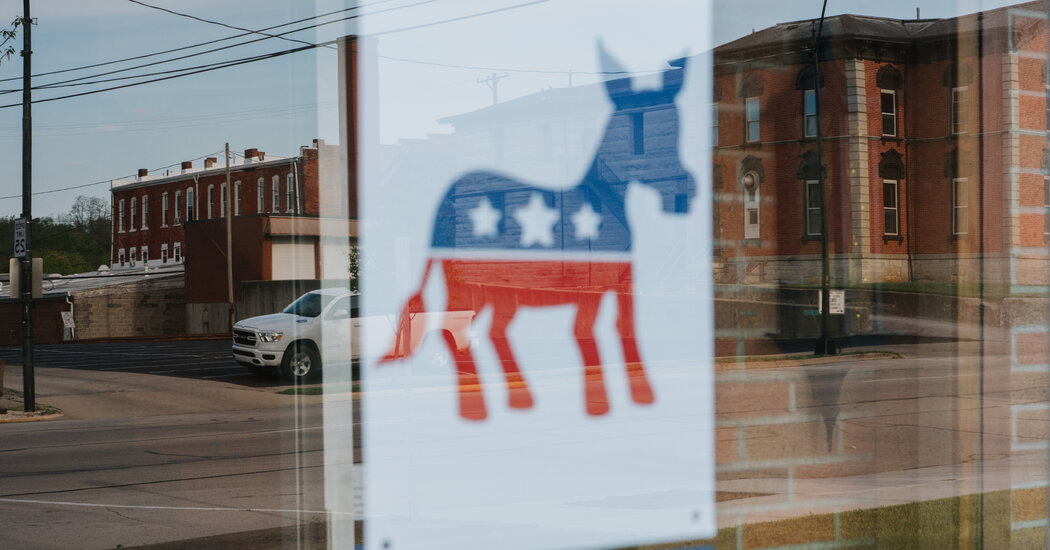
Erickson dismissed the progressive group Justice Democrats and its allies as representative of a faltering movement on the left that has “utterly failed at delivering results throughout the entirety of the Donald Trump era, with the exception of a handful of high-profile and loud wins in the bluest of blue districts. In fact, those organizations and the small cohort of far-left voters they represent have not flipped a single seat from red to blue since they were founded, and last cycle, the Democrats who lost primaries were their incumbents.”
Democratic voters, Erickson argued, know that
the far left has seriously damaged the Democratic Party brand, making it unpalatable as an option to many swing voters, even if the alternative is Trump and his MAGA crew. Kamala Harris lost in large part because she took positions that were substantively wrong and politically toxic in 2019 on the promise from far-left groups that they would deliver her a primary win. But she learned as well as anyone that the chasm between the far-left, hyperonline activists and Democratic primary voters is as wide as the Grand Canyon, and she lost both the nomination in 2020 and the general election in 2024 because of it.
On Feb. 2, William Galston and Elaine Kamarck, both senior fellows at the Brookings Institution, posted their paper “Renewing the Democratic Party.” In it, they wrote that the party must undergo an ideological “revolution” to win back even marginal support from the working class, which, they wrote, believes
that the Democratic Party is dominated by elites whose privileges do not serve the common good and whose cultural views are far outside the mainstream and lack common sense.
They believe that educated professionals look down on them and that the professional class favors policies that give immigrants and minorities unfair advantages at their expense.
They believe that educational institutions preach a set of liberal values that are out of the mainstream and that parents, not schools, should be teaching values. They reject the assertion that slavery and discrimination have made it difficult for Black Americans to work their way out of the lower class and believe that Black Americans can and should rise “without special favors,” as other groups experiencing prejudice have done.
In an email responding to my queries, Galston provided anecdotal evidence that the Democratic Party is changing in a favorable direction:
The Democrats’ shattering defeat last November has convinced many actual and aspiring leaders that to be competitive in future elections, their party must change. This opened the door to new ways of thinking and challenges to the status quo.
Some of Galston’s examples:
-
“The party’s designated responder to Trump’s speech, Senator Elissa Slotkin, delivered a calm and moderate message, which was well received by Democrats.
-
“The party’s likely candidates for this year’s high-profile governor’s races in New Jersey and Virginia are moderates with impeccable records of service to the country.
-
“Most Democrats have abandoned the extreme 2020 ideas — defunding the police, eliminating ICE, etc. — that their eventual presidential nominee, Joe Biden, opposed during his successful primary campaign.
-
“Gavin Newsom — up to now, no one’s idea of a moderate — just decided to break with party orthodoxy on the hottest of hot-button issues — transgender rights.
-
“Most Democrats have come to understand that Biden’s approach to immigration was a political as well as policy failure and are open to a discussion of alternatives. In a recent Pew poll, 40 percent of Black Democrats and 43 percent of Asian Democrats supported increased efforts to deport people living illegally in the U.S.”
The emerging orthodoxy within the Democratic Party, Galston continued,
is that Trump’s appeal to working-class Black and Hispanic voters represents a mortal threat to its future and that winning them back is a necessary if not sufficient condition for future success. These voters are not cultural progressives, and taking their views seriously will exert a much-needed discipline on the party.
Some of those I wrote to believe a Democratic shift to the center would find support among the party’s voters.
Joshua Kalla, a political scientist at Yale, argued that there are strong tensions between Democratic elites, including donors, and the Democratic electorate as a whole.
Democratic Party elites hold more left-wing views than the electorate. This also shows up in surveys that find Democratic donors, both large and small, are potentially pulling the party to the left.
Despite that pressure, Kalla wrote by email, the incentive to moderate comes from the electorate:
Large segments of Democratic primary voters care about electability over specific issue positions. Polling from the 2020 primary consistently found that Democratic primary voters believe it is more important for the nominee to be able to win than to agree with them on the issues.
Second, a plurality of Democratic voters think the party should moderate, as a recent Gallup survey finds. Even 1 in 3 self-identified liberal Democrats think the party should become more moderate.
Kalla’s conclusion: “The incentives to move to the center are electoral: Both Democratic primary voters and general election voters tend to prefer more electable, more moderate candidates.”
There are others who argue that the claim that the Democratic Party is prone to extremism falls apart when the party is compared with its Republican adversary.
Paul Frymer, a professor of politics at Princeton, emailed me to say:
As currently constituted, the Democratic Party, its organization and its voters and its donors ought not to be equated with the Republican Party.
The organization doesn’t have an extremist leader that threatens party members to stay loyal; doesn’t have billionaire donors with ideological tests — small donors are not equivalent to Musk and, before that, the Koch brothers; most of its most progressive candidates, from Bernie Sanders to A.O.C., have been willing to make strategic moves to the middle in key moments and endorsed more moderate candidates.
The party’s voting bloc is trending more liberal but has a considerable number of constituencies that are both willing to follow a more centrist candidate and are fiercely aligned against MAGA such that they will vote for any Democrat.
Desmond King, a professor of American government at Oxford, argued in an email that while moving to the center is crucial for Democrats, they must be sure not to violate fundamental commitments that define the party:
It is vital that the Democrats monitor the effects of the current administration on some of their core areas, notably civil rights, workplace rights, education policy and bureaucratic efficacy in such policies as environmental and financial regulation.
Change is happening so quickly that these longstanding core issues may get overlooked but are fundamental to retaining their voter base. The Democratic Party needs to ensure policies favored by its activist primary voters are absorbed and complemented with old-fashioned health and inequality-reducing universalist programs the demand for which will increase if tariffs have an inflationary effect or national debt levels strain the budget.
From a different vantage point, Bart Bonikowski, a sociologist at N.Y.U., wrote by email that he
would challenge the assumption that Democrats should be moving to the center. There is little evidence that running on progressive policies has hurt Democrats or, conversely, that abandoning those positions has been electorally profitable.
Continuing to protect the civil rights of all Americans while expanding economic opportunity is not just smart politics — it is the party’s duty to its core constituencies. But more important, in the current political moment, calls for Democratic centrism are a distraction.
American democracy is being systematically dismantled before our eyes by an administration that has no regard for the U.S. Constitution. Thus, we are no longer in an era of political competition between liberalism and conservatism, but between democratic values and authoritarianism. It is time for Democrats to steadfastly defend those values, which are so deeply cherished by most Americans.
Jacob Hacker, a political scientist at Yale, replied to my inquiries by email, saying that he, too, would push back against the “twin premises that the Democrats need to moderate across the board as the Democratic Leadership Council did and that the prime reason they can’t is professional liberal voters.”
