

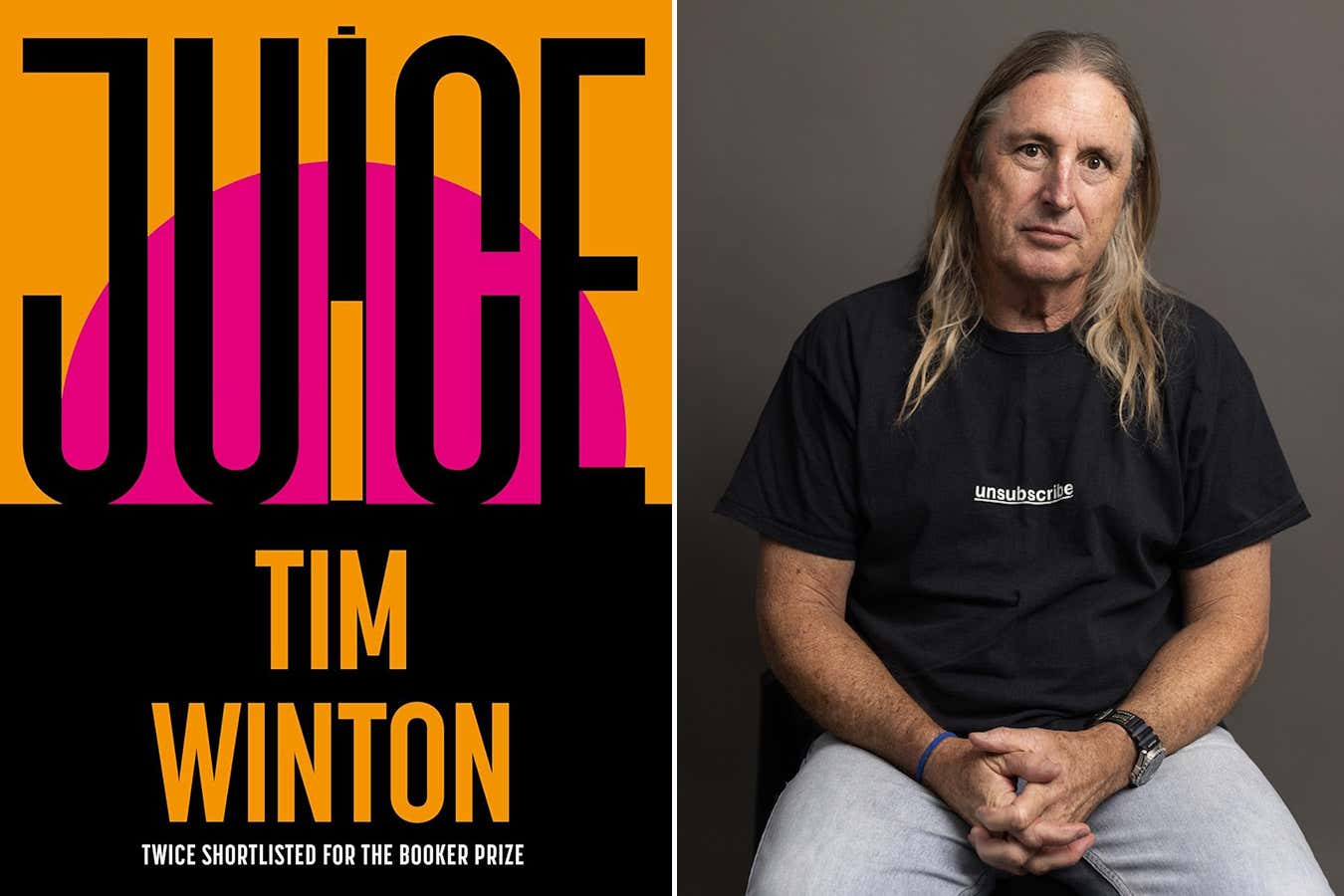
The New Scientist Book Club read Tim Winton’s novel Juice in February
The New Scientist Book Club moved from reading about the emancipation of a sex robot in January, with Sierra Greer’s Annie Bot, to a scorching vision of Australia many generations from now in February, with Tim Winton’s Juice.
Winton’s story follows an unnamed narrator as he tells the story of his life in this over-heated world. We gradually come to understand the work he was recruited for – exacting retribution on the descendants of those who brought the world to its knees with climate change – and what it takes to survive.
I thought Juice was absolutely brilliant: gripping, terrifying and beautifully written. But what did book club members have to say about it? There has been fierce discussion about this novel over on our Facebook page, much of it positive. Glen Johnson “loved” it and thought Winton did a “fantastic job”. “All of his descriptions of adaptations in a climate zone I know pretty well (I lived in Perth WA for 18 years) seemed so natural, despite being so different from current practice,” he writes. “Almost like the natural adaptations of the always resourceful rural Australian.”
So did Victor Churchill. “I found it absolutely compelling – dark in places for sure, while managing to maintain an air of positivity in the face of all tribulations,” he writes. “I had some quibbles with the plotting, but overall found this a very engaging – while uncomfortable in parts – read. The author takes his time about letting the protagonist discover what’s going on so you, the reader, are given jaw-dropping moments as you see what is going on behind the dispassionate language.”
Kim Woodhams Crawford was also a major fan: “I found it spot on with the potential for climate disaster – no matter what your politics, there’s not a zero chance of the future turning out like that, especially here, where it topped 42 degrees earlier this week.”
Not all were as gripped, however. “I didn’t enjoy the first 18 pages to be honest. I almost gave up, but decided to read another 18. I am very glad that I did. Once the narrator began his backstory, the novel really picked up and I was rapidly gripped,” says Linda Jones. Phil Gurski was another who criticised a “very slow start”.
There were also mixed feelings about the way Winton chose to tell his story – some loved the way it was narrated by our imprisoned protagonist, others weren’t so sure. “To me it has almost this magic realism-like vibe with the whole singing for your life and telling the whole life story,” writes Gosia Furmanik. Jacqueline Ferrand wasn’t as convinced. “In this case of a dystopian future would a total stranger want to listen to the total sum of your past life,” she asks. And Steve Swan wouldn’t have been as patient as the man armed with a bow who was listening to the story. “If I were that third party, I probably would have shot him by now,” he writes.
One issue that got people talking was whether or not Juice is dystopian. Winton wrote about this in an essay for us, in which he said: “Sometimes I think we use the word dystopia as an opiate. It serves as a softener, an instrument of distance. And I don’t think we can afford it.” Members really dug into this topic.
“It did not strike me as ‘dystopian’,” writes Victor. “I’d associate that word with novels describing a society suffering and struggling under an autocratic regime, for example, or in the throes of ongoing catastrophe; whereas this book could perhaps be described as post-dystopian: people are in the world they are in, have adapted their lives where they can to cope with it, and are getting on with it.”
“We won’t know if it is dystopian until we have a few more generations under our belt,” adds Margaret Buchanan. “Temperatures recently experienced across Australia would suggest to me that it is not a dystopian novel.”
Niall Leighton firmly disagreed, however. “It does seem that the problem is a semantic one, of whether a real sense of living in dystopian conditions can be described as living in a dystopia,” he writes. “Winton’s novel, to me, is clearly set in a dystopia, but then so are the actual lives of many people I know, with probably most people walking steadily deeper into one, to one degree or another.”
Niall also raised an interesting point – one I’ll be mulling over for some time. Does writing a dystopian vision of the future help avoid that future? “If we are to be the revolution, to quote Shevek, we have to be able to imagine it,” he writes. “I agree with Tim Winton that we can’t afford distance from reality. I disagree, strenuously, that what we need is more of these dystopian warnings.” What he thinks we need are stories “about a place we can hope to build, where we would all want to live, where all forms of discrimination and hierarchy have been abolished. I know it’s difficult (I’m trying!), but we need that more than we need Juice.”
Gosia, meanwhile, had some quibbles about plausibility: “I’m not convinced that [with] all that archival material… the service [would have] decided that the best course of action is to kill the descendants of fossil fuel oligarchs instead of educating the general populace and trying to regenerate the earth,” she writes. “So it feels like the motivation was retribution rather than change. And they failed in the end, and the climate kept deteriorating so it seems it was all pointless.”
What did people think of the ending? I personally loved the drop of hope we are offered, if we choose to take it, and the open ending – but then I enjoy that kind of thing (hello, Stranger Things). So did Samantha de Vaux. “Would I have written a more hopepunk ending? Perhaps but I tried to embrace this one because it is the story we are being told and that belongs to the author, and his characters, not me,” she writes. “I enjoyed this difficult book and ending because it challenged and engaged me on a visceral level.”
For now, it’s time to put aside Winton’s tale – dystopian or not – and move onto our read for March. This time, we’re trying some non-fiction, albeit non-fiction with a generous slice of culture: Daisy Fancourt’s Art Cure: The science of how the arts transform our health. Fancourt is professor of psychobiology and epidemiology at University College London, and she is here to tell us about how the arts can genuinely improve our lives – that they are the “forgotten fifth pillar of health”, alongside diet, sleep, exercise and nature. Her essay here, written exclusively for the New Scientist Book Club, will give you a taster, and this extract from the book is a fascinating insight into how one person who had had a stroke found that art classes transformed his life. Sign up to read along with us here and join our Facebook group to discuss the book here.
Topics:
