

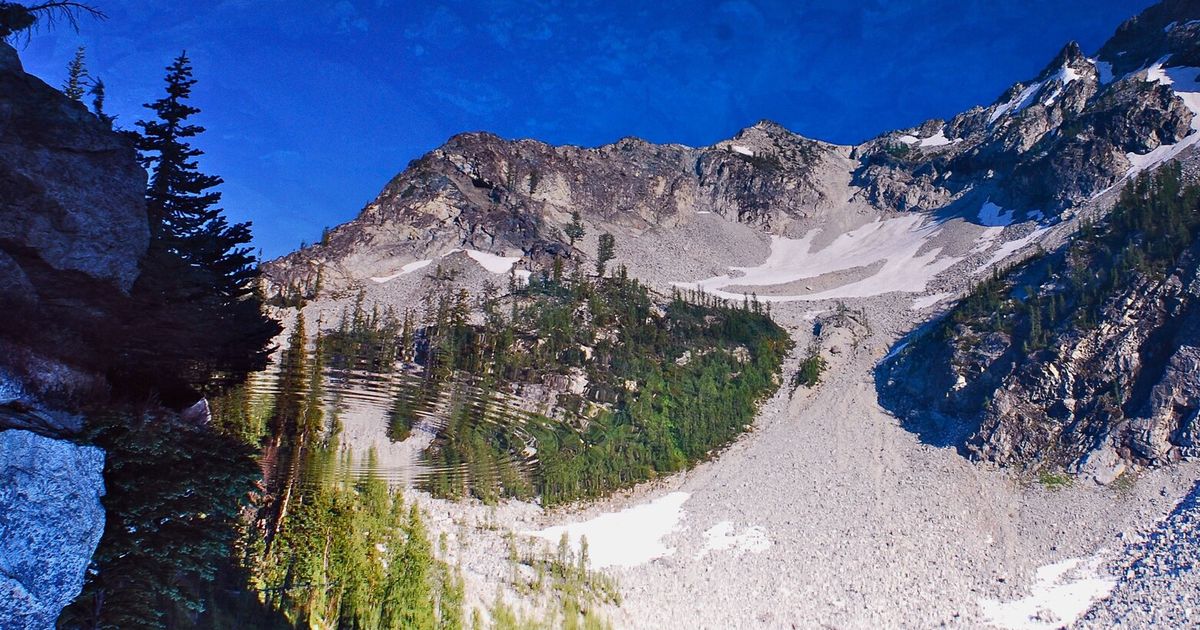
The other day, my husband and I were wondering if President Donald Trump has ever gone backpacking. Really. Has he? As we slogged up the trail with our packs and water bottles, we tried to envision him out there climbing 3,000 feet to a high mountain lake.
What would he think of the views, the masses of wild huckleberries or the fact that it rained recently — an anomaly for August in the North Cascades? What about the Republican senator from Utah, Mike Lee, who introduced the public land sell-off bill, which was eventually removed from the federal spending and policy bill? How do we impart the value of wilderness to those who may not spend much time in it?
I grew up in apple country in Eastern Washington. By the time my sister and I were old enough to walk, we were hiking to lakes and streams all over the North Cascades. My parents never told us not to yell in the woods, or not to litter. Before leaving a campsite, we combed the area for any speck of trash. We knew not to cut trails, not to get close to wildlife and not to leave a campfire unattended. We also knew the thrill of falling asleep to the sound of owls in the dark and the glittering expanse of the Milky Way above our heads.
I don’t think my parents ever read the “Leave No Trace” pamphlets that came out in the late 1980s. Their wilderness ethic was born from their rural roots. My mother grew up on a dairy farm in Wisconsin, and my father grew up on a mink farm in Oregon. He learned about wilderness the way most boys did in the 1950s — messing around outside, playing with gunpowder, fishing in the creek below their house and camping with his older brothers.
My parents were also part of the massive increase in outdoor recreation in the U.S. Between 1950 and 1970, visitor numbers at national parks across the United States increased fivefold — from 33 million to 172 million in 1970. Today, over 330 million people visit our national parks every year. As a tourism scholar, I have studied the impacts of outdoor recreation and amenity migration — relocation for quality of life, not money — for over 20 years. I have done fieldwork in the Himalayas, New Zealand, Hawaii and in my own hometown, the Methow Valley. I understand the pressures of human activity on public land and have spent most of my life documenting the structural changes associated with it.
While I have rued the fact that too many people are using public land and their increasing lack of wilderness ethic, it never occurred to me that our president and some Republican senators might try to sell our land to balance the budget or build affordable housing.
How do you explain to someone who has never stood on a peak and felt the wind in their face why it’s important that every acre of public land remain just that? Public. Free. Wild. Ecuador passed a constitutional amendment in 2008 granting legal rights to nature, as has India, Bolivia, New Zealand, Panama and even some U.S. states, such as Pennsylvania. If corporations can have legal rights, why not nature? Even from a purely economic standpoint, the value of wilderness lies between $5 billion to $9.4 billion per year in the U.S. Sen. Lee’s bill would have only given states 5% of the revenue generated from their land.
Growing up, everyone I knew was Republican — orchardists, ranchers, farmers. But their values were based on a rural ethic that transcended party lines. No one would have ever agreed to sell public land. Public land isn’t red or blue. It’s part of our national heritage and one of the few places where we can experience solitude, beauty and the ineffable. While the public land sell-off was removed from the Big Beautiful Bill for now, the threat remains. I hope our wilderness ethic can bring us together in the age of Trump. We need it now more than ever.
