

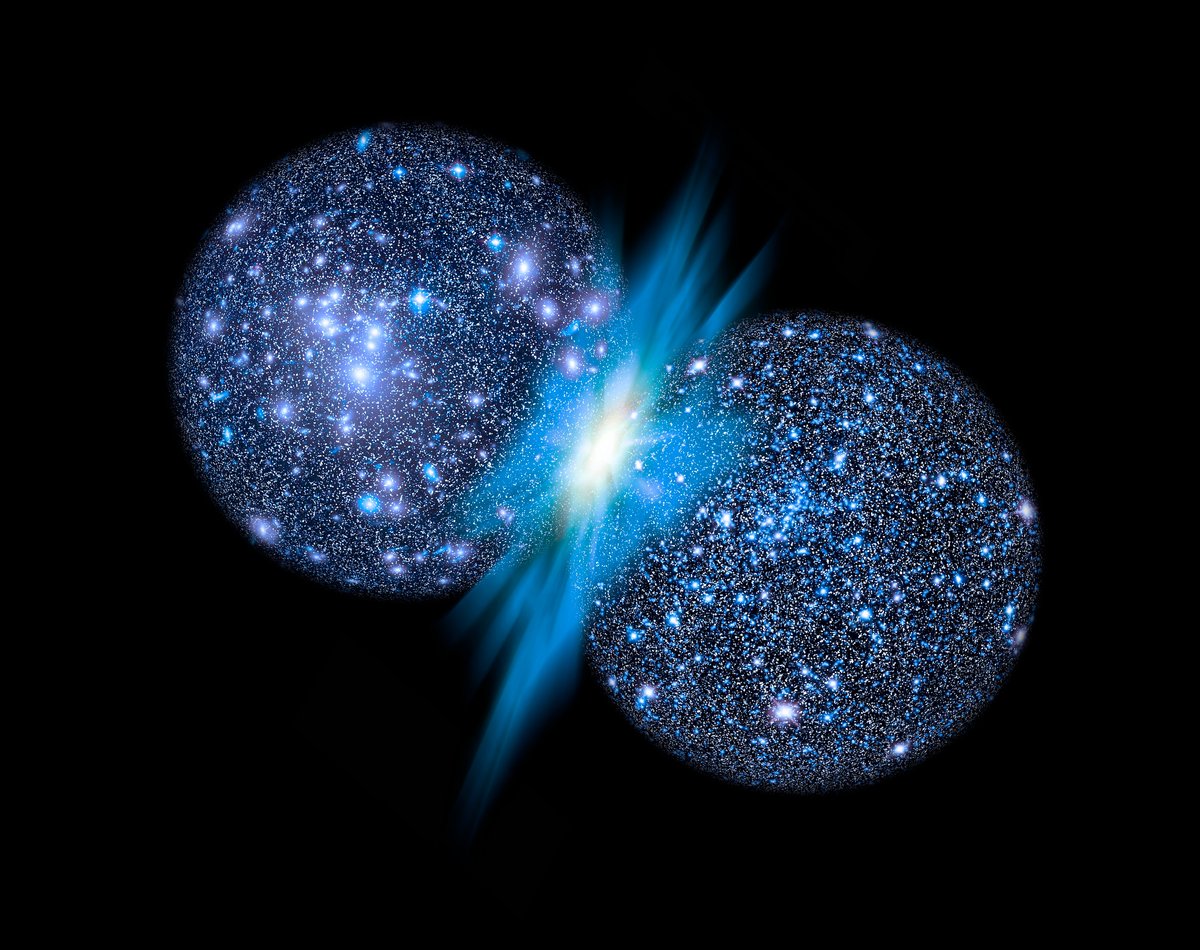
Why is there something rather than nothing? Philosopher Martin Heidegger called this “the first of all questions,” and it has vexed scholars and theologians alike throughout history.
Science has yet to find an answer, either—but researchers have narrowed it down. What’s clear is that the big bang churned out infinitesimally more baryonic matter—the protons and neutrons that glom together as atomic nuclei—than it did antimatter. This is strange because matter and antimatter annihilate each other when they interact—and today whenever physicists turn energy into particles, antiparticle doppelgangers emerge in equal numbers. So, all things being equal, matter and antimatter in the hot, dense primordial universe should have reacted together to simply poof out of existence. Total annihilation would be the norm—and we shouldn’t be here. Somehow, though, this process instead left behind a miniscule excess of matter, forged in the first split second of time, which became the source of essentially everything we’re made of and all that we can see.
Physicists have now found a new clue about the source of this mismatch by studying quarks and gluons—the building blocks of baryonic matter. Nature, it seems, is set askew not through either quarks or gluons alone but via their intermingling. The research, which appears today in Science, used the Relativistic Heavy Ion Collider (RHIC) at Brookhaven National Laboratory in Upton, N.Y. (RHIC was permanently shuttered earlier this year to make way for a new, better particle collider at Brookhaven.)
On supporting science journalism
If you’re enjoying this article, consider supporting our award-winning journalism by subscribing. By purchasing a subscription you are helping to ensure the future of impactful stories about the discoveries and ideas shaping our world today.
“This is one of the most significant results achieved by the RHIC program,” says Dmitri Kharzeev, a physicist at Stony Brook University, who was not involved with the new paper but is mentioned in its acknowledgments. “It reshapes our understanding of baryon structure and how baryonic matter emerged.”
Physicists create baryonic matter all the time by smashing subatomic particles together with all the power their equipment can muster. And every time they do, the same corresponding amount of antimatter pops out, too. The net “baryon number”—the total number of baryonic particles (like protons) they create minus the number of antiparticles—is always zero.
If the early universe obeyed this rule, our modern cosmos would be devoid of substance, just energy fields rippling eternally through emptiness. But try as they might, physicists can’t seem to break the symmetry. “No experiment has ever observed a violation of it,” says Prithwish Tribedy, a physicist at Brookhaven National Laboratory, who worked on the new result.
When two protons collide, the baryon number (particles minus antiparticles) is two. The protons explode in a blaze of new particles rapidly created and destroyed, but the difference remains two until the end. How does the baryon number get passed around all those intermediate particles along the way? As Tribedy puts the question, “What should we actually track to find out where it goes?”
Many physicists thought a proton’s baryon number would reside in the two “up” quarks and one “down” quark that comprise the particle. But RHIC’s data showed that it actually comes from interactions between the proton’s quarks and its gluons. (Gluons are neutrally charged particles that get their sticky name from being what binds quarks together.)
The researchers used an experiment at RHIC called STAR (Solenoidal Tracker at RHIC) to pinpoint the baryon number’s transport between particles by looking at collisions of two heavy nuclei, ruthenium and zirconium. The versions of these elements used in the study have the same total number of protons and neutrons combined, but ruthenium has four more protons and four fewer neutrons, making its nucleus more electrically charged. This difference allows physicists to disentangle the exchange of electrical charge that occurs as a ruthenium-zirconium collision unfolds, tracking its propagation through the myriad new particles produced. After doing this, the STAR team could discern that electric charge alone cannot account for baryon-number transport. Something else plays a role, something neutral: the gluon.
“The connected gluonic structure appears to provide the better dynamical tracer of where the baryon number goes,” Tribedy says.
RHIC’s finding—one of its final contributions to physics—doesn’t answer Heidegger’s question, alas. But it does allow physicists to trace this quantity at a fundamental level and to watch how the baryon number is mysteriously conserved. Hopefully this will bring us closer to that primordial moment when it wasn’t—in that fateful fraction of a second after the big bang. “Baryon number has been conserved ever since, so understanding how it is encoded and transported is essential,” Kharzeev says.
The answer to why there’s something rather than nothing remains elusive, but scientists now know gluons likely play a key role in this greatest of cosmic mysteries.
It’s Time to Stand Up for Science
If you enjoyed this article, I’d like to ask for your support. Scientific American has served as an advocate for science and industry for 180 years, and right now may be the most critical moment in that two-century history.
SciAm always educates and delights me, and inspires a sense of awe for our vast, beautiful universe. I hope it does that for you, too.
If you subscribe to Scientific American, you help ensure that our coverage is centered on meaningful research and discovery; that we have the resources to report on the decisions that threaten labs across the U.S.; and that we support both budding and working scientists at a time when the value of science itself too often goes unrecognized.
In return, you get essential news, captivating podcasts, brilliant infographics, can’t-miss newsletters, must-watch videos, challenging games, and the science world’s best writing and reporting. You can even gift someone a subscription.
There has never been a more important time for us to stand up and show why science matters. I hope you’ll support us in that mission.
