

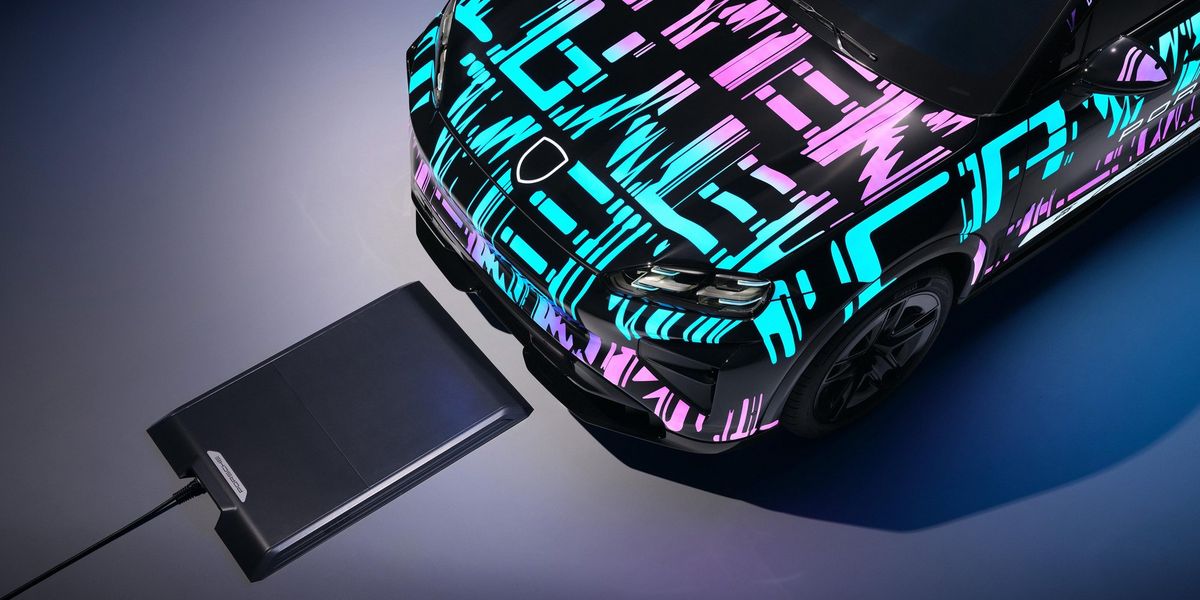
Charging an EV at home doesn’t seem like an inconvenience—until you find yourself dragging a cord around a garage or down a rainy driveway, then unplugging and coiling it back up every time you drive the kids to school or run an errand. For elderly or disabled drivers, those bulky cords can be a physical challenge.
As it was for smartphones years ago, wireless EV charging has been the dream. But there’s a difference of nearly four orders of magnitude between the roughly 14 watt-hours of a typical smartphone battery and that of a large EV. That’s what makes the wireless charging on the 108-kilowatt-hour pack in the forthcoming Porsche Cayenne Electric so notable.
To offer the first inductive charger on a production car, Porsche had to overcome both technical and practical challenges—such as how to protect a beloved housecat prowling below your car. The German automaker demonstrated the system at September’s IAA Mobility show in Munich.
With its 800-volt architecture, the Cayenne Electric can charge at up to 400 kW at a public DC station, enough to fill its pack from 10 to 80 percent in about 16 minutes. The wireless system delivers about 11 kW for Level 2 charging at home, where Porsche says three out of four of its customers do nearly all their fill-ups. Pull the Cayenne into a garage and align it over a floor-mounted plate, and the SUV will charge from 10 to 80 percent in about 7.5 hours. No plugs, tangled cords, or dirty hands. Porsche will offer a single-phase, 48-ampere version for the United States after buyers see their first Cayennes in mid-2026, and a three-phase, 16-A system in Europe.
Porsche’s Wireless Charging is Based on an Old Concept
The concept of inductive charging has been around for more than a century. Two coils of copper wire are positioned near one another. A current flowing through one coil creates a magnetic field, which induces voltage in the second coil.
In the Porsche system, the floor-mounted pad, 78 centimeters wide, plugs into the home’s electrical panel. Inside the pad, which weighs 50 kilograms, grid electricity (at 60 hertz in the United States, 50 Hz in most of the rest of the world) is converted to DC and then to high-frequency AC at 2,000 V.The resulting 85-kilohertz magnetic field extends from the pad to the Cayenne, where it is converted again to DC voltage.
The waterproof pad can also be placed outdoors, and the company says it’s unaffected by leaves, snow, and the like. In fact, the air-cooled pad can get warm enough to melt any snow, reaching temperatures as high as 50 °C.
The Cayenne’s onboard charging hardware mounts between its front electric motor and battery. The 15-kg induction unit wires directly into the battery.
In most EVs, plug-in (conductive) AC charging tops out at around 95 percent efficiency. Porsche says its wireless system delivers 90 percent efficiency, despite an air gap of roughly 12 to 18 cm between the pad and vehicle.
Last year, Oak Ridge National Laboratory transferred an impressive 270 kilowatts to a Porsche Taycan with 95 percent efficiency.
“We’re super proud that we’re just below conductive AC in charging efficiency,” says Simon Schulze, Porsche’s product manager for charging hardware. Porsche also beats inductive phone chargers, which typically max out at about 70 percent efficiency, Schulze says.
When the car gets within 7.5 meters of the charging pad, the Cayenne’s screen-based parking-assist system turns on automatically. Then comes a kind of video game that requires the driver to align a pair of green circles on-screen, one representing the car, the other the pad. It’s like a digital version of the tennis ball some people hang in their garage to gauge parking distance. There’s ample wiggle room, with tolerances of 20 cm left to right, and 15 cm fore and aft. “You can’t miss it,” according to Schulze.
Induction loops detect any objects between the charging plate and the vehicle; such objects, if they’re metal, could heat up dangerously. Radar sensors detect any living things near the pad, and will halt the charging if necessary. People can walk near the car or hop aboard without affecting a charging session.
Christian Holler, Porsche’s head of charging systems, says the system conforms to International Commission on Non-Ionizing Radiation Protection standards for electromagnetic radiation. The field remains below 15 microteslas, so it’s safe for people with pacemakers, Porsche insists. And the aforementioned cat wouldn’t be harmed even if it strayed into the magnetic field, though “its metal collar might get warm,” Schulze says.
The Porsche system’s 90 percent efficiency is impressive but not record-setting. Last year, Oak Ridge National Laboratory (ORNL) transferred 270 kW to a Porsche Taycan with 95 percent efficiency, boosting its state of charge by 50 percent in 10 minutes. That world-record wireless rate relied on polyphase windings for coils, part of a U.S. Department of Energy project that was backed by Volkswagen, Porsche’s parent company.
That effort, Holler says, spawned a Ph.D. paper from VW engineer Andrew Foote. Yet the project had different goals from the one that led to the Cayenne charging system. ORNL was focused on maximum power transfer, regardless of cost, production feasibility, or reliability, he says.
By contrast, designing a system for showroom cars “requires a completely different level of quality and processes,” Holler says.
High Cost Could Limit Adoption
Cayenne buyers in Europe will pay around €7,000 (roughly US $8,100) for the optional charger. Porsche has yet to price it for the United States.
Loren McDonald, chief executive of Chargeonomics, an EV-charging analysis firm, said wireless charging “is clearly the future,” with use cases such as driverless robotaxis, curbside charging, or at any site “where charging cables might be an annoyance or even a safety issue.”
But for now, inductive charging’s costly, low-volume status will limit it to niche models and high-income adopters, McDonald says. Public adoption will be critical “so that drivers can convenience-charge throughout their driving day—which then increases the benefits of spending more money on the system.”
Porsche acknowledges that issue; the system conforms to wireless standards set by the Society of Automotive Engineers so that other automakers might help popularize the technology.
“We didn’t want this to be proprietary, a Porsche-only solution,” Schulze says. “We only benefit if other brands use it.”
From Your Site Articles
Related Articles Around the Web
