

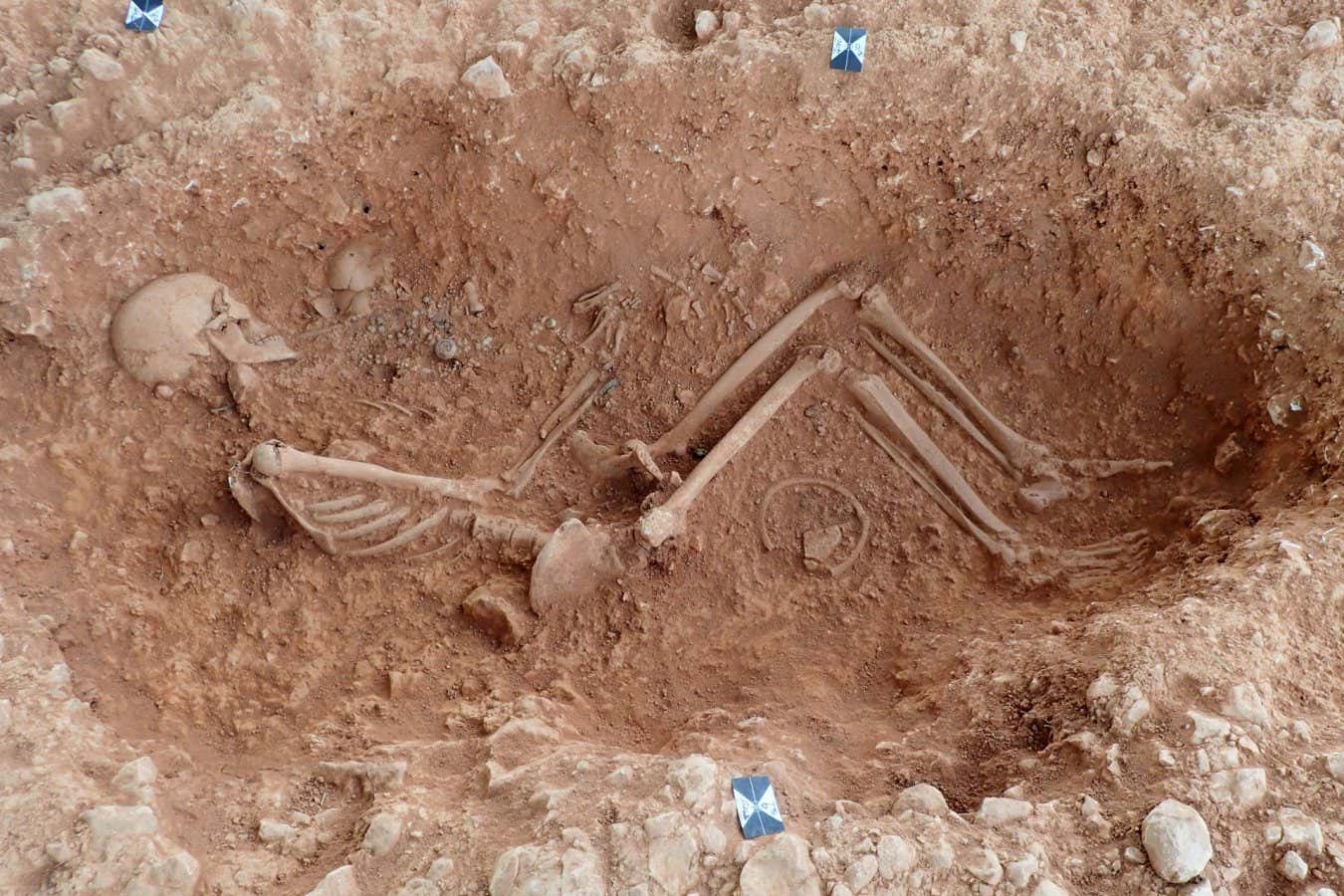
The skeleton of a woman cradling a baby in her left arm, buried at an Anglo-Saxon cemetery in Scremby, UK
Dr Hugh Willmott, University of Sheffield
Scientists are homing in on a pregnancy test for women who lived hundreds or even thousands of years ago.
For the first time, researchers have detected levels of oestrogen, progesterone and testosterone in the skeletal remains of women from the 1st to the 19th century AD – some of whom were buried with fetuses. The findings show that ancient bones and teeth preserve clear traces of certain sex hormones, which could help identify which individuals in archaeological sites were pregnant or had just given birth at their time of death, says Aimée Barlow at the University of Sheffield in the UK.
“The physiological and emotional experience of pregnancy and pregnancy loss and childbirth are very profound for women, but so far, they’ve largely remained invisible in the archaeological record,” she says. “This method has the potential to revolutionise the way we study reproductive histories of past populations. I’m thrilled, to be honest.”
Pregnancy is difficult to see in ancient individuals, especially if the fetus didn’t have a visible skeleton yet. Even fetuses in the second and third trimester can be overlooked since their bones can resemble those of the mother’s hands – which are often placed over their abdomens for burial.
Modern pregnancy tests measure levels of hormones like hCG in blood or urine. But hCG quickly breaks down, leaving little trace of its presence in the body.
Progesterone, oestrogen and testosterone, however, can linger in tissues longer. Recent research shows that these steroid hormones can be found in people’s blood, saliva and hair – even in long-buried strands from Egyptian mummies.
To assess the potential for detecting ancient pregnancies, Barlow and her colleagues sampled rib fragments and one neck bone from two men and seven women buried in four English cemeteries. They also sampled the people’s teeth, along with those of a third man.
Two of the women had confirmed fetal remains in their abdomens, and two others were buried with newborn babies. The sexes of the other people had been determined by DNA analysis.
The team ground each sample into a powder and used chemicals and other techniques to isolate any steroid hormones. Laboratory testing then determined how much oestrogen, progesterone and testosterone each of the 74 samples contained.
Oestrogen only showed up in four samples, with no clear pattern – possibly because it breaks down quicker than progesterone and testosterone, and might not store well in tissues.
Progesterone, however, showed up especially high in the vertebra of a young woman who died carrying a full-term fetus between the 11th and 14th centuries. The other third-trimester woman, buried in the 18th or 19th century, had elevated progesterone in her rib. Moderate progesterone levels also appeared in the dental plaque of the two women buried with babies in the 5th or 6th century.
Notably, these four women had no traces of testosterone whatsoever in their bones, nor in any part of their teeth – although one buried with a premature baby had a small amount in her plaque. By contrast, the three women not associated with fetuses or infants, who were buried in an 8th-to-12th century cemetery and a Roman-era grave, had testosterone in their ribs and in all layers of their teeth.
Testosterone at low levels plays important roles in women’s health, so its presence in those samples isn’t surprising, says Barlow. “But perhaps the absence of testosterone indicates a recent or current pregnancy at the time of death,” she says.
“This is an exciting and unexpected intersection of archaeology with hormone science,” says Alexander Comninos at Imperial College London. “These techniques could be used to detect pregnancy in skeletal remains more reliably and so give us more accurate insights into ancient pregnancy.”
Even so, while the results are promising, further research must iron out the details, says Barlow. Men’s bones and inner teeth often showed moderate levels of progesterone, for example, for reasons yet to be understood, she says. “The interpretations are very cautious at the moment.”
Follow in the footsteps of the Romans on this immersive walking tour along Hadrian’s Wall, one of Britain’s most iconic, ancient landmarks and a UNESCO World Heritage Site. Topics:
Walking Hadrian’s Wall and Roman innovation: England
