

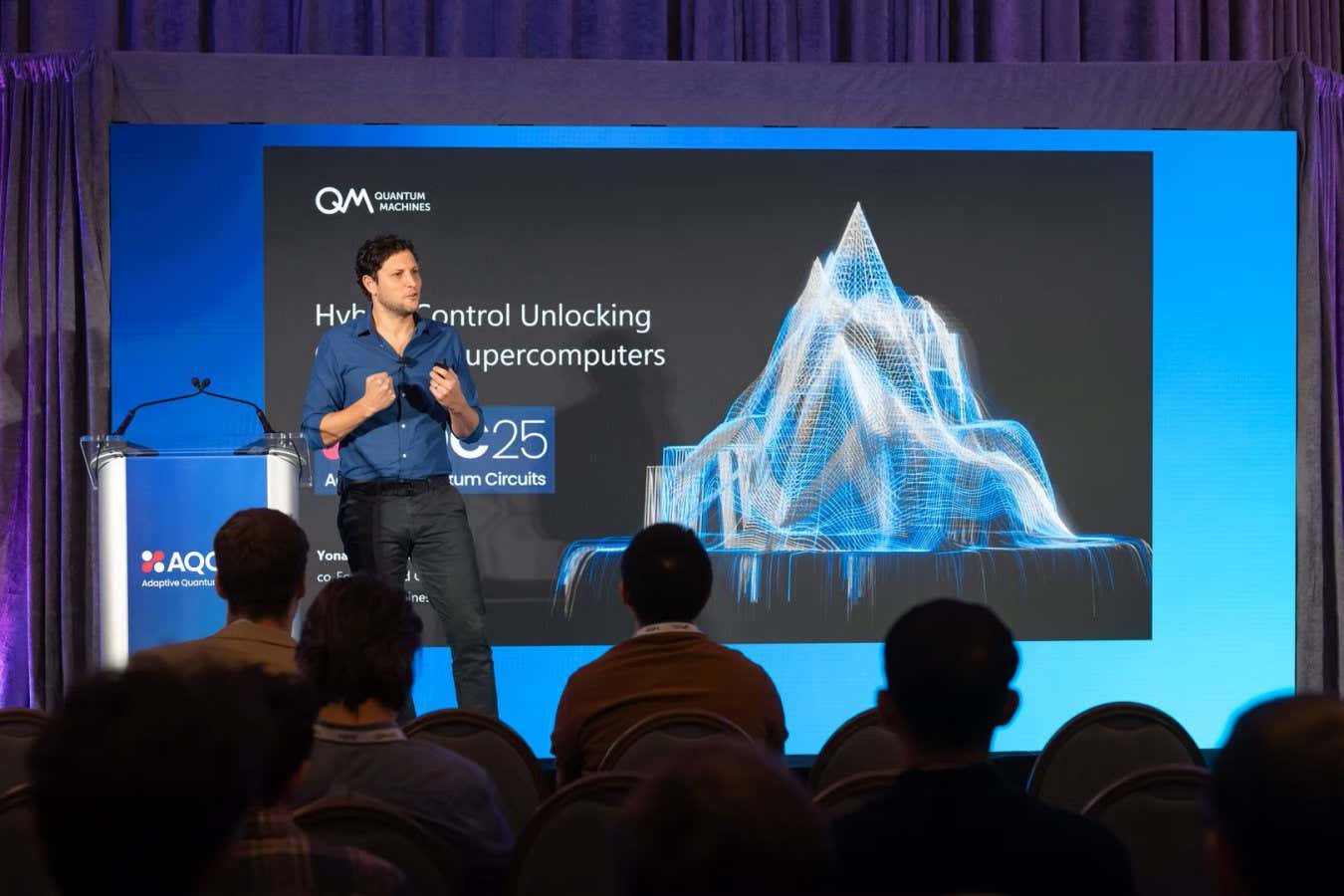
Yonathan Cohen at Quantum Machines speaking at AQC25 conference
Quantum Machines
A vital ingredient for making quantum computers truly useful just might be conventional computers. That was the message from a gathering of researchers this month, which explained that classical computers are vital for controlling quantum computers, decoding the results of their calculations and even developing new techniques for manufacturing quantum computers in future.
Quantum computers are made from qubits – quantum objects that may come in the form of extremely cold atoms or tiny superconducting circuits. The more qubits that a quantum computer has, the more computationally powerful it gets.
But qubits are fragile, so they must be carefully calibrated, monitored and controlled. Otherwise, they can introduce errors to the calculations run on a quantum computer or make these devices inefficient. To control qubits, researchers turn to classical computing technologies – which they discussed at the AQC25 conference in Boston, Massachusetts, on 14 November.
Organised by Quantum Machines, which makes controllers for several different kinds of qubits, the AQC25 conference gathered more than 150 researchers, ranging from quantum computing professors to AI start-up CEOs. Across several dozen presentations, they elaborated on the role of conventional computing as an enabling technology – and sometimes the limiting factor – for the future of quantum computing.
According to Shane Caldwell, a scientist at Nvidia, the expectation is that a fault-tolerant quantum computer for useful problems will be made possible only if it is supported by a classical computing infrastructure at the petascale – the scale at which the world’s most powerful traditional supercomputers currently operate. While Nvidia doesn’t make its own quantum computing hardware, the firm recently launched a system for connecting quantum computing processors (QPUs) with traditional GPUs – the specialised computer components that are commonly used in machine learning and high-performance scientific computing.
Even when a quantum computer is running efficiently, its output comes in the form of a set of quantum properties of its qubits. These must be decoded into more traditional formats in order to become useful – again requiring classical computing devices.
Pooya Ronagh from the Vancouver-based start-up 1Qbit spoke about this decoding and how it means that the speed of fault-tolerant quantum computers will be determined by the operating speed of its classical components, such as controllers and decoders. In other words, whether an expensive machine made from highly specialised quantum hardware has to run for a few days or a few hours to solve a computational problem might come down to its non-quantum parts.
In another presentation, Benjamin Lienhard at the Walther-Meissner-Institute for Low Temperature Research in Germany discussed how the use of traditional machine learning algorithms could make reading out superconducting qubits’ quantum states more efficient. Similarly, Mark Saffman at the University of Wisconsin-Madison reported on using classical neural networks to improve readout for qubits made from extremely cold atoms. Regardless of the type of qubit they study, researchers agreed that non-quantum devices will help those qubits become useful.
IBM’s Blake Johnson presented on the details of the classical computing decoder that his team is developing as part of plans to build a quantum supercomputer by 2029. That supercomputer will use a non-traditional error-correction scheme, and efficient decoding is one of its biggest challenges.
“As time goes by, we’re seeing that the more classical [computing] we bring closer to the QPUs, the more we can squeeze the integrated performance of the system to new limits,” said Yonathan Cohen at Quantum Machines.
Traditional computers even have a role in assessing the behaviour of future quantum computers and how they will be built. For instance, Izhar Medalsy at a start-up called Quantum Elements said that the company’s AI-powered virtual versions – or “digital twins” – of quantum computers can inform actual hardware design.
The Quantum Scaling Alliance, co-led by 2025 Nobel Laureate John Martinis, was also represented at the conference. It exemplifies the importance of quantum and classical working together. The alliance connects qubit builders, traditional computing companies such as Hewlett Packard Enterprise and experts in materials simulations such as the software company Synopsys.
The consensus view from the conference was clear: the future of quantum computing is fast approaching, but that is in part thanks to experts who have spent their careers working firmly in the classical world.
Topics:
