

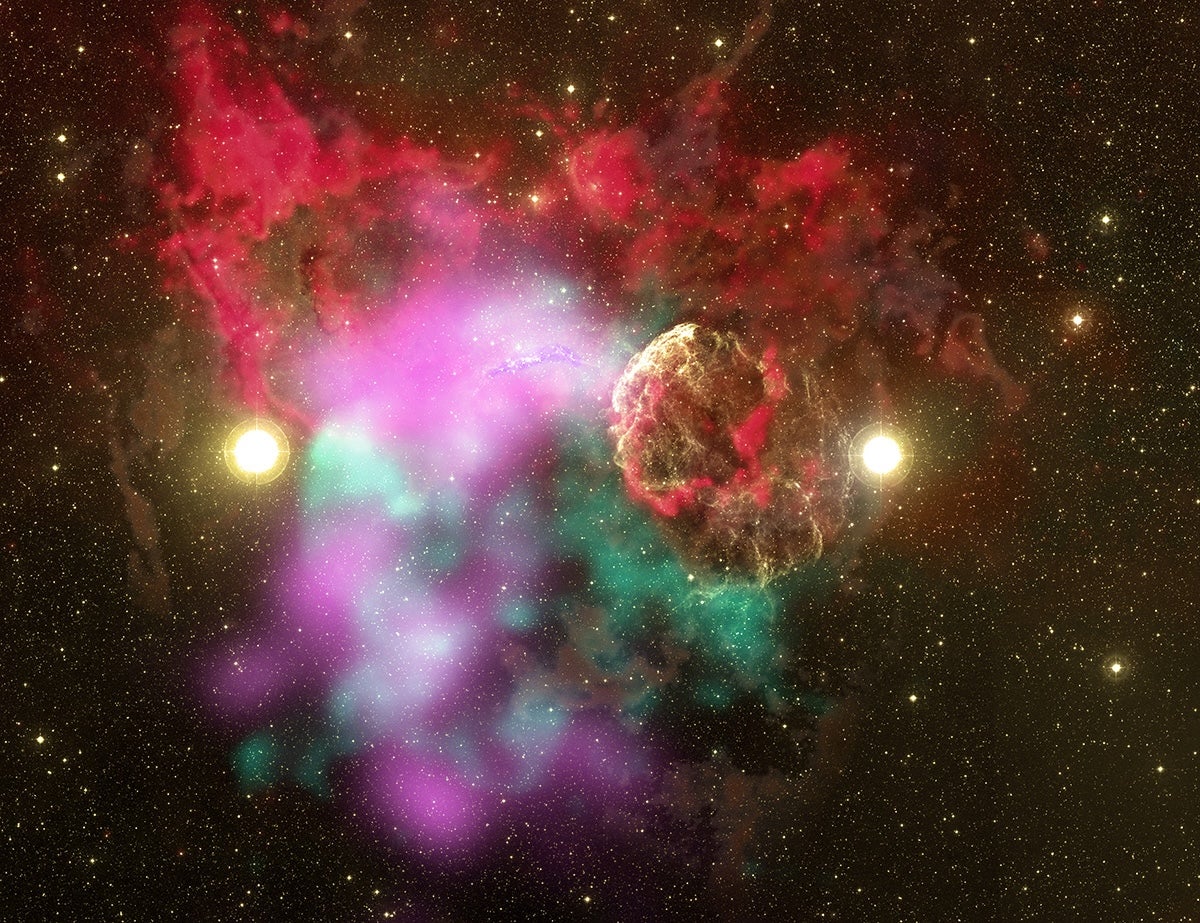
For decades, astrophysicists have been puzzling over a mystery hidden in plain view: Most supernovae come from the biggest stars, and most of our galaxy’s biggest stars are thought to be in multistar systems. Yet no one had ever found two supernovae occurring in a single multistar system—until now, that is.
This newly discovered system is made up of one of the most studied supernova remnants in our galaxy, IC 443 (the Jellyfish Nebula), and a second, fainter remnant, called G189.6+3.3, hiding nearby. IC 443 shines so brightly that it masks this second remnant, which only proved detectable via reams of old data and fresh observations from exquisitely sensitive new space telescopes.
Astronomers usually seek out supernova remnants—neutron stars and the occasional black hole, plus their energy-wracked surroundings—by the shock waves left behind by their catastrophic birth. Such shock waves occur when a massive star’s core runs out of fuel, implodes and blasts the rest of the star to smithereens. To uncover the shock waves from this supernova duo, astronomers relied on two subtle signatures: a spherical shell structure of debris and the glow of ejected stellar material slamming into surrounding interstellar gas.
On supporting science journalism
If you’re enjoying this article, consider supporting our award-winning journalism by subscribing. By purchasing a subscription you are helping to ensure the future of impactful stories about the discoveries and ideas shaping our world today.
In 2023 a team using eROSITA, an x-ray telescope launched in 2019, found evidence of a plasma shell structure heated to more than eight million degrees Celsius, but the telltale glow remained elusive. The glow typically shows up in radio signals; yet G189.6+3.3 lacked a radio signal that matched the entire shell structure. The evidence was too ambiguous to be a “smoking gun” for a second supernova remnant.
A breakthrough came when astronomers instead looked for the glow in gamma rays (a higher-energy form of light than radio waves). Using 16 years of data from NASA’s Fermi Gamma-ray Space Telescope, a team led by Miltiadis Michailidis, a Stanford University astronomer and lead study author, found a complex gamma-ray glow that traces the x-ray shell, indicating that G189.6+3.3 is, in fact, the remnant of a supernova. The details have been published in Nature Communications.
It’s not just any supernova remnant, though. Looking deeper at the gamma-ray data, the team found the northern part of the remnant emits a totally different signal than the rest of the region. This discrepancy, they say, denotes where two different types of particles are releasing gamma rays within the expanding shock waves. And the researchers argue this insight provides powerful clues about how these dual supernovae first came to be.
Most of G189.6+3.3, it seems, is in a relatively matter-sparse volume of space, so the gamma-ray glow there comes from shock-wave-accelerated electrons suffusing that region. The remnant’s northern part is aglow with gamma rays from accelerated protons, however—indicating the shock is interacting with a dense cloud of ionized hydrogen gas called the S249 H II region. It just so happens that this cloud is the same one that astronomers already knew to be interacting with the Jellyfish Nebula—suggesting strongly that these two remnants are actual neighbors rather than dissociated objects far away from each other that just happen to appear close together in Earth’s sky.
In subsequent computer simulations, the team established a plausible sequence of events: The two objects began as a pair, each a massive, short-lived star bound to the other by their respective gravity. When the first star exploded, the force of the explosion sent the second star flying through space. It traveled far enough that, when the second star exploded, this second supernova didn’t combine with the remains of the first. Also, the “two supernova explosions occurred on a reasonably short astronomical time scale” within several thousands or tens of thousands of years of each other, says Mikako Matsuura, an astronomer at Cardiff University in Wales, who was not involved in the study.
By so conclusively linking these two supernovae, scientists can now measure the timing and distance between them—and use it to directly calculate, for the first time, not just the energy of a supernova but how that energy propagates through its surroundings and sends pieces of stellar shrapnel zooming through deep space. This, in turn, can help refine our bigger-picture understanding of how stars and galaxies formed.
The study has major implications for studying binary star systems as well. “We only have theoretical models for the evolution of binaries and the different stages of the star’s evolution,” Michailidis says. Now those models can be checked against actual physical observations.
Additionally, these binary supernova remnants “might replicate the conditions [that existed] at an early age of the universe,” Matsuura says, when the cosmos was smaller and crammed with greater numbers of constantly interacting and short-lived massive stars. Closer scrutiny of this newfound system could therefore reveal more about the lives and deaths of these earlier, now vanished stars.
As a next step, the team is now planning to search for other binary supernova remnants. With more examples in hand, they hope to fine-tune their theoretical models to better predict how and where these strange systems arise and evolve in the Milky Way and across the universe.
It’s Time to Stand Up for Science
If you enjoyed this article, I’d like to ask for your support. Scientific American has served as an advocate for science and industry for 180 years, and right now may be the most critical moment in that two-century history.
I’ve been a Scientific American subscriber since I was 12 years old, and it helped shape the way I look at the world. SciAm always educates and delights me, and inspires a sense of awe for our vast, beautiful universe. I hope it does that for you, too.
If you subscribe to Scientific American, you help ensure that our coverage is centered on meaningful research and discovery; that we have the resources to report on the decisions that threaten labs across the U.S.; and that we support both budding and working scientists at a time when the value of science itself too often goes unrecognized.
In return, you get essential news, captivating podcasts, brilliant infographics, can’t-miss newsletters, must-watch videos, challenging games, and the science world’s best writing and reporting. You can even gift someone a subscription.
There has never been a more important time for us to stand up and show why science matters. I hope you’ll support us in that mission.
