

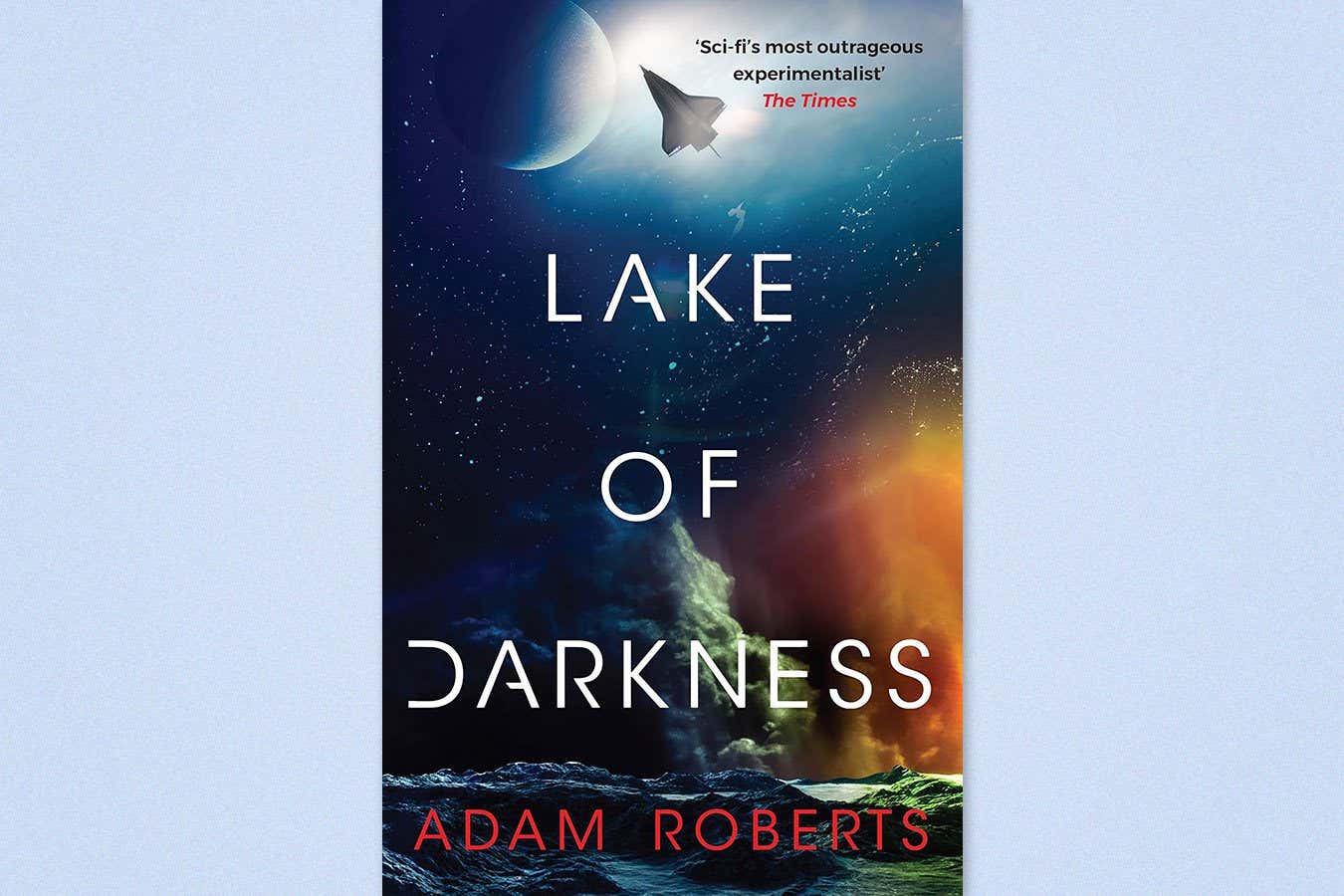
Lake of Darkness is the New Scientist Book Club’s July pick
You were born, in all likelihood, towards the end of the 20th– or towards the beginning of the 21st-centuries. Yes? I have no desire to condescend to you. Many of the features of life today will be readily comprehensible to you, if you can only — as surely you can — extrapolate from your past into our present with a little common sense.
Take the ship. There are lots of imaginary startships in your popular culture, but many of these are only vaguely thought-through: naval ships, or land-based buildings, foolishly projected into deep space. Corridors? Why would we want corridors in a startship? Rigid external superstructures and frame, containing decks and floor — very fragile, under the kinds of shearing forces and pressures of spaceflight. But you already knew this, if you thought about it for a moment. The Sβ Oubliette did not look like a skyscraper lying on its side, or a pyramidically-stacked aircraft carrier. It looked, if you prefer an aquatic analogy, like one of those semi lucent glittering blobs that pulse through the depths of the ocean.
Some of a startship is its drive and power-systems: propulsion, guidance and AI. But most of it — nine-tenths, as I mentioned above — is a hospital. Human animals are not built for living in space, and any enterprise that puts human beings in space for long stretches of time must spend most of its time attending to the health of those humans. This is not — or, let’s say, it is rarely — a matter of broken bone, or infectious disease, as with older mundane hospitals. It is a congeries of related problems, chief amongst them radiation poisoning and bone-health from calcium loss, with modal health, mental-emotional well-being and temporal dysphasia coming close behind. Deep space is suffused with high levels of various rays and fields that degrade the human body on a cellular level: burns, mutations, cancers, decadences. Much of a deep space mission is attending to these injuries. Cancer cannot be inoculated against, but it can be treated. Cellular and DNA damage cannot be prevented, but can be addressed post hoc. Psychological derangement and distress, and spiritual emptiness, are perennials, and more likely to occur in the constricted environments of a startship than in the stimulus-rich homes and habitats of our utopian collectives, but even they can be coaxed back towards wholeness and health by the right strategies. Solace is possible. And so the mission goes on. For the crew, about a third of their waking hours are given over to ship’s business, a third to health-checks and treatments, leaving a few hours of leisure time per artificial day.
In the case of a ship’s emergency — as now, aboard the Sβ Oubliette — the leisure time is eaten into, and the duty absorbs more of the day. But the healthcare is never stinted.
As for corridors: the interior of any given startship will be different, depending on design and purpose and aesthetics, but the basic structure is a cluster of moveable Meissner tetrahedra, linked together with smartcable. The interiors of these structures, being non-spheres of uniform diameter, are spun in a complex of spiral trajectories to mimic gravity. It’s a poor imitation, and extra work pushing limbs in exercise bands, compressing the body and — most of all — addressing calcium loss and density with medical interventions are also needful. But Meissner bodies make more livable interiors than the circular strips of ribbon rotated like merry-go-round, like in your moving-along picture show Two Thousand And One Odysseys. Those are very tricky to live in, believe me. Some places do operate them: usually as temporary structures while larger, more stable ones are being built. But you wouldn’t want to live in such a rotating strip. Turn around suddenly — turn your head too quickly — and you’ll start puking. Large-diameter slow-spinning Meissner bodies, by slowly moving the 3D space on an in-logic inaround, is a much more tolerable arrangement.
You don’t care about any of that. Why would you?
This is an extract from Adam Roberts’s Lake of Darkness (Gollancz), the latest pick for the New Scientist Book Club. Sign up and read along with us here.
Topics:
