

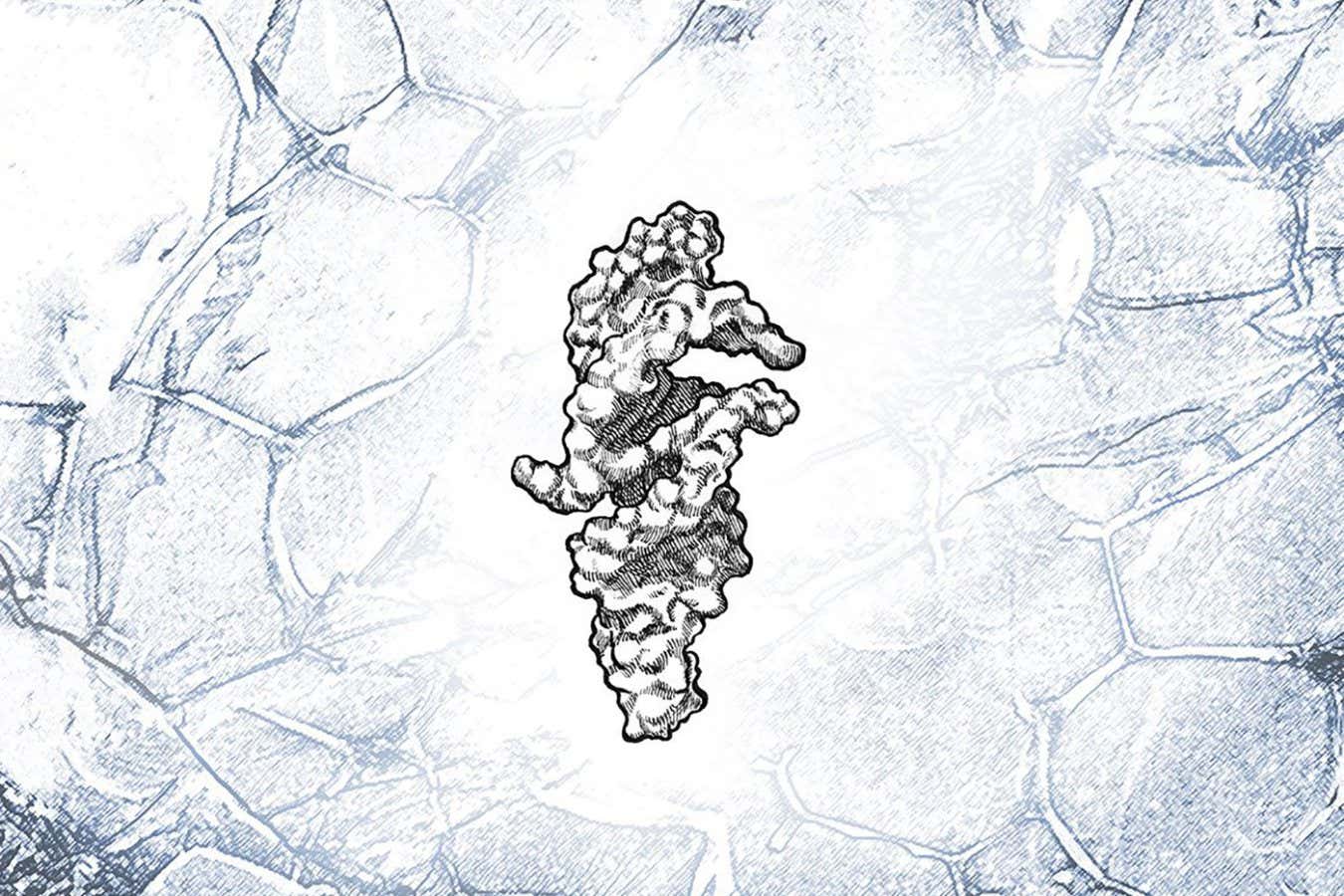
Artist’s depiction of QT45 (based on AlphaFold3 prediction) overlayed on a microscopy image of the frozen environment that aids RNA replication
Elfy Chiang, microscopy image by James Attwater
According to the RNA world hypothesis, life began when RNA molecules evolved the ability to make more copies of themselves. Now we have discovered an RNA molecule that is almost capable of this – it can carry out the key steps involved, just not all at once.
“It’s been a long quest to get to the point where you can convince yourself that RNA has the capacity to make itself under the right conditions. I think this shows that it is possible,” says Philipp Holliger at the MRC Laboratory of Molecular Biology in Cambridge, UK.
In living cells, proteins carry out key tasks such as catalysing chemical reactions, and the recipes for making them are stored in double-stranded DNA molecules. RNA is a chemical cousin of DNA that usually exists in the form of single strands.
It isn’t as good for storing information as DNA because it is less stable, but it can do something DNA can’t: fold up to form protein-like enzymes that can catalyse chemical reactions. Because RNA can both store information and act as a catalyst, it was suggested as early as the 1960s that life might have begun with RNA molecules capable of catalysing their own formation.
But finding such molecules has proved really difficult. Researchers had long assumed that self-replicating RNAs must be relatively large and complex, but it turns out to be very hard to unfold large RNAs to replicate them.
What’s more, while it has been shown that relatively short RNA molecules can form spontaneously in the right conditions, large molecules are very unlikely to have done so.
“This led us to think, well, maybe we’re wrong. Maybe something simple, something small, could carry out this process,” says Holliger. “And so we went looking, and we found one.”
RNAs are made of building blocks called nucleotides. The team started by generating a trillion random sequences that were 20, 30 or 40 nucleotides long. From these, they picked out three that could carry out reactions such as joining nucleotides together. The three were joined together and put through several rounds of evolution – randomly changing, or mutating, parts of the sequence and selecting the better-performing variants.
The resulting molecule, called QT45, is just 45 nucleotides long. In alkaline water that is just above freezing, it can use single-stranded RNA as a template for making complementary strands by joining together short strands of two or three nucleotides, including making a sequence complementary to its own. “It’s currently quite slow and low-yielding, but that’s not a surprise,” says Holliger.
QT45 can also make more copies of itself from those complementary strands. “This is, for the first time, a piece of RNA that can make itself and its encoding strand, and those are the two constituent reactions of self-replication,” says Holliger. But so far, the team hasn’t managed to get both reactions to happen in the same container. The plan is now to both evolve the molecule further and experiment with conditions such as freeze-thaw cycles to see if both reactions could happen at once.
“The most exciting thing is, once the system begins to self-replicate, it should become self-optimising,” Holliger says. That’s because the error-ridden process will produce a lot of variations, a few of which may work better, producing more of themselves, and so on.
“The new results from the Holliger lab are exceptional and a significant advance, pushing things even closer to a fully self-replicating RNA,” says Sabine Müller at the University of Greifswald in Germany.
“Perhaps the most significant aspect of this finding is to discover a moderately sized RNA oligomer sequence with these self-synthesising capabilities,” says Zachary Adam at the University of Wisconsin-Madison.
The number of 45-nucleotide-long RNA sequences alone is “unimaginably large”, Adam points out, so the team did well to find QT45 from a starting point of just a trillion random sequences.
On the early Earth, molecules similar to QT45 might have been able to self-replicate in an environment a bit like modern-day Iceland, Holliger says, with ice present, but also hydrothermal activity to drive freeze-thaw cycles and create pH gradients. Some sort of compartmentalisation would be needed to isolate the key components, he thinks, but there are many ways this can happen, from pockets of meltwater in ice to cell-like vesicles forming spontaneously from fatty acids.
Topics:
