

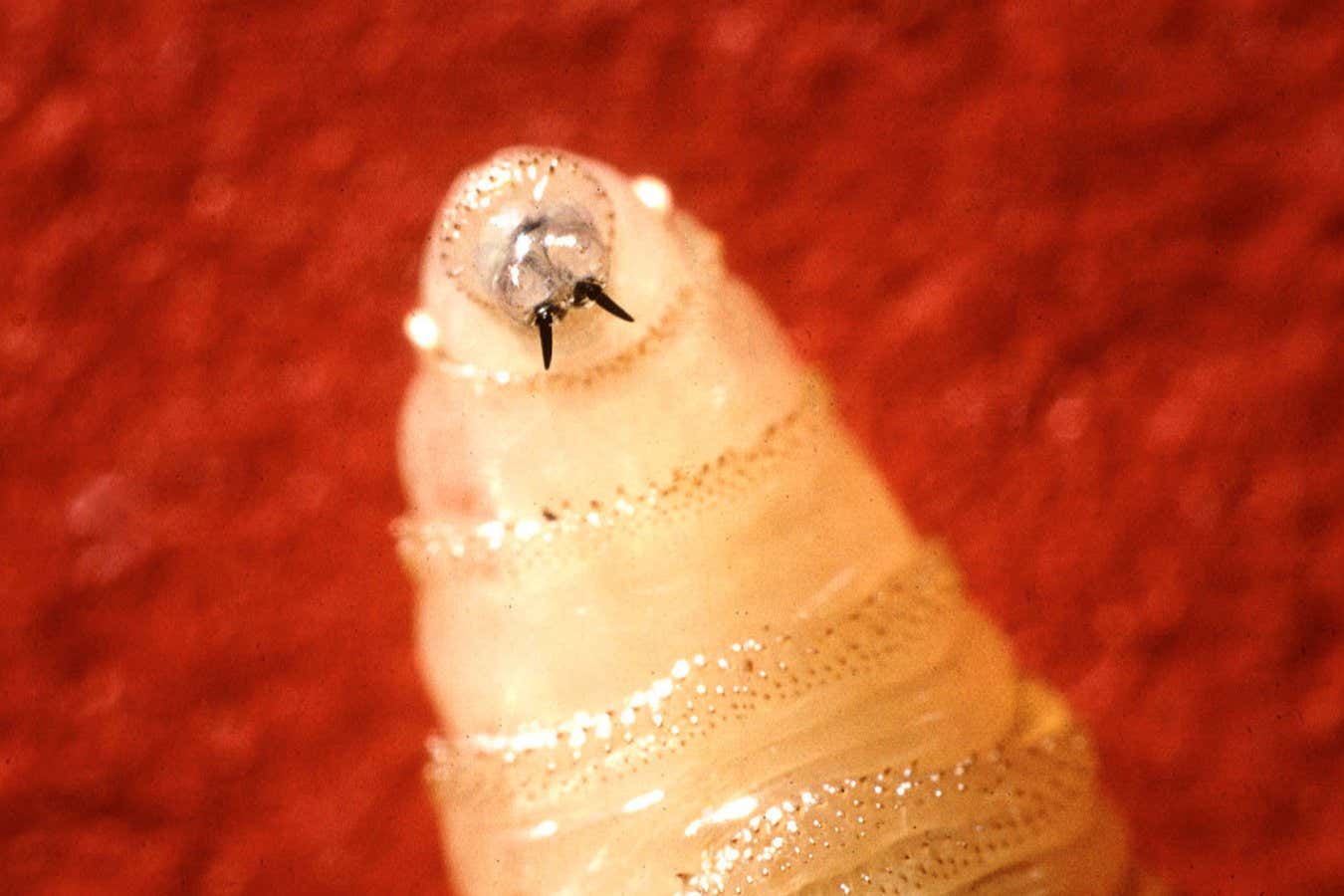
Tusk-like mandibles protrude from a screwworm larva’s mouth
Scott Camazine/Alamy
In a few cases, the extinction of a species would be a good thing. That’s a controversial opinion, but I do think the world would be better off, for instance, without malaria-spreading mosquitoes.
We now have the genetic technology to achieve this, in the form of extinction drives – more accurately called gene drives – that can defy evolution and spread harmful traits throughout a population. Unfortunately, it doesn’t look like this technology will be deployed against malaria-carrying mosquitoes any time soon. Instead, Kevin Esvelt at the Massachusetts Institute of Technology, the biologist who created the first CRISPR-based gene drive, thinks the screwworm (Cochliomyia hominivorax) will be the first in line.
“The one that I would bet on is the New World screwworm, that nasty bot fly that’s now been found a couple times in Texas,” says Esvelt. “It’s even more hated than malaria mosquitoes, if you can believe that.”
Screwworm flies lay their eggs in wounds on mammals and sometimes birds. When the larvae hatch, they burrow into the flesh of their host and start eating it alive. As a wound expands, more eggs may be laid in it. If they aren’t removed, the larvae can cause serious injuries and pain, and will eventually kill the host. They are a huge problem for livestock farmers, not to mention people who find they have screwworms twisting into their flesh.
The screwworm used to be found throughout much of the Americas. It was eliminated from North America and Central America in the 1960s but has remained a major problem throughout much of South America.
The key to its elimination in North America was the so-called sterile-insect technique. This relies on the fact that female screwworms mate only once, so if the male they mate with is sterile, they won’t produce any offspring. So, if you zap screwworms with radiation to sterilise them and release enough to outnumber the wild ones, you can wipe out populations locally.
The downside of the sterile-insect technique that it is expensive, as are newer versions of the technique that rely on genetic modification rather than radiation. That’s why it has never been attempted in South America. So even if the US and Mexico manage to eliminate the screwworm again, this won’t help people or animals on that continent. But gene drives could.
How do gene drives work?
Gene drive is a catch-all term for any mechanism that skews trait-inheritance ratios. Normally, any given piece of DNA in one parent gets passed on to only half of their offspring. And if that piece of DNA has a harmful effect, fewer of the offspring that inherit it will survive to pass it on, and it will eventually be eliminated from a population.
Gene drives are pieces of DNA that include genes that somehow ensure that more than half of offspring inherit them. For instance, some work by slowing down rival sperm that don’t carry the gene drive. The CRISPR gene drive created by Esvelt works by copying and pasting itself from one chromosome to another.
This means that if an animal carrying a gene drive mates with one without it, all the offspring will inherit the gene drive, allowing the drive and any trait it governs to spread in a population even if it’s disadvantageous and there is natural selection against it. This can be used to wipe out entire populations.
For instance, a gene drive can be used to damage a gene crucial to a species’ fertility. If only one parent carries the gene drive, the offspring will still be fertile because they inherit an undamaged gene from one parent. But if both parents carry the drive, the offspring will be infertile. So as the drive spreads, and it becomes more common for both parents to carry it, the population will start to crash.
The big advantage of the gene-drive technique over the sterile-insect technique is that to a large extent, a gene drive spreads itself. You don’t need to release huge numbers of insects over vast areas at great expense. It also works for species that mate more than once and is far preferable to spraying huge quantities of pesticides that are harmful to many species, including us.
No controversy needed
I would love to see gene drives used to kill off the mosquito species that carry malaria – or just to stop them spreading malaria – but it’s not looking likely to happen soon. The problem is that the campaigns against genetically modified crops that began in Europe have spread to many countries in Africa the idea that any kind of genetic engineering is dangerous and immoral. For instance, one of the most advanced initiatives to fight malaria with gene drives was in the West African country of Burkina Faso. Last year the project was raided by police and shut down.
My view is that being for or against genetic modification is like being for or against hammers. Genetic modification is an essential tool – for example, just about all the food you eat is genetically modified in some way, even if it wasn’t intentionally done – it’s what’s we do with it that counts.
That’s the case with gene drives, too; it’s what we use them for that matters. They might sound particularly terrifying and likely to escape our control, but we need to see things in perspective. Gene drives are a natural phenomenon. We have found loads of gene drives out in the wild, and that is likely the tip of the iceberg. They are probably present in most species, including us.
Disadvantageous gene drives almost never spread that widely because resistance evolves and stops them. That’s almost certainly what would happen if we tried to wipe out an insect pest with a single gene drive released in one place.
“You’re always going to get resistance,” says Esvelt. But resistance can be overcome by creating several different versions of a gene drive, he says.
To drive a widespread insect to extinction would also require insects carrying these drives to be released in many different countries. This is very unlikely to happen in Africa because of opposition from countries like Burkina Faso, but Esvelt thinks it could happen in the Americas, where genetically modified crops are now commonly grown and eaten – and where the screwworm is widely reviled.
There are already two projects under way to develop gene drives for wiping out screwworms, one at the National Institute of Agricultural Research (INIA) in Uruguay and the other as part of the so-called GUARDIAN programme at the Defense Advanced Research Projects Agency (DARPA) in the US. It’s not clear how advanced these programs are – the leader of the INIA project, Alejo Menchaca, didn’t respond to my questions, while DARPA sent a statement with no useful information in it. But working gene drives have already been developed in mosquitoes, so it is almost certainly possible in screwworms, too, given sufficient effort.
Earlier this month, de-extinction company Colossal Biosciences also proposed creating a gene drive against screwworms, but if this goes ahead, the company will be starting from scratch. “Colossal has no experience with gene drives whatsoever in any way, shape, or form, to my knowledge, or with working with insects in any way, shape, or form,” says Esvelt.
One argument against wiping out species such as mosquitoes with a gene drive is that it could have unexpected knock-on effects on ecosystems. I find this ridiculous. We’ve wiped out the megafauna and many other species, completely transformed the planet’s land surface with farms and cities and are now also dramatically changing the climate. But it’s too risky to ecosystems to save millions of lives by wiping out a few human-adapted mosquito species that are invasive in most of their range? Really?
In the case of the screwworm, however, we have already done the experiment, at least in part of its range. “We already wiped it out of North America, and nothing obviously bad happened to the ecosystem,” says Esvelt. It’s also possible to freeze screwworm and revive them, he says, so some screwworms could be kept on ice in case some bad effect emerges that requires their release.
So, watch this space. In a few years’ time, we might see the first release of artificial gene drives to wipe out the screwworm across the Americas. If it works, the technology could eventually be deployed against many pests – hopefully including the ones that spread diseases such as malaria and dengue.
Topics:
