

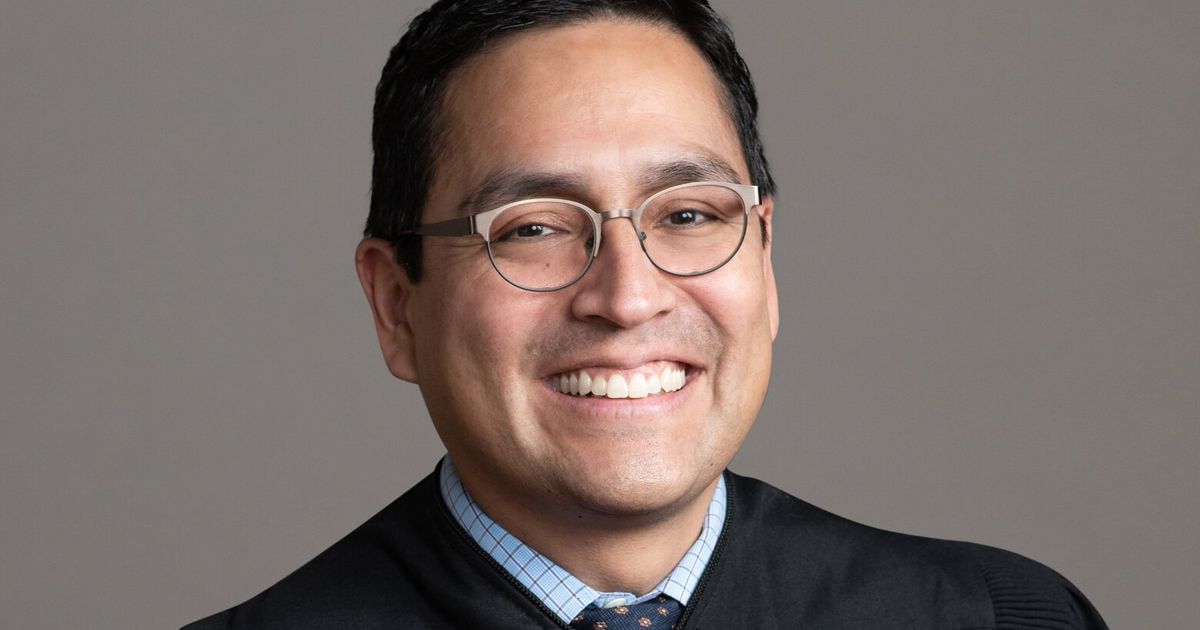
Judicial restraint, including the idea courts should limit decisions to resolving disputes before them in the narrowest possible way, should be an aspiration for anyone seeking to serve on Washington state’s Supreme Court. Michael Diaz combines a keen knowledge of the law with just that kind of measured temperament.
The former civil rights attorney is best cut out for the task in the Position 3 race for the state’s highest court.
Currently a judge on the state’s appellate court, Diaz is running to replace Justice Raquel Montoya-Lewis, who did not seek reelection. His breadth of judicial experience includes nearly five years on the King County Superior Court bench, prior to his appointment by former Gov. Jay Inslee to the Division 1 Court of Appeals in 2022. The 51-year-old also teaches constitutional law at Seattle University as an adjunct faculty member.
Born in Peru, Diaz’s family immigrated to the U.S. when he was an infant; he was the first in his family to go to law school. During his decadelong stint as an assistant U.S. attorney in Seattle, Diaz helped negotiate the consent decree that governed reforms of the Seattle Police Department, following a U.S. Justice Department finding the department routinely used excessive force, particularly on people in crisis.
In 2016, President Barack Obama nominated Diaz for a lifetime appointment on the federal bench but the Republican-controlled Senate wouldn’t allow a vote on his nomination.
Noting to the editorial board that jurists should not attempt to “slay dragons on every case,” Diaz characterized his judicial philosophy as having the humility to keep his decisions precisely aimed at “building the common law slowly over time.” That’s the kind of prudence the high court needs.
On the critical shortage of public defenders, Diaz suggested that the justice system pursue solutions akin to how healthcare providers embraced different levels of skill for different legal circumstances.
“We are about 50 years behind medicine,” he said.
That kind of thinking will be necessary to balance the constitutional rights of all who come into Washington’s system of justice with the struggling budgets of many courts around the state.
Diaz faces two opponents: Jaime Hawk, a King County Superior Court judge, former ACLU lawyer and public defender; and David Stevens, a Mason County Superior Court judge. Though these races are nonpartisan, Hawk, like Diaz, is heavily backed by Democrats; Stevens by Republicans. Tarnishing the court with open partisanship isn’t helpful to what ails it.
Hawk’s vague answers to the board and endorsement list suggests she’s more likely to veer out of the judicial branch and into the lane of legislative-like policymaking than her opponents. Diaz, with a track record of more than 200 appellate opinions, is the clear choice for the high court.
