

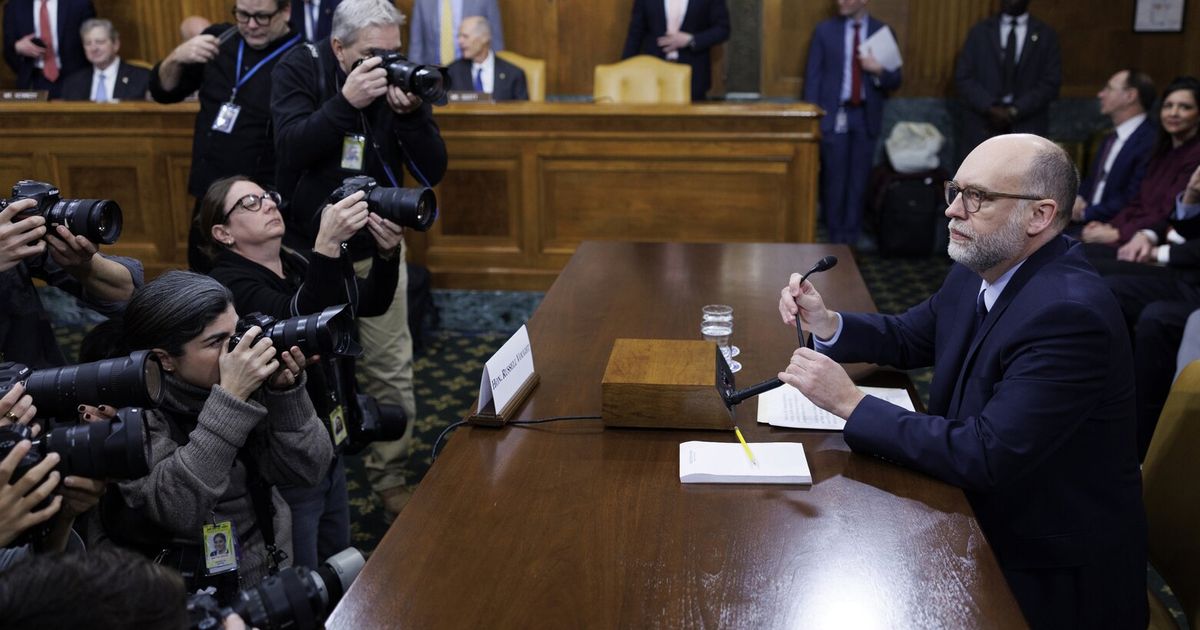
After 30 hours of U.S. Senate Democrats holding the floor to block the nominee for Office of Management and Budget chief, they lost last week’s roll call vote. But they did not go quietly. Not at all.
During the vote on Russell Vought, Democrat after Democrat defied the rule against continuing debate during a vote, often shouting their resistance. Sen. Ashley Moody, R-Fla., who was presiding over the Senate, gaveled each one down, repeating, “Pursuant to Rule 12, no debate is permitted during a vote.”
It was a sight to see.
In the end, Vought was confirmed by a party-line vote: 53 Republicans to 47 angry Democrats, united in their opposition.
“Our members did not want to vote quietly in the night,” said Sen. Patty Murray, who has held her office for 32 years. “We want people to know the dangers we are facing.”
“We are currently seeing the administration illegally taking funds,” said the Seattle Democrat and member of the Senate Appropriations Committee. ” … They need to find $1 trillion between now and September to extend tax cuts to the wealthiest. They are doing it now by fiat.”
While Elon Musk gets a lot of press for his brutal takeover of government systems and brash glee of feeding the U.S. Agency for International Development “into the wood chipper,” Vought arguably is the man behind the curtain, pulling the levers and stretching the separation of powers doctrine to the breaking point.
Not only is Vought the architect of Project 2025, the takeover plan Trump said he had never heard of during his campaign, he is an unabashed election denier. He even said so in writing in a Senate Budget Committee questionnaire during the confirmation process: “I believe that the 2020 election was rigged.”
As OMB director in the first Trump administration, Vought knows his way around the system and has inventively set the course for the governmental upheaval unfolding before the nation. Washington research institutions, like others across the country, are reporting major losses and interruptions of research, including medical trials. In Washington, pressure for federal employees to take buyouts threatens the integrity of the corps of shipbuilders, power grid minders and planners and workers at the Hanford nuclear reservation.
Writing in the Project 2025 document, Vought described the budget director’s job “as the best, most comprehensive approximation of the President’s mind.”
The OMB, he declared, “is a President’s air-traffic control system” and should be “involved in all aspects of the White House policy process,” becoming “powerful enough to override implementing agencies’ bureaucracies.”
In other words, he is telling the president that he doesn’t have to spend money the way Congress has appropriated it. He wouldn’t even answer Democrats who asked whether he would send appropriated money to Ukraine.
Yet Senate Republicans were not any more useful than bobbleheads in scrutinizing those dangers.
Cue Musk and his wood chipper. Vought provided the fuel and Republicans cleared the way.
The result is broken trust among lawmakers, which could come back to bite the administration and controlling Republicans. In less than a month, the federal government will run out of money when the latest continuing resolution expires.
Tight majorities, particularly in the House, might be a way to tether federal Republicans to some semblance of practical reality and a biting reminder of their responsibilities. After all, some of the most conservative members have vowed never to vote for a continuing resolution to keep government running.
With the House split currently at 218 Republicans to 215 Democrats, that could require Democratic votes for a solution.
Shutting down government is a tragedy to be avoided. But without assurances to Democrats that their Republican colleagues will honor any spending agreement, trust becomes a precious and elusive commodity.
“Republicans should be working in a bipartisan way, but they have shown no interest,” Rep. Suzan DelBene, D-Medina, a member of the House budget committee, said. “The question is whether any funding bill will be honored.”
Fresh from a meeting Wednesday, Murray said she told a Republican counterpart, “We need an understanding that this administration will spend on what you and I agree to.”
The situation is that dire.
“No one wants the chaos of a government shutdown,” she said. “But I don’t want to see our country lose something that is so important.
“They are going to need Democratic votes. They are in a bind.”
So, this is what senior Democratic members of Washington’s delegation are facing. But both Murray and DelBene say concerned Americans have a role to play.
Speak up. Resist tuning out. Call the White House. Call your federal representatives and help them document the challenges these drastic approaches are causing.
Public uproar over a Trump administration funding freeze memo caused it to be withdrawn for now.
However, not all funding has been restored, DelBene said, and she and others want to know about those situations and any other challenges.
The former Microsoft executive is particularly worried that Musk’s Department of Government Efficiency team is gaining access to taxpayers’ sensitive data. Noting that Trump suddenly fired 19 inspectors general last month without notice to Congress, DelBene said the loss of those watchdogs removes crucial accountability and oversight.
“The stories are very important,” she said. ” We want to track down the details.”
