

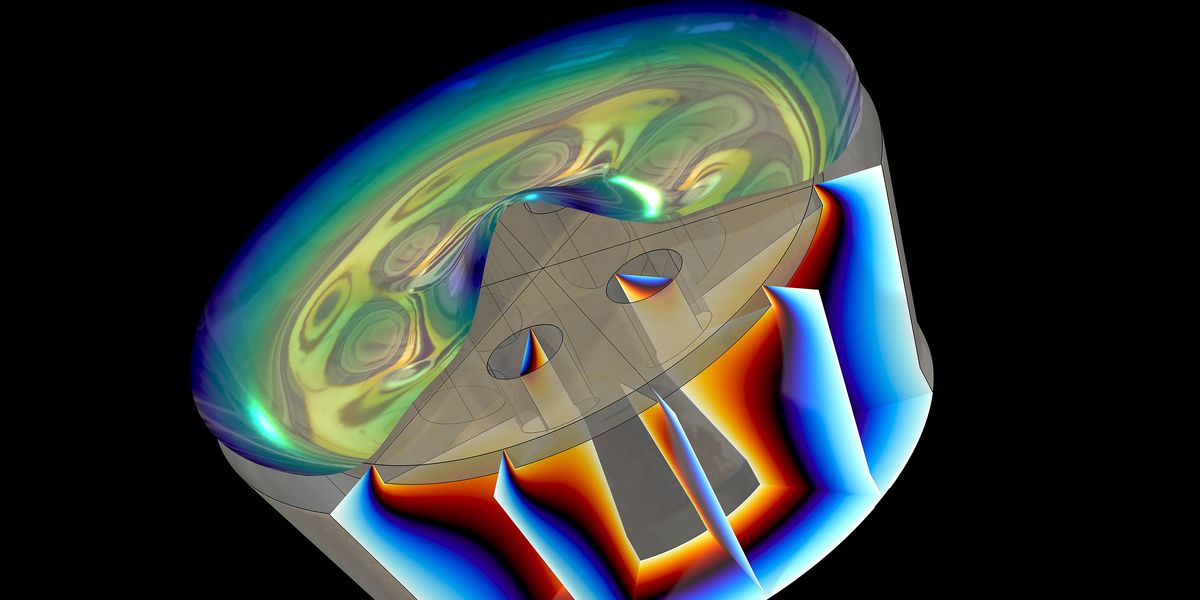
Physics simulations have a problem—engineers who need those simulations’ results often don’t have time to wait. Add in real-world settings with multiple independent calculations required (for example, separate thermal, mechanical, and electromagnetic elements in the system), and “multiphysics” computations that are both realistic and real-time might seem an either-or proposition.
Coders and modelers gathering in Burlington, Mass. this week will be exploring new inroads to multiphysics on-the-go in the COMSOL simulation software environment. Over three days of keynotes, workshops, and demos, COMSOL users will be weighing new approaches to resolving the simulation time crunch.
“Surrogate models are an interesting new technology where you take your fully-fledged multiphysics model and compress it down into a compact format that’s quick to evaluate using machine learning,” says Bjorn Sjodin, senior vice president of product management at the Stockholm-based parent company, also called COMSOL.
The challenge is more widespread than COMSOL alone, too. According to a review published earlier this year in the journal Procedia Computer Science, a range of industries face simulation bottlenecks where, the authors say, “executing high-fidelity simulation can take even weeks per design.”
Surrogate models, the Procedia authors note, involve whittling equations down to simplified versions of the larger simulation environments. In other words, the surrogates capture essential behaviors of specific systems being modeled but without so much computational overhead. Often this trimming-down process can involve strategically sampling the original complex model at key points, and then training a faster approximation that can predict results for new scenarios.
“You can evaluate these models instantaneously,” Sjodin says of COMSOL’s surrogate modeling system. “Whereas if you solve the full model with unknown inputs, it could take you 15 minutes. And people are very impatient.”
According to Sjodin, European automotive manufacturers are now using COMSOL’s surrogate models to rapidly simulate entire electric vehicle battery packs, enabling real-time decisions that managers and engineers had once needed to wait a coffee break or longer for. Meanwhile, Sjodin adds, a Swiss institute has deployed the COMSOL surrogate system as an app for Indian farmers to predict food spoilage in cold storage. The surrogate simulation, the institute found, enabled the farmers to reduce food spoilage by 20 percent.
COMSOL’s full numerical simulations predict performance of an antenna surface (right sphere), while its streamlined surrogate model (left sphere) arrives at nearly the same results in substantially less running time.COMSOL
Making Multiphysics Into an App
Sjodin says COMSOL intends to turn users of the simulation system into something closer to software developers in their own right.
“You can compile those apps into standalone executables that you can distribute around the world without any kind of license payment,” Sjodin says.
The company’s surrogate models, he says, are able to run as standalone applications, which can work on laptops or smartphones.
“If you want to give this to someone on the factory floor, these surrogate models are really useful because it allows you to evaluate and get results immediately,” Sjodin says. The models run quickly compared to the full multiphysics simulation because the app version of, say, a specific battery pack’s thermal performance and chemical composition comes pre-loaded. The simulation is fast, because it already has on hand pre-calculated parameters specific to the physical environment to be simulated—and only the environment to be simulated.
In addition to AI smarts that speed up the computing time for each run, COMSOL relies on other tricks as well. What modelers call “reduced order” models (ROMs) involve optimizations like mathematical pattern recognition and slimming down some of the more complicated equations in a calculation. “Neural networks come into play there, but also other technologies, more traditional reduced order modeling technologies,” he says.
For instance, in a 2024 industry-wide review of ROMs, researchers from Trieste, Italy’s International School for Advanced Studies described a range of ROM techniques that are based on more than just AI or neural networks.
“ROMs are divided in two big families: intrusive methods, in which one manipulates directly the governing equations, and non-intrusive methods, in which only the simulation data are considered,” the researchers wrote. The paper shows that a mixture of neural nets and more conventional mathematical ROM tools can achieve computational speedups up to 100,000 times as fast as models without ROM smarts added in.
From Your Site Articles
Related Articles Around the Web
