

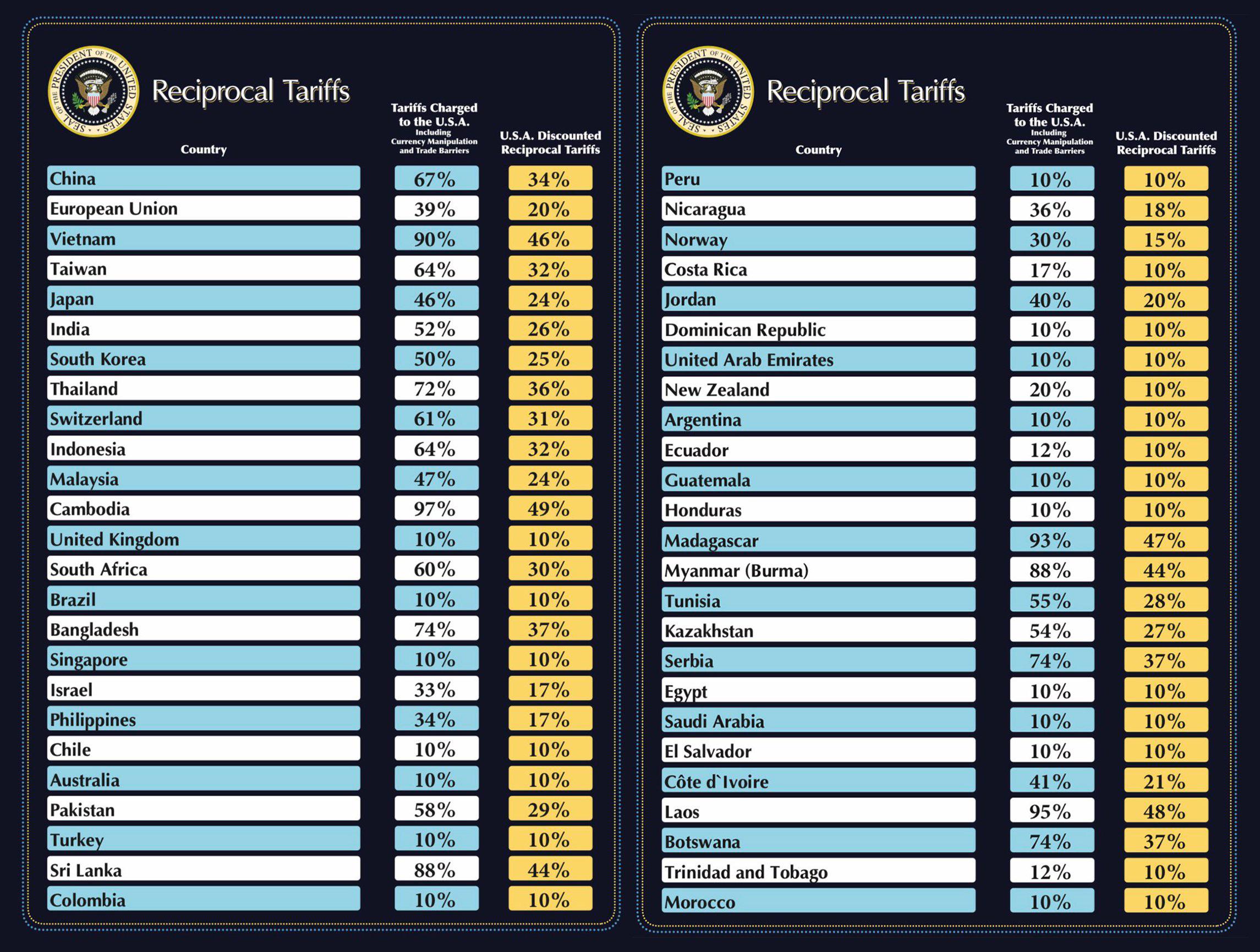
How did the Trump Administration come up with these tariff rates? Why would a nation like Madagascar, for example, with a small economy, be hit with a 47% tariff? Reciprocal tariffs were determined based on America’s trade deficit with other nations. They took each nation’s trade surplus with the US by total exports and divided that number by two, proclaiming we are asking them for half of what they have been charging the United States.
The assumption behind this method is that a trade surplus means one country is “taking advantage” of the other. However, trade imbalances do not function in such a cut-and-dry manner. The US runs trade deficits with some countries while running surpluses with others. The global economy is interconnected, and imposing arbitrary tariffs based on a deficit does not reflect the broader picture.
For example, China may have a surplus with the US, but it also imports raw materials from other nations to manufacture goods. If the US places a retaliatory tariff, it does not necessarily mean that China has been unfairly charging the US. China’s advantages of natural resources and lower production costs is part of the trade deal. There is a reason the US and China were one the largest trading partners, as China relied on American consumers the same way that America relied on cheaper Chinese goods. China was then investing in US debt, which it once viewed as a safe trade, but that is no longer the case, and America will suffer as a result. All of these measures are causing America’s trading partners to flee.
Look at Canada, where the population is far smaller than America’s, which is one of many variables. There is less demand overall and while Canada relied on the US for numerous imports, America was not subsidizing Canada. A trade deficit is not a subsidy! The US pays for Canadian goods and services with USD, which Canada then reinvests in the US economy. This is how global trade works; it is not a one-way street where Canada simply takes advantage of the US.
We cannot expect a complete balance in trading. Look at poorer nations—they simply could never purchase the same volume from America. Wages in these nations are far less than the US minimum wage, and thus, production is cheaper from a labor standpoint alone. For example, no one from Cambodia will be seeking an American-made car. A Cambodian factory will not move operations to the US to avoid the 49% tariff. They will look for alternative buyers outside of the US. Imbalances are a natural part of trade. Treasury Secretary Bessent said, “Let them eat flat screens,” but that is not the core of the issue. Americans did enjoy cheaper goods, but the bigger issue is that these tariffs make American investments LESS attractive as major companies cannot operate from a purely domestic standpoint.
The calculations do not factor in currency exchanges. Capital flows and currency values often influence trade deficits. If foreign capital flows into the US to buy Treasury bonds, real estate, or equities, it strengthens the USD, making US exports more expensive and imports cheaper. This is not a function of unfair trade practices but of the global demand for US assets.
By imposing tariffs arbitrarily, the cost of imported goods rises, which can negatively impact domestic industries who rely on those goods. Most American manufacturers rely on foreign goods to operate or finalize their “Made in America” products. Hiking up tariffs will cause the cost of production to soar. The workforce will shrink as profits decrease. Consumers bear the brunt of these policies through higher prices.
The assumption that tariffs should be determined by “half of the surplus” rule ignores the reality that trade wars are not linear. These tariffs are NOT “reciprocal” as the Trump Administration insists. They are not looking at the actual tariffs set by other nations. Those advising Trump believe that other countries will want to negotiate “tariffs” to permit free trade, but instead they are simply hoping to close trade deficits, and that simply cannot occur. Thursday’s sell-off is indicative of capital flowing out of the US. The Trump Administration basically told the world that America is closed for international business, and capital is responding to the threat. The real impact of these tariffs will soon come as we move deeper into a period of stagflation.

