

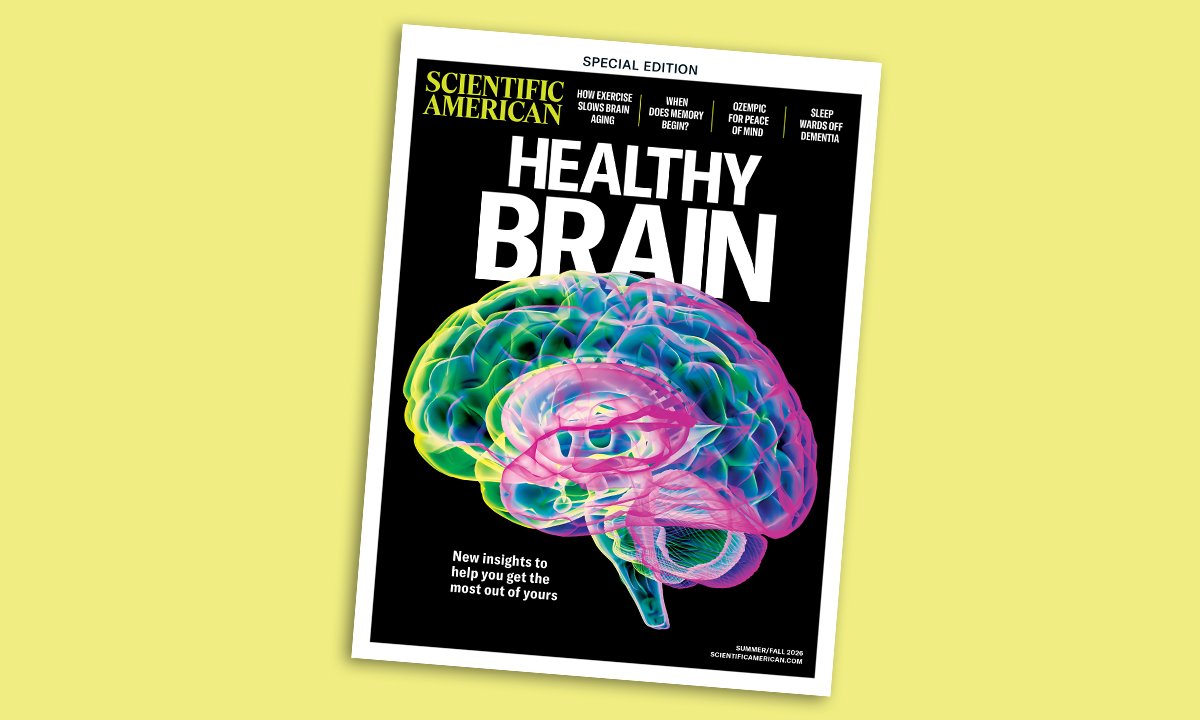
It took years, an international consortium and a small army of volunteer proofreaders. That effort led to the first full map of every neuron and synapse in an animal brain—139,000 neurons, 50 million connections, none of them left unaccounted for. The animal brain being mapped? A fruit fly’s. In comparison, the human brain has upward of 86 billion neurons, connected by some 100 trillion synapses. It is easily one of the most complex objects we know—including the universe itself. In this special edition, Scientific American surveys that complexity—the everyday mechanics of a working brain, what keeps it healthy or lets it fail, and the odder mysteries scientists have yet to solve.
The brain, it turns out, is less a fixed organ than a system in constant negotiation with the rest of the body and the world around it. Sleep, for instance, isn’t downtime but active maintenance, when the brain flushes out cellular waste in ways that may help stave off dementia. That body-mind entanglement means that physical exercise may slow cognitive aging in the long run; synchronized movements such as dancing forge surprisingly deep connections between people. And new weight-loss drugs are exposing the neural circuitry behind hunger, pleasure and satiety and, in the process, complicating what we thought about food addiction.
But even a well-tended brain can falter, and nowhere is that more apparent than in people with Alzheimer’s. A more nuanced picture of the disease is now yielding a wider range of treatment strategies, including those that involve insulin and immune-modulating drugs. Some hope lies in prevention, as evidence suggests diet, exercise and social engagement may lower one’s risk. Meanwhile new blood-based biomarkers are offering better detection.
On supporting science journalism
If you’re enjoying this article, consider supporting our award-winning journalism by subscribing. By purchasing a subscription you are helping to ensure the future of impactful stories about the discoveries and ideas shaping our world today.
If illness shows how memory can be lost, a parallel line of discovery is illuminating how it is built in the first place. The machinery switches on earlier than long assumed, as brain scans of infants reveal. Decades of work have now identified specific molecules that lock memories into place, with the search for others underway. And it turns out the act of forgetting may be less a flaw than a feature: everyday memory lapses are increasingly understood to be part of how learning happens.
Minds can be found everywhere in nature, often in places we’d never think to look for them—even without a brain to house them, clusters of cells no bigger than a speck can learn, remember and make surprisingly complex decisions. Consciousness itself can hide in unexpected places, too, with some patients in comas who seem entirely unresponsive revealing signs of a mind at work.
The search for awareness is now centered on machines, with the debate over artificial-intelligence sentience forcing scientists to take a hard look at what cognition and consciousness actually mean. The discourse is reshaping how we see other species as well. Growing evidence of even insects’ cognitive sophistication raises real ethical questions about how we should treat them.
The complexity of the mind guarantees that generations of scientists to come will be well occupied trying to understand it. But the tactics to help yours thrive are refreshingly unmysterious: whole foods, sleep, movement, friends. You don’t need to solve the brain to take good care of it.
Subscribe to Support Independent Journalism
Great science journalism requires human expertise, time, effort and creativity. And it costs money. That’s why I and the journalists here at Scientific American hope you’ll join our community.
When you subscribe, you are supporting staff and freelance journalists who are passionate about telling science stories that are true, important and compelling. Our editors and reporters are often experts in their fields, which means they understand the nuances of big discoveries and can untangle the breakthroughs from the hype. With a subscription, you are also supporting rigorous fact-checking to ensure the words we publish are precise and accurate. And you’re supporting original illustrations, graphics and photos that bring you closer to an advanced laboratory, an ice sheet in Antarctica or a space mission in orbit. You’re helping us craft other types of high-quality journalism as well: Our newsletters are carefully written, edited and curated by staffers you have or will come to know and love. Our Science Quickly podcast is based on original reporting, collaboration with editors and scientists and exacting production.
Subscriptions keep this engine running so we can continue to deliver thoughtful, rigorous and independent science journalism to you. In an era of viral misinformation, this work is crucial. If you value what we do, I hope you’ll consider joining us as a subscriber
