

Feedback is New Scientist’s popular sideways look at the latest science and technology news. You can submit items you believe may amuse readers to Feedback by emailing feedback@newscientist.com
Egg versus ground
Feedback still gets pulse-raising flashbacks to the lockdown of early 2020, when we were home-educating Feedback Jr and consequently had to teach said child how to do things that we didn’t ourselves know how to do. A substantial amount of time was consumed doing various science-themed activities, like looking for “mini-beasts” and setting up experiments, but at least we were spared the pain of the egg drop experiment.
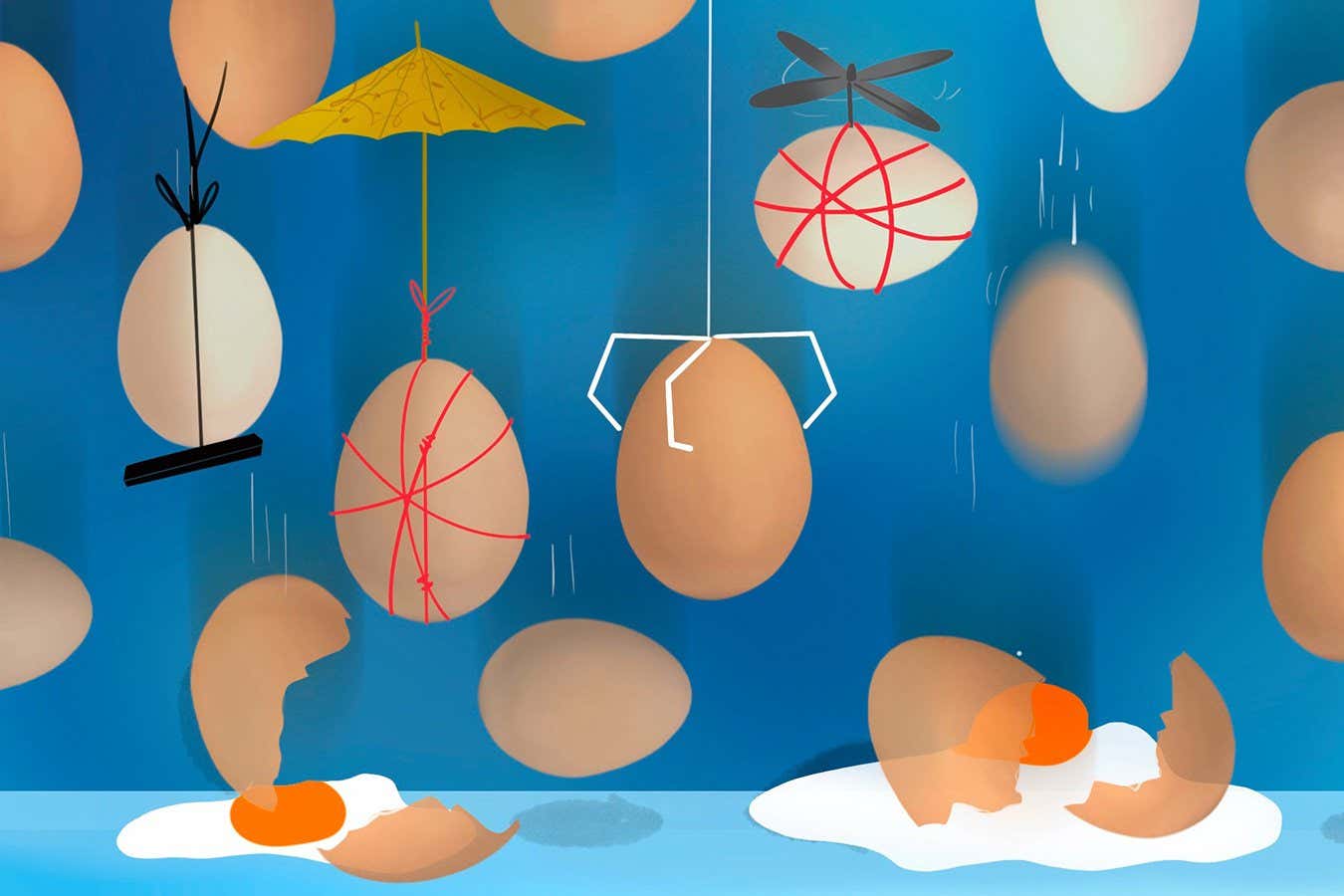
This classic science practical challenges kids to design a device that will protect an egg from cracking if you drop it onto a hard surface from a specified height. Feedback would probably glue a cocktail umbrella to the egg, in the hopes that this makeshift parachute would slow its fall, then call it a day and go to have an actual cocktail. Others, however, take the egg drop experiment more seriously.
Hence the study published in Communications Physics on 8 May – although we note it was accepted on 1 April, which seems telling. Physics reporter Karmela Padavic-Callaghan describes the endeavour as “egg drop experiment but make it peer review”.
The researchers “contest the commonly held belief that an egg is strongest when dropped vertically on its end”. This refers to the conventional wisdom that, if you drop an egg with the blunt end down, it should be less likely to break, because the shell has more stiffness in the vertical direction.
By conducting “hundreds of experiments”, supplemented with “static and dynamic simulations”, the researchers determined that eggs are actually more likely to break if they land vertically, so you are better off dropping them horizontally.
They say: “Orienting the egg along its equator allowed it to reach 0.3 mm higher than in the vertical orientation without cracking, confirming a real albeit small advantage of dropping the egg along its equator.”
If any readers are planning to throw eggs at any prominent public figures, you now have empirical guidance on how to ensure they break on impact.
Alien maths
Will we ever know what unidentified aerial phenomena (UAP), previously known as unidentified flying objects (UFOs), really are? Almost certainly not, according to a paper by Karim Daghbouche at German non-profit organisation GridSAT Stiftung.
Suppose you see a flying saucer or something else weird in the sky. You could use reverse engineering to work out what it is. By studying how it manoeuvres, you can make inferences about what kind of engine it has, and so forth. But, says Daghbouche, reverse-engineering UAPs is extremely difficult. Due to “the inherent challenges in data-gathering” and the possibility of “unknown physics”, inferring anything concrete like “unconventional propulsion systems” will always be “computationally intractable”.
In fact, says Daghbouche, the mathematical problem is so hard that it is “NP-complete“: a maths term for a specific type of ultra-difficult problem. Worse, it “may escalate to PSPACE-hard or to an Entscheidungsproblem“. The latter, for those not versed in this kind of mathematics, is genuinely impossible.
News editor Jacob Aron says, simply, “Incredible”. Feedback is inclined to agree: if your set of possible explanations includes aliens with unimaginable technology, plus time travellers and visitors from alternative dimensions, it’s going to be tricky to focus in on just one answer.
This might be another instance of a “no shit Sherlock”, a scientific study that works through a great deal of complexity only to arrive at a blindingly obvious conclusion. But is it really an NSS if it’s NP-complete?
Of course, one might consider the more human-centric explanations for UAPs, which rely on concepts like “honest mistake”. In which case, the problem ceases to be NP-complete and becomes decidedly tractable.
Feedback was struck by the final line of the paper’s abstract, where it says that, due to the difficulty of figuring out what they are, “UAP are as analogous to modern smartphones in the hands of Neanderthals”.
Feedback is pretty sure that a Neanderthal would be able to figure out how to use an iPhone, and, for that matter, to develop a semi-sensible interpretation of UAPs.
Squared away
Since we’re in a mathematical frame of mind, Brendan Ashe writes in to point out that we are in a square year: 2025 is 45². There won’t be another one until 2116.
This reminded Brendan of a curious experience a few years ago. Enduring a long car journey, he and his son passed the time by googling famous people who were born in one square year and died in the next. There weren’t many, but Russian neurologist Ivan Pavlov (of dogs and bells fame) “was born in 43 squared [1849] and died in 44 squared [1936]”.
Then there came a dark twist. As Brendan relates: “We were also excited to note that Pope Francis was born in 44 squared, and I immediately foretold the Pope’s death in 2025.”
There is a special psychological hell for those of us who make a throwaway joke like this, only for it to come true. “Now my prophecy has been fulfilled, I can’t help wondering how guilty I should feel,” says Brendan.
Got a story for Feedback?
You can send stories to Feedback by email at feedback@newscientist.com. Please include your home address. This week’s and past Feedbacks can be seen on our website.
