

(Editor’s note: This column is part of a Seattle Times Opinion series exploring the First Amendment and its five freedoms.)
In today’s political culture, it’s hard to avoid spiraling into fatalism: That we, the people, don’t stand a chance against the rich, powerful interests that seem to run everything. The belief that the deck is perpetually stacked against us, the system was rigged from the get-go, and attempts to speak up and do something about it are pointless.
Fortunately, the nation’s founders provided an antidote to all this: The little-known petition clause, nestled at the end of the First Amendment of the U.S. Constitution. Its principles are being used right now, in just about every part of America.
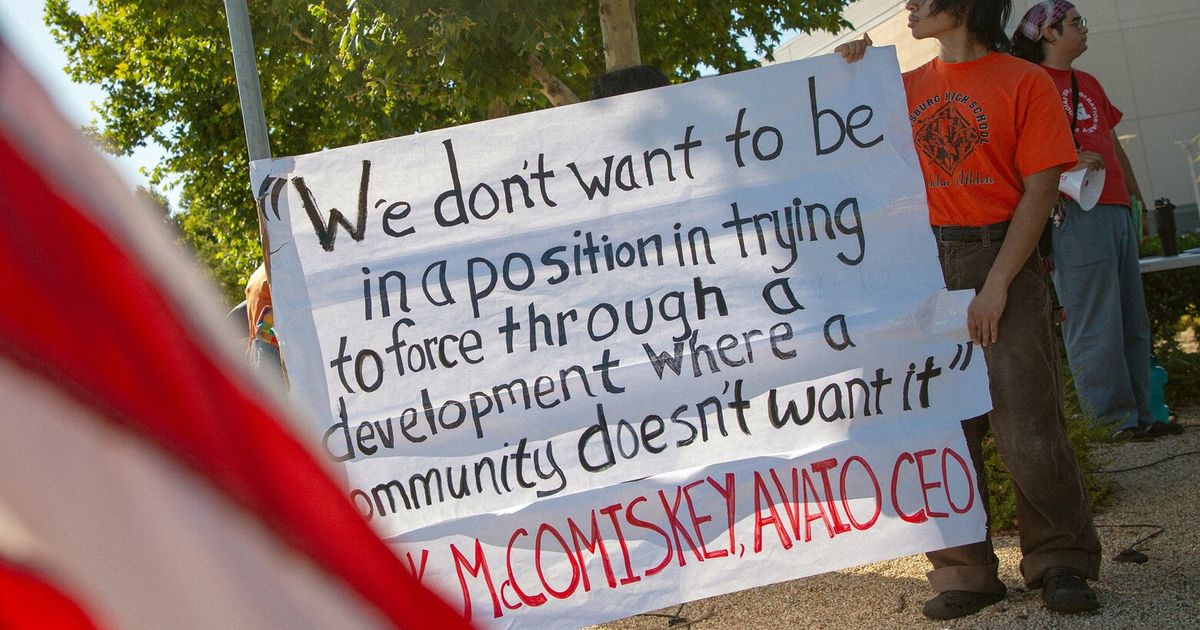
Don’t believe me? Witness the backlash against AI-enabling data centers around the country. From Pittsburg, Calif., to Altoona, Pa., Americans are signing online petitions and grabbing the mic at meetings of their local city councils, county commissions and just about every local seat of power.
And, given the vast numbers of moratoriums local officials have adopted in response, I’d say these grassroots efforts are proving wildly effective.
Some may confuse this groundswell with Americans’ far better-known freedom of speech, which is also enshrined in the First Amendment. But more accurately, it is the underappreciated ability to petition our government for a redressing of grievances. They’re putting into action what fictional news anchor Howard Beale, portrayed by actor Peter Finch in the 1976 movie “Network,” said plainly: “I’m as mad as hell, and I’m not going to take it anymore!”
The petition clause, as it’s known, is the last of the five freedoms listed in the First Amendment’s 45 words: “Congress shall make no law … abridging the right of the people … to petition the Government for a redress of grievances.”
I like to think of it this way: That America’s founders put a little red button in the Constitution, free for all to use when it becomes necessary to speak out against injustice; to try to right a wrong.
That right to petition underpins our right to tell the government to fix something, without fear of prosecution or retribution. Its legal roots go all the way back to the English Magna Carta more than eight centuries ago, declaring the governed could “claim immediate redress” for the king’s transgressions.
“It is a mechanism that forces the government to come to grips with problems the citizenry feel have not been adequately dealt with by the society,” constitutional scholar, professor and longtime civil liberties attorney Burt Neuborne said in a podcast hosted by the National Constitution Center. “And you can’t sweep it under the rug.”
Because the Constitution lacks an explicit right to file a lawsuit, the petition clause also forms the basis for our access to the judicial system — to sue the government and pursue a remedy in the courts, according to Andrew Siegel, at Seattle University.
But in the early days of the republic, its use was more literal. John Quincy Adams, the only president who spent his post-White House career as a member of the House of Representatives, repeatedly brought thousands of signatures protesting slavery to the halls of Congress, including from the enslaved themselves.
But, as Neuborne notes, the U.S. Supreme Court has over time emphasized the First Amendment’s speech clause and “construed the petition clause as a kind of exercise of speech.”
Still, the petition clause stands as an enduring beacon against dark forces metastasizing in American politics. Consider that despite all 435 seats in the U.S. House of Representatives, just 21 — less than 5% — of them are deemed “toss-ups” by the Cook Political Report. European monarchies have greater churn. Gerrymandering serves to silence blocks of voters. Even in Washington state, just three of its 49 legislative districts currently have both Republican and Democratic representation, an imbalance that means sizable chunks of the electorate feel left out of the priorities of their elected lawmakers. A direct way to redress grievances is all the more critical given that landscape.
And the right to petition didn’t stop at the U.S. Constitution. It also galvanized the authors of state constitutions to include their own such clauses. Forty-eight of them did, including Washington. This state’s Article I, Section 4 declares that “The right of petition and of the people peaceably to assemble for the common good shall never be abridged.”
This right is still being tested in Washington’s court system and was even recently back before its Legislature in Olympia. In 2021, Sen. Jamie Pedersen, D-Seattle, and former Sen. Mike Padden, R-Spokane, teamed up to pass the Uniform Public Expression Protection Act, or UPEPA. Yes, the title’s a bit drab. But the law prevents powerful forces from filing lawsuits as an intimidation tactic against regular Joes and Janes who bravely speak up for their communities and themselves.
In an editorial, The Times’ editorial board noted that without the law, a high-powered company, could drag people into court who question “an office park precariously close to some wetlands or a sweetheart tax break to bring jobs to town.” Those who had the courage to raise their voices could face steep legal costs and years embroiled in such litigation.
“Courts shouldn’t be a tool that moneyed interests can use to bludgeon people into silence,” the board wrote. “Democracy works best when all voices have a chance to be heard without fear of litigious retribution.”
But underneath it all, the petition clause makes those voices possible. It proves that, even in an age when so many feel powerless in the modern political environment, that our active participation matters — and can sometimes bring lasting change, according to Thomas Mann, a political-science professor at Seattle University.
“Even if it doesn’t ‘feel’ like it, even if at times it seems hopeless, there are still mechanisms that, despite everything, can work if enough people put pressure on the government via every organ of petition available,” he said.
Think again about the public pressure on data centers. Everyday citizens are showing up, exercising their right to push back against server farms whose power and land use could fundamentally change communities. They may not realize it, but the power to petition governments at all levels to redress grievances is the right that made it possible.
