

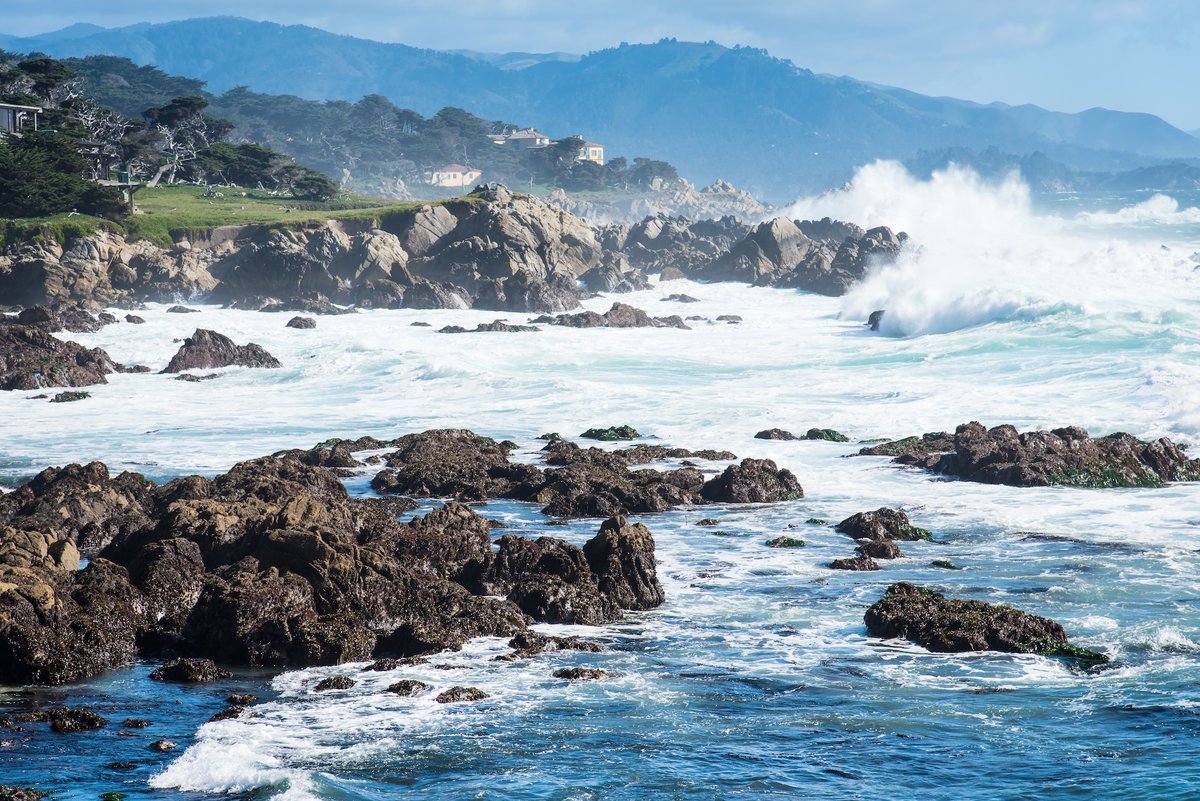
A slow-moving surge of water called a Kelvin wave is arriving in southern California and looks to be about as large as these waves can get. Though it’s not like the wall of water from a tsunami, the pulse is expected to cause record-breaking sea levels and coastal flooding across the state.
It’s also potentially a preview of what California’s sea levels will look like decades from now because of climate change, says Daniel Swain, a climate scientist at University of California Agriculture and Natural Resources. “What we’ll see at the worst this winter will be something that is closer to the norm later this century in terms of sea level,” he says.
The Kelvin wave, which is currently pushing sea levels about a foot above normal in southern California, originated at the equator as part of the superstrong El Niño happening right now. Normally, trade winds push warm water toward the western tropical Pacific. In El Niño years, these winds weaken or reverse. This bulge rolled slowly east until it hit the northern coast of South America. Blocked by the continents, it spread north and south, becoming what’s called a coastally trapped Kelvin wave. The Coriolis effect caused by the planet’s rotation then pinned the waves against the western coasts of North and South America, preventing the water from sloshing back out to sea.
On supporting science journalism
If you’re enjoying this article, consider supporting our award-winning journalism by subscribing. By purchasing a subscription you are helping to ensure the future of impactful stories about the discoveries and ideas shaping our world today.
Kelvin waves are a typical feature of El Niño, says Severine Fournier, an ocean circulation researcher at NASA’s Jet Propulsion Laboratory in California. This year the first such wave originated in January, and several arrived in May and June. And more Kelvin waves are developing and expected to arrive in the next several months. The waves move at about 125 to 155 miles per day, so they take a couple of months to cross the Pacific and about a week to crawl up the California coast.
The one hitting now is about as big as Kelvin waves get, Swain says. “This is an unprecedented El Niño event with extremely strong westerly wind bursts,” he says. The strength of these winds determines how much water sloshes across the ocean. The sea-level rise caused by Kelvin waves typically tops out at about 18 inches, Swain says. California may see sea levels rise by around 14 inches this winter because the size of the bulge attenuates as it reaches the coast like ripples spreading from a rock tossed in a pond, he adds.
That’s not the West Coast’s only problem, though—several factors will exacerbate coastal flooding.
For one, water expands at it warms, and this year’s strong El Niño is expected to bring record-breaking warm water to the California coast. “The temporary ocean level elevation from the combination of these Kelvin waves themselves plus the thermal expansion associated with El Niño could be on the order of two feet or even a little bit higher,” Swain says, “and that’s a very alarming number.”
California also sees seasonal extreme high tides known as “king tides” in November through January that will further push water onshore. And then El Niño also raises the chances of storms in the Pacific, making storm surges more likely this winter. “Particularly in southern or central California, we tend to get stronger waves than usual during El Niño,” says Mark Merrifield, an oceanographer at the Scripps Institution of Oceanography at the University of California, San Diego. The result will likely be serious coastal flooding and beach erosion.
All of these effects presage what the state may have to deal with as the planet continues to warm because of continued fossil fuel burning.
Climate change has already driven sea levels up by about eight inches over the past century in San Francisco and La Jolla, Calif., according to a 2022 state-level report. (Local sea rise can differ depending on whether geological forces are also simultaneously pushing up coastlines.) There is uncertainty about future rise, depending on the rate of the planet’s melting of the ice caps, Swain says, but “we expect at least another two feet of sea level rise in California [later this century].” That forecast is similar to the temporary rise that is expected this winter.
“What it really tells us is: if our infrastructure can’t handle this winter,” Swain says, “that means it definitely won’t handle that being the average condition.”
Subscribe to Support Independent Journalism
Great science journalism requires human expertise, time, effort and creativity. And it costs money. That’s why I and the journalists here at Scientific American hope you’ll join our community.
When you subscribe, you are supporting staff and freelance journalists who are passionate about telling science stories that are true, important and compelling. Our editors and reporters are often experts in their fields, which means they understand the nuances of big discoveries and can untangle the breakthroughs from the hype. With a subscription, you are also supporting rigorous fact-checking to ensure the words we publish are precise and accurate. And you’re supporting original illustrations, graphics and photos that bring you closer to an advanced laboratory, an ice sheet in Antarctica or a space mission in orbit. You’re helping us craft other types of high-quality journalism as well: Our newsletters are carefully written, edited and curated by staffers you have or will come to know and love. Our Science Quickly podcast is based on original reporting, collaboration with editors and scientists and exacting production.
Subscriptions keep this engine running so we can continue to deliver thoughtful, rigorous and independent science journalism to you. In an era of viral misinformation, this work is crucial. If you value what we do, I hope you’ll consider joining us as a subscriber
