

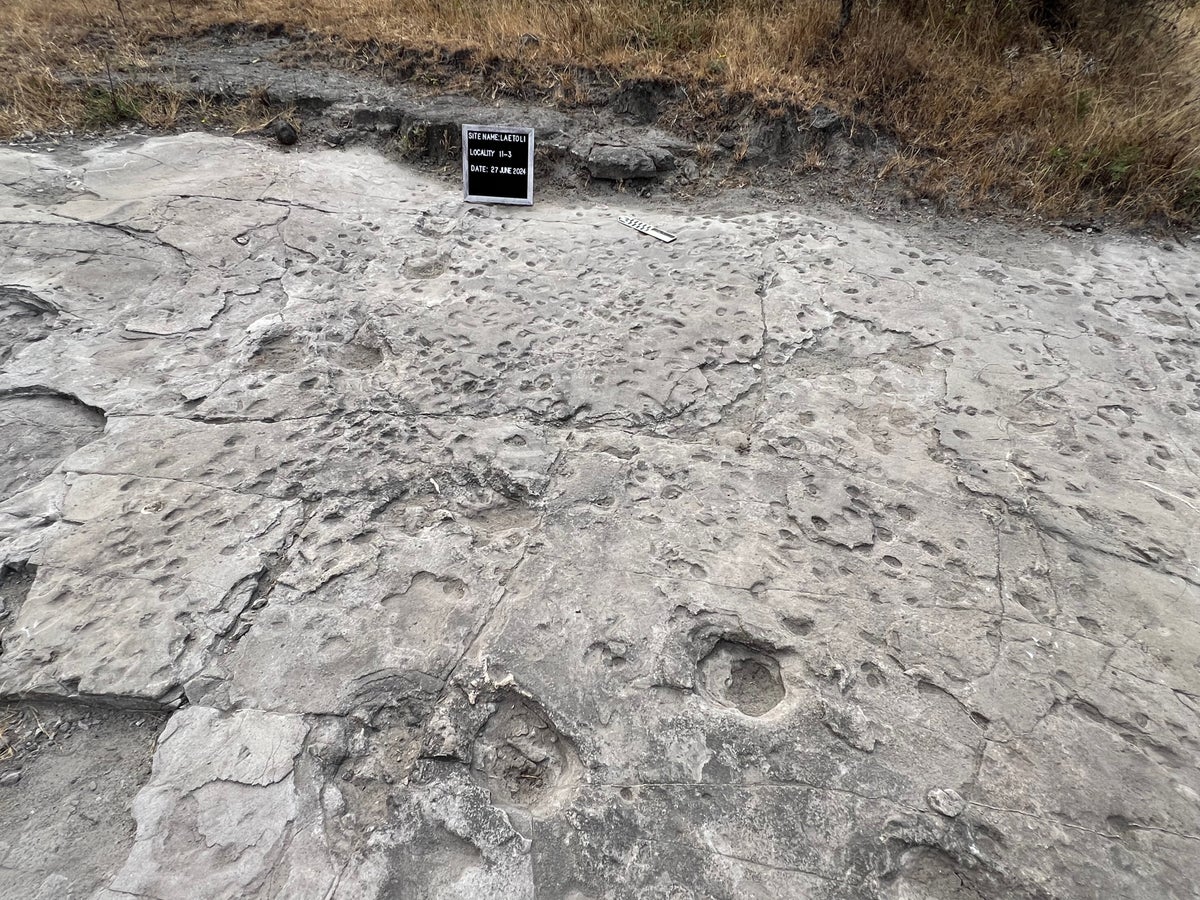
The oldest-known hominin footprints are in danger of being destroyed by state-backed tourism and other economic activity, a new investigation claims. The Laetoli site contains 3.66-million-year-old fossil footprints made by Australopithecus afarensis, the same species as the early human ancestor known as “Lucy.”
Laetoli is one of several archaeological sites that are under threat in Tanzania, according to the new report, which was published today in the journal Antiquity. The paper’s co-authors Elgidius Ichumbaki and Peter Schmidt argue that Tanzanian state groups charged with safeguarding Laetoli and three other sites that are critical to human history have dismissed the concerns of conservationists and local communities in the interests of tourism.
The Tanzanian Ministry of Natural Resources and Tourism, which has overall responsibility for the nation’s heritage sites, did not respond to a request for comment.
On supporting science journalism
If you’re enjoying this article, consider supporting our award-winning journalism by subscribing. By purchasing a subscription you are helping to ensure the future of impactful stories about the discoveries and ideas shaping our world today.
The three other sites are ruins at Kilwa Kisiwani, an island and UNESCO World Heritage Site; rock art at Kondoa, also an UNESCO World Heritage Site in the Dodoma region of Tanzania; and the Kaiija shrine and early Iron Age metal works in Katuruka, west of Lake Victoria.
Ichumbaki, a former student of Schmidt’s and now an associate professor at the University of Dar es Salaam in Tanzania, points to a 2008 shift in government priorities to try to monetize these heritage sites by bringing in more tourists. The infrastructure and buildings needed to support that tourism were constructed without impact assessments required by Tanzania and, in the case of the World Heritage Sites, international policy, according to the study. Heavy machinery and laborers who were untrained in preservation best practices damaged the sites in the construction process, the authors say. At the same time, the Tanzanian government gave organizations without special training in the preservation of heritage sites more oversight of these places, the authors wrote.
In the case of Laetoli, Ichumbaki says, “one would have expected at least as much care is done before the construction of the buildings.” Instead “it is done so crudely…, a major building put on the site in the middle of the footprints, basically.”
Schmidt, an emeritus professor of anthropology at the University of Florida, who has conducted field research in Tanzania for almost six decades, adds that a new path at the site to facilitate tourist visitors was constructed on top of more recent but still ancient footprints that the local Maasai people had held sacred. “Those footprints were impacted by this infrastructure based on the policy of commodification of heritage,” he says.
The Laetoli site includes fossil footprints believed to have been made by Australopithecus afarensis—the ancient hominin known as “Lucy.”
Dave Einsel / Stringer via Getty Images
“Sites like [Laetoli] are really exceptional because they give you just a window into the world as it existed millions of years ago,” says Kevin Hatala, an associate professor at Chatham University in Pennsylvania, who conducts research on early hominin footprint sites in Tanzania and Kenya but was not involved in the new study. “You have this landscape there, at Laetoli, with these volcanic ash layers that extend over kilometers and kilometers, and you can pick up little snapshots of the animals that existed within that landscape, as well as, of course, the hominins who lived in that landscape, too.”
“The footprints demonstrate without a doubt that walking on two legs (bipedalism) is an ancient human adaptation,” says Jeremy DeSilva, a paleoanthropologist at Dartmouth College, “that walking upright was the key evolutionary innovation that launched this marvelous human experiment.” DeSilva was also not involved in the new study.
Ichumbaki and Schmidt say they hope their report will spark urgent action by the Tanzanian government and international groups to conserve Laetoli and other Tanzanian heritage sites for the future. Engaging local communities will be key to this effort, they say. For example, the Kaiija site has deep spiritual and cultural meaning to the Haya people (Ichumbaki is Haya). And in the past, the community has acted as stewards of the site.

This composite image shows buildings constructed at the Laetoli site, and a path constructed through the site to allow visitor access.
Peter Schmidt, Elgidius Ichumbaki
“In many cases, heritage sites hold significant meaning and connections for local communities, even when, from a scientific perspective, they may appear far removed from contemporary community life,” says Purity Kiura, an archaeologist at the National Museums of Kenya, who helps manage conservation of early hominin sites in the country and was not involved in the new study. She points to work on conserving a 1.5-million-year-old footprint site in northern Kenya, where she and other researchers engaged with the local community to learn more about the site’s cultural importance.
“The footprint site is not only a scientific resource but also a place that is deeply connected to the community’s identity, traditions, history and values,” she explains. “Consequently, strengthening the community’s expertise and capacity to participate in its management and preservation was a critical component of the project.”
At sites such as these, balancing conservation with the desire to generate tourism revenue and bolster local economies is fraught with challenges. “There’s always going to be that risk when you’re constructing something permanent on top of an unexplored area … that could conceal something that’s really interesting and important that we will never know about,” Hatala says. In the case of Laetoli, there really is nothing else like it in the world, he adds. If it is damaged, then whatever was lost is gone for good. Footprints across a landscape can’t be locked up in a museum.
It’s not too late to save such sites, however, Schmidt and Ichumbaki say. “The most fundamental step is that there be internal change because external forces have only limited effect,” says Schmidt, referring to Tanzanian state officials. “They have the capacity, they have the instrument by which change can be affected.”
“The sites are at a critical situation at the moment, and the time to act is now,” Ichumbaki says. “We shouldn’t really continue waiting to see these sites being destroyed in the name of development. The government in Tanzania and the international community need to intervene to say something must be done to salvage the sites. It is either now or never.”
