

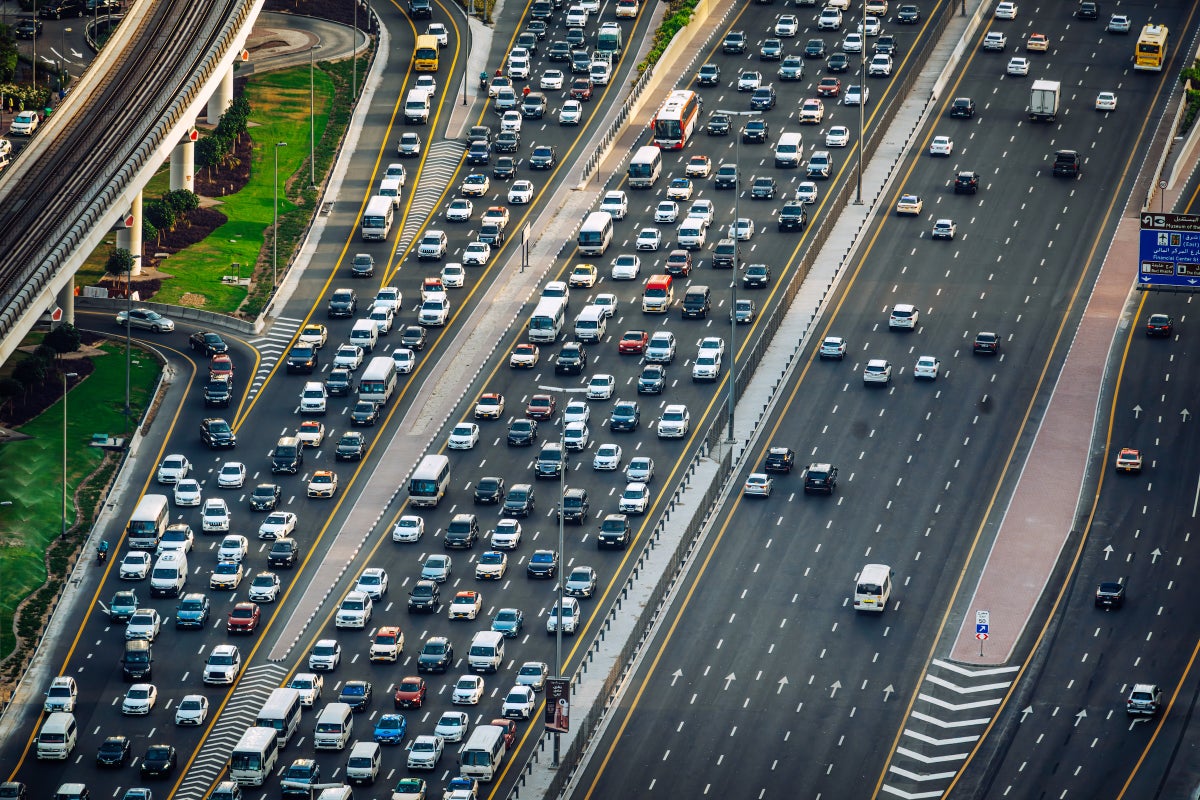
Millions of people will take to the roads this holiday season, only to end up spending frustrating hours sitting in traffic jams. Congestion costs drivers time, fuel and patience – while also increasing pollution and placing huge pressure on transport networks.
If you’ve ever found yourself staring enviously at the lane next to you, convinced it’s moving faster, you’re not alone. Most of us instinctively believe that changing lanes will get us home sooner. But mathematics suggests this intuition is usually wrong.
As an applied mathematician, much of my research is driven by one question: how can we predict and control the behaviour of complex systems operating under uncertainty? And this can apply as much to holiday traffic as it does to emerging quantum technologies.
On supporting science journalism
If you’re enjoying this article, consider supporting our award-winning journalism by subscribing. By purchasing a subscription you are helping to ensure the future of impactful stories about the discoveries and ideas shaping our world today.
We tend to think traffic jams need a trigger: an accident, roadworks or a lane closure. Yet some of the most frustrating queues have no obvious cause at all. These are known as phantom traffic jams—stop-start waves that travel backwards through traffic even though every vehicle is moving forwards.
In 2008, Japanese researchers asked 22 drivers to drive around a circular track while maintaining a constant speed and safe distance from the vehicle in front. Within minutes, tiny and unavoidable differences in braking and reaction times grew into a stop-start wave that travelled continuously around the circuit, despite there being no obstacle anywhere on the road.
The explanation is surprisingly simple. One driver brakes slightly more than necessary. The driver behind reacts a little later and brakes a little harder. The next driver does the same.
In this way, the initial tiny disturbance grows as it travels backwards until drivers hundreds of metres behind are forced to stop completely, even though nobody can identify what caused the queue in the first place.
The mathematics behind traffic
Rather than modelling every driver individually, mathematicians treat traffic as a continuous flow – borrowing ideas from fluid dynamics, where the movement of vehicles is analysed much like the flow of water through a pipe.
One of the simplest relationships in traffic flow theory is q = ρv, where q is the traffic flow (the number of vehicles passing a point each hour), ρ is the traffic density (amount of cars on the road) and v is their average speed.
This deceptively simple equation explains a counterintuitive phenomenon. Initially, adding more vehicles obviously increases the overall traffic flow, as more vehicles pass along the road.
But once the road becomes too crowded, everyone is forced to slow down. Eventually, this reduction in speed outweighs the increase in number of vehicles such that the overall flow is reduced.
The equation shows there is an optimal traffic density that maximises the number of vehicles passing through the road each hour. Beyond that point, adding more cars reduces the efficiency of the road – and increases the time it takes everyone to get to their destination.
The same mathematics explains why constantly changing lanes is rarely worthwhile.
A lane change creates a small disturbance that neighbouring drivers must react to. If many drivers behave in the same way, these disturbances accumulate and increase the likelihood of traffic waves. So, what feels like a clever decision for one driver can ultimately make conditions worse for everyone.
Can maths help reduce traffic jams?
In my research on probabilistic mathematical methods, I develop approaches that combine prediction, coordinated decision-making and feedback to keep complex systems stable, even when the available information is incomplete or “noisy” (full of extraneous data).
In traffic, the disturbances we seek to prevent are the stop-start waves that create phantom traffic jams. In other complex systems, they might be power failures, communication bottlenecks or unstable autonomous systems.
Rather than designing solutions for one specific application, applied mathematicians develop general mathematical frameworks. That’s one reason why ideas originally developed for engineering systems can also help us think differently about traffic – with each of our mathematical tools playing a different role:
-
Signal processing transforms measurements from road sensors, cameras and connected vehicles into useful information.
-
Stochastic modelling accounts for uncertainty arising from driver behaviour, weather conditions and changing traffic demand.
-
Machine learning identifies patterns in all this data, and forecasts where congestion is likely to develop.
-
Control theory then closes the loop by determining how traffic systems should respond, whether by adjusting traffic-light timings, introducing adaptive speed limits, recommending alternative routes or coordinating fleets of autonomous vehicles.
Rather than optimising the journey for one driver, the objective becomes improving the performance of the entire traffic network.
Perhaps the most striking demonstration came in 2018, when researchers repeated the Japanese circular-track experiment with one key difference. They replaced one of the human-driven vehicles with a single autonomous car, programmed to accelerate and brake smoothly.
Remarkably, that one vehicle, less than 5% of the traffic, was enough to dampen the stop-start wave around the entire circuit, improving traffic flow and reducing fuel consumption for every driver involved.
Tips for your next car journey
Traffic congestion is unlikely ever to disappear completely. Population growth, increasing travel demands and the unpredictability of human behaviour will always put pressure on our roads.
But mathematics is helping us move away from reacting to congestion, towards preventing it.
One important aspect is understanding how large networks of interacting agents can make coordinated decisions using only local information, without requiring every component to know the state of the entire system. These ideas are central to the design of intelligent transport systems, where connected vehicles and infrastructure must cooperate to improve traffic flow.
In the meantime, if you’re about to set off on holiday in your car, here are three driving tips all backed up by strong mathematical evidence. If everyone adopts them, this should reduce the time you spend in traffic queues.
-
Maintain a safe following distance;
-
Accelerate and brake smoothly;
-
Resist the temptation to keep switching lanes in search of tiny gains.
Applied mathematics shows the fastest way to your destination isn’t to drive more aggressively. It’s to help keep the entire system stable.
This article was originally published on The Conversation. Read the original article.
