

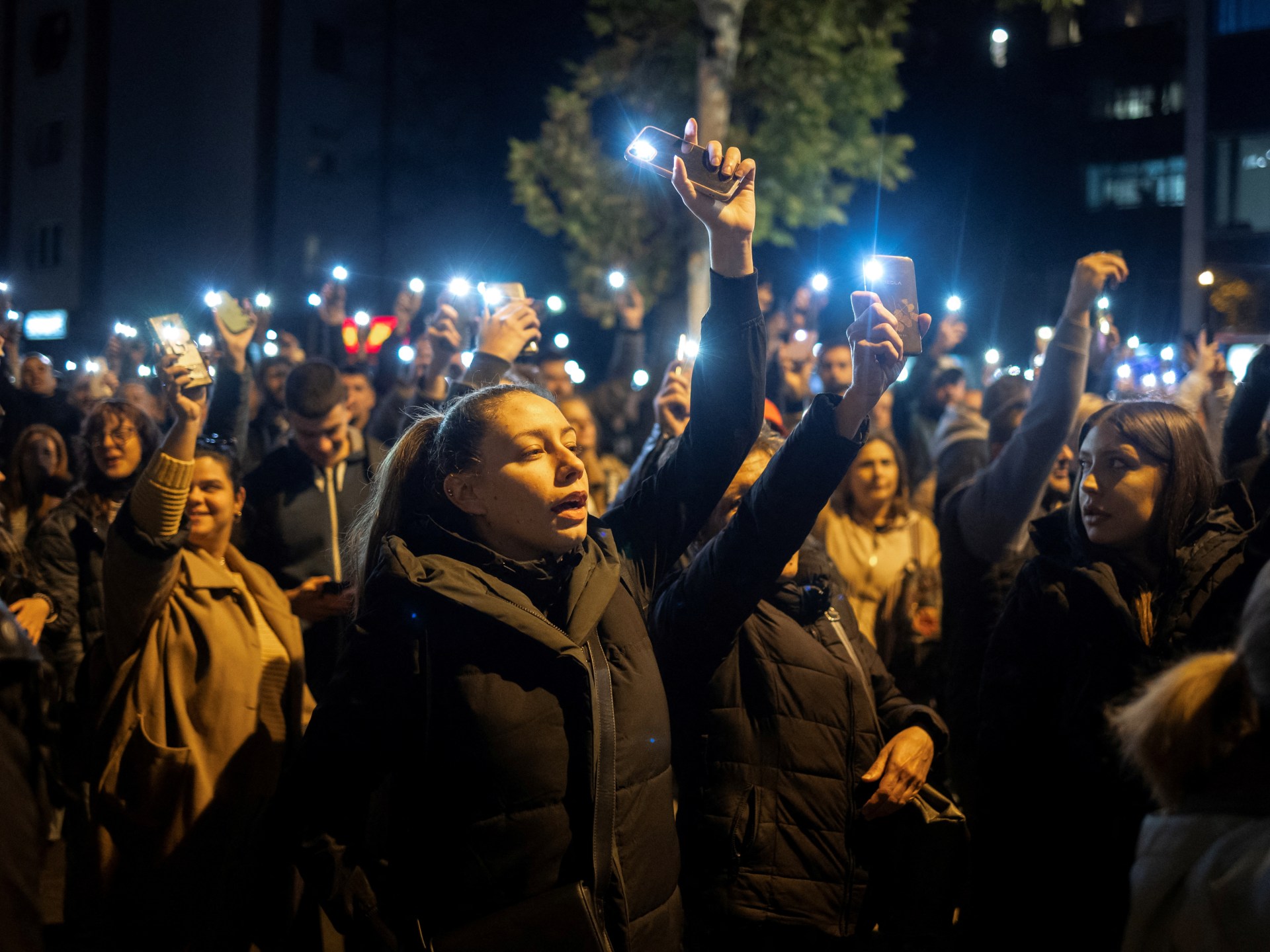
For four months now, Serbia has been gripped by unprecedented protests. The upheaval was sparked by the collapse of a roof at a newly renovated train station in Serbia’s second biggest city, Novi Sad, which killed 15 people and critically injured two on November 1.
Despite various strategies by the government to try to suppress the demonstrations, they have only gained momentum. Universities have been occupied and large demonstrations and strikes have been held across the country.
Foreign observers and the international media have either ignored this mass mobilisation or reduced it to “anti-corruption” protests. Russia and China have stood by President Aleksandar Vučić and his ruling Serbian Progressive Party (SNS), while the United States and the European Union, which usually flaunt their democracy promotion credential, have expressed no support for the protests.
However, what has been happening in Serbia is much more than citizens venting frustration with their government or demanding resignations. In the past three months, a new model of governing institutions and society has been taking shape.
This is a historic development worth paying attention to, given that it comes against the backdrop of Europe-wide backsliding on democracy and a crisis of the political establishment.
Blockades and occupations
The protests in Novi Sad began soon after the disaster struck, with local residents and students carrying out 15-minute road blockades to commemorate in silence the 15 lives lost. This form of protest spread across the country in a highly decentralised manner, with more than 200 cities, towns and villages holding such vigils.
On November 22, a group of students from Belgrade University’s Faculty of Dramatic Arts attempted to hold a small 15-minute vigil when they were physically assaulted by a group of people.
In response to this and other similar attacks and in the absence of any reaction from the authorities, the students decided to occupy their facilities three days later. This inspired other students to take similar actions.
In the following weeks, six major public universities were occupied, which has practically paralysed higher education in the whole country, as all academic activity in these institutions has been suspended.
On February 13, the students went a step further, occupying the Student Cultural Center in Belgrade, once a thriving cultural and student life hub, which under the administration of the Ministry of Education became run-down and was largely used for commercial purposes.
With the universities occupied, the students decided to take their mobilisation to the streets. On January 28, they organised a 24-hour occupation of a main traffic junction in Belgrade. This was followed by a similar occupation in Novi Sad on February 1 and in the city of Kragujevac on February 15.
Groups of students walked 100km (60 miles) to support their colleagues in Novi Sad and Kragujevac. Along the way, they were greeted by masses of people who provided meals, refreshments, medical aid and accommodation.
At the end of the mass rally in Novi Sad, hundreds of taxi drivers showed up to drive the students back to Belgrade. The residents of Kragujevac accommodated in their homes around 700 protesters from out of town. Citizens’ solidarity with the students has been spectacular.
Throughout these occupations and marches, the students’ demands have remained the same: the release of all documents pertaining to the train station’s reconstruction, the prosecution of those attacking protesters, the dismissal of charges against protesters, and an increase in the higher education budget.
They are not demanding the government’s resignation, snap elections, or that the opposition take over.
Disobedient universities
The occupations have challenged not only the status quo within Serbian universities, but also outside.
Students have developed effective self-governance through student plenums or assemblies, where each student has the right to speak and all decisions are voted on. Ad hoc working groups are put in place to deal with various issues, from security and logistics to PR and legal questions.
The university occupations function without a discernable leadership, alternating the representatives who speak to the public. They are adamant about their autonomy, vocally distancing themselves from all political parties and party politics, as well as from established civil society organisations and even informal groups.
In doing so, they are creating a new political space and new means for the political to be enacted, breaking through the confines of ossified institutionalised politics and representative democracy.
Students have effectively created what might be called a “disobedient institution”, partly within the system and partly outside of it, which proclaims its own political sovereignty, recognises and formulates its own needs, defines its own rules, and pursues its own agendas.
Unlike student protesters recently demonstrating in support of Gaza in the West, students in Serbia are fully controlling the institutions they have occupied while enjoying an overwhelming support of the public: around 80 percent of Serbian citizens support their demands. Moreover, the universities are publicly funded and not yet transformed into money-making factories, as is the case in the US, which gives the students’ demands that much more weight.
Leading by example
While opposition parties and civil society groups close to them have proposed to resolve the crisis by forming an “interim government” made up of technocrats or party representatives, students are calling for “systemic change” and fundamental, bottom-up democratisation.
These ideas have made it to the street. During the mass rally in Novi Sad, which I attended, students organised the first citizens’ plenum. People were asked to vote by raising their hands if they wanted to extend the blockade for another three hours. Raising my hand among thousands of others was thrilling.
The students have repeatedly stressed the need for other groups to organise and act within their own institutions, making their own demands. Some have heeded their call.
On January 24, Serbia got the closest it could to a general strike given that the SNS regime practically controls all public institutions, including the unions, and was able to put pressure on them not to join.
Workers from various institutions, businesses and a number of professional associations still joined the strike. While education unions withdrew from the general strike, individual schools and even individual teachers suspended classes.
Left without the protection of their professional associations, the teachers subsequently formed a new, informal institution, “Association of schools on strike”, which apart from backing the students’ demands, put forward their own. They are continuing to strike despite facing incredible pressure, including the threat of pay cuts.
Other sectors have also responded with various protest actions. The Serbian Bar Association suspended the work of its lawyers for a month. Belgrade’s public transportation company workers and public pharmacies union protested against the privatisation of their respective sectors.
Workers in the cultural sector created an informal “Culture in blockade” initiative. After holding several protests and plenums of their own, on February 18, they occupied the Belgrade Cultural Center, one of the city’s most important cultural institutions. Meanwhile, many theatres have also gone on strike.
Democracy from below
We now live in a time in which liberal politics has become entirely exhausted. In Serbia, this is most apparent in the fact that there is very little public confidence in the political establishment, including the opposition, while students enjoy popular support because they have nothing to do with status quo politics and have no ambition to take over anything other than what they already have – their universities.
As liberal democracy is retreating before the forces of illiberalism, authoritarianism and techno-fascism, while facilitating their rise, there is a desperate need to formulate alternative societal and political imaginaries and the students of Serbia have shown the way.
Unlike socialist “self-management”, which was pursued as state policy by the communist regime of the Yugoslav Federation and implemented from the top down, the self-governance of students, and increasingly other social actors, comes from the ground up. The students have seized an institution, recreated and democratised it, thereby redefining the very meaning of democracy.
In this way, students have opened up a horizon towards another kind of democracy, another kind of future beyond “capitalist realism” and the dying liberal order.
Stanford University professor Branislav Jakovljević has described the current political moment in Serbia as a conflict between society and the state. The people of Serbia have an opportunity to (re)claim institutions of the state and democratise them. They will need great courage and vivid imagination to engage in this highly experimental renegotiation of how their society should be governed.
The hope is that, in this endeavour, they will be guided by the ethics the students have consistently displayed: those of justice, freedom and solidarity.
The views expressed in this article are the author’s own and do not necessarily reflect Al Jazeera’s editorial stance.
