

Business reporter
Mike Johns didn’t expect his return trip from Los Angeles to Scottsdale, Arizona in December to go viral.
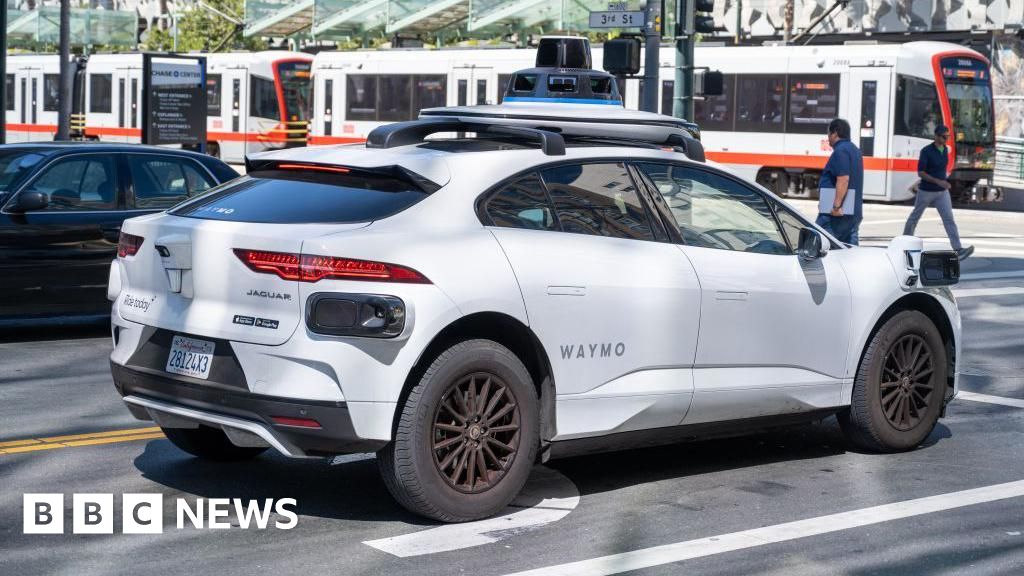
To get to the airport he booked a driverless taxi and enjoyed a thrill when he jumped in with curious bystanders looking on.
But he got much more attention than he bargained for.
Mr Johns found himself being driven around and around a car park while those same bystanders looked on.
The Waymo ride was not doing what it should and there was no obvious way Mr Johns could fix it – and he had a flight to catch.
Mr Johns recorded the experience, a video that went viral almost immediately and was picked up on TV stations around the world, casting fresh public doubt about self-driving cars and how ready they are for real-world passengers.
“Why is this happening to me on a Monday morning?” Mr Johns filmed himself asking.
Eventually a voice activated inside the car telling him to access the Waymo app to get the vehicle back under control.
Waymo which is owned by Alphabet, the parent company of Google, told the BBC that it released a software update almost immediately fixing the problem.
The company says its driverless system is “better than humans at avoiding crashes that result in injuries, airbag deployments, and police reports”.
Nevertheless, Mr John’s experience is not the first time the company has had to take action.
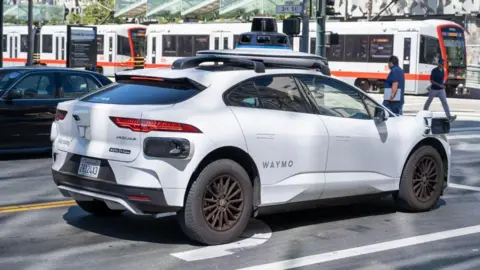
Last year the company recalled more than 600 cars after one hit a street pole.
And in May 2024 the National Highway Traffic Safety Administration (NHTSA) launched a probe into 22 incidents involving Waymo vehicles .
 Getty Images
The road to a driverless future has also gone awry for rival services.
In December, US car giant General Motors closed down its self-driving car subsidiary Cruise.
GM attributed the change of strategy to “the considerable time and resources that would be needed to scale the business”.
In October 2023, one of its vehicles hit a pedestrian and dragged her for more than 20ft (6m), leaving her seriously injured.
Meanwhile, in February of last year, it emerged that Apple’s rumoured self-driving car project was folding.
Uber abandoned its own driverless car efforts in 2020.
But some big players remain in the race, including Zoox, which is owned by Amazon, as well as chipmaker Nvidia and Elon Musk’s Tesla.
Waymo is the leading US player though. It already operates self-driving taxis in Phoenix, San Francisco, Los Angeles and Austin, Texas and is promising to launch soon in Atlanta and Miami, Florida.
So why has Waymo succeeded where other efforts, at least in the US, have failed?
“Three things – people, money and process,” says Sven Beiker, a lecturer at Stanford Graduate School of Business, and managing director of Silicon Valley Mobility, an automotive consultancy.
He points out that over the years Waymo has employed some of the leading figures in autonomous vehicle engineering, it has the financial weight of Google-owner Alphabet behind it, and has become thorough in its approach.
“They’ve come around to really playing by the book, to be a good steward of processes… working with regulators to make sure what they deploy is safe.”
So what’s next?
Regions with good weather are likely to see driverless services first says Philipp Kampshoff, global co-leader of Automotive and Assembly Practice at the consultancy giant McKinsey.
That would include southern US states like Texas and Florida, where Waymo already has plans.
“Robo-taxis still operate much better in good weather conditions. They still, for the most part, struggle in heavy snow,” Mr Kampshoff says.
He also points out that the batteries perform better in warmer conditions, which is particularly important for driverless cars that need a lot of energy to power on board computing.
“Bringing this all together, in the second part of the 2020s, you will see one city after the other being unlocked and then scaling within these cities,” he says.
It will be a slow process.
“It’s actually quite a labour intensive process to roll out this technology, which includes a fair amount of human driving,” says Mr Beiker.
“You need to drive those vehicles through the streets where you want to deploy them, and you need to drive them over and over again, and you need to, to some extent, manually edit the data,” he adds.
And the whole process could also be held up by safety concerns.
“This is only going to happen if we’re not running into major accidents. The moment major accidents are going to happen, a lot of these operations are going to be shut down,” says Mr Kampshoff.

 Scania
For those working on self-driving trucks, safety is arguably on even bigger worry.
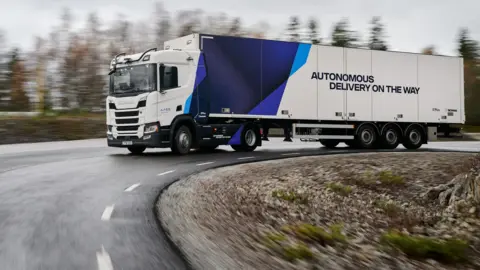
“Safety is the number one concern that we work on,” says David Liu, the chief executive of Plus, which makes driverless software for trucks and works with global companies such as Amazon, Hyundai, Volkswagen and Scania.
“Autonomous trucks and autonomous vehicles, need to be much safer than average human driven vehicle,” says Mr Liu.
“Human drivers are great, but not flawless. Most of the accidents we get ourselves into are due to driver inattentiveness. And we don’t have that issue with technology,” Mr Liu explains.
“A robo-taxi mostly runs within cities in low-speed environments, while trucks are typically run on highways at higher speed.
“So we do need to put in different set of technology to be able to see more clearly around the trucks and be able to handle a longer braking distance, for instance.”
 Getty Images
To see into the driverless future it might be worth watching developments in China.
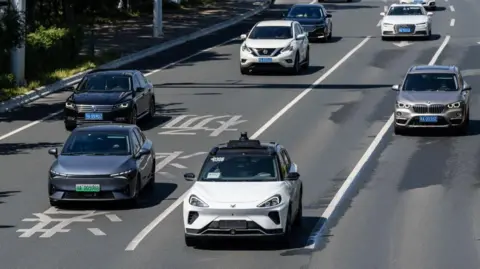
In the city of Wuhan more than 500 driverless cars are being operated by the company Baidu.
Across the country driverless cars are reported to be operating in 16 cities and being tested by 19 manufacturers.
“There’s definitely more competition… there are four or five companies that are very similar to Waymo,” says Mr Beiker who is currently working on a study of robo-taxi deployments around the world, sponsored by Sweden’s innovation agency Vinnova.
Back in Scottsdale, Mr Johns reflects on his experience and the rollout of autonomous vehicles.
“One big thing is that we’re all a part of a paid experiment. At the end of the day, what they’re doing is fixing it as they go, per city. And that’s a problem.”
