

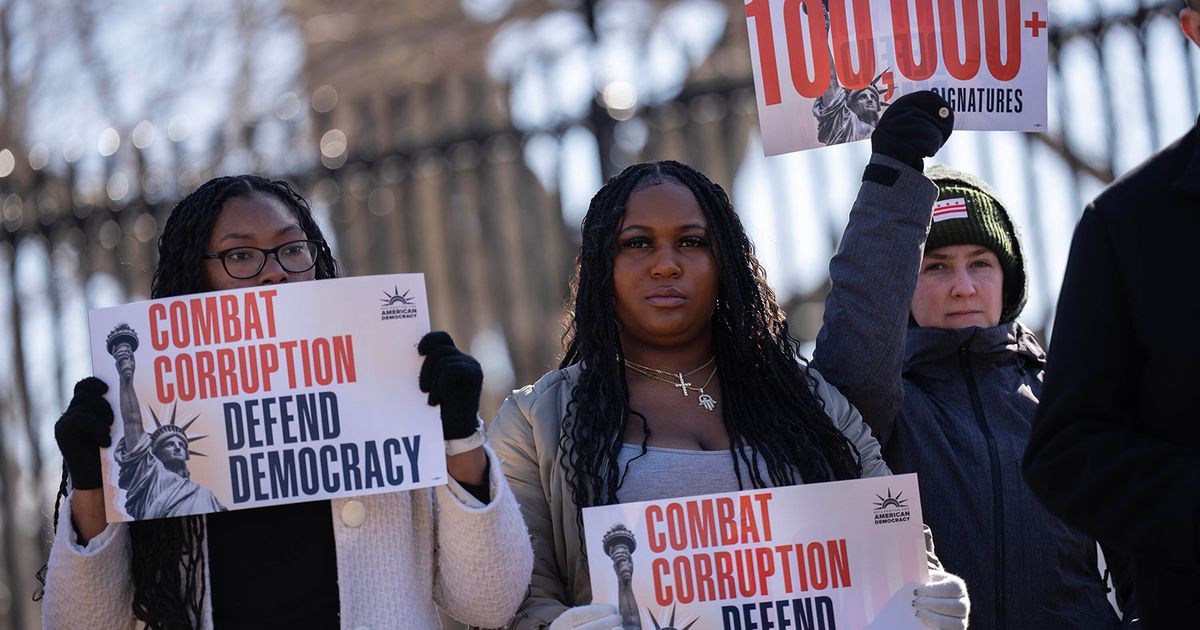
Who should have more power — the people of the states or the corporations that are authorized by them? For legislators in Hawaiʻi and Montana, the answer is most definitely the former, not the latter. Both states are advancing laws to put power back in the hands of people and get corporations out of the business of influencing elections by overcoming Citizens United, the landmark 2010 Supreme Court ruling on campaign finance.
The idea is elegant in its simplicity. Corporations and other organizations owe their powers to state statutes, not federal law, and states reserve the right to alter that power. Hawaiʻi has changed its law by saying that corporations have “artificial-person powers” and cannot engage in election or ballot measure activity in the state reserved for real people. Montana has a citizen’s initiative on the November ballot that would ban organizations from contributing “anything of value” to candidates, political parties, and state or local ballot issues.
Both extend their reach beyond corporations to trade associations, nonprofits and unions to say that if they want to stay in business in the state, they can’t spend on politics.
Most Americans think that money in politics is a problem. Polls show that 72% of the American public say there is too much money in politics; 85% say the high cost of campaigning keeps “good people” from running for office; and 80% say candidates are more likely to respond to wealth than voters.
When the wealthy disproportionately influence politicians, politics becomes transactional. Big donors expect a return on investment; in turn, politicians have an incentive to prioritize their donors’ interests — and profits — over those of average citizens. More broadly, the perception that money has perverted our politics undermines trust in democracy.
The explosion of unregulated campaign cash into candidate coffers owes its origins to a 2008 court case pitting the Federal Election Commission against Citizens United, a conservative nonprofit group that wanted to air a film criticizing then-Sen. Hillary Clinton — a plan that fell afoul of the FEC’s limitations on political spending. After taking up the case, the Supreme Court found that Citizens United had a First Amendment right, just like a real person, to spend money distributing the film. Because the spending was independent of a candidate or campaign, the court reasoned, it could not be corrupt.
That ushered in the era of super PACs, as nonprofit and for-profit corporations began to contribute unlimited sums of money on elections in every state.
But that is only the most visible portion of the spending that Citizens United allowed. Behind the scenes, some of the biggest donors can shield their contributions from public scrutiny by steering their cash to dark money organizations that use their favorable tax status — as 501(c)(3)s, (c)(4)s or (c)(5)s — to shield their donors from public disclosure. Their money is “dark.”
Hawaiʻi and Montana want to flip this around. They contend that the power to spend in politics is a revocable power and they are revoking it.
The notion that states can confer power on organizations and revoke it is the “reserved powers doctrine,” a foundational but overlooked fact of corporate law and one the U.S. Supreme Court has upheld for 200 years, said Tom Moore, senior fellow at the Center for American Progress and author of the legal strategy behind the Hawaiʻi and Montana efforts. He’s calling the reform the “Corporate Power Reset” and said it’s something every state has the capacity to do.
“It’s not a regulation. It’s a redefinition,’’ Moore told me. Of the 25 states that have this provision in their state constitutions, 15 of them have proposed similar bills, he said, and another eight have expressed an interest since Hawaiʻi passed its law.
But while the Hawaiʻi law and the Montana plan are bold solutions to a blight on our democratic process, they will have to get past a very hostile legal environment, made worse by a skeptical Supreme Court and its misguided claim that corporations have First Amendment rights.
In Hawaiʻi, the Grassroots Institute of Hawaiʻi has already sued the state, with the help of the conservative Institute for Free Speech, arguing that banishing corporations from political speech is censorship. When Americans organize corporations and other associations, “they don’t thereby lose the First Amendment right to speak about the issues and politicians who impact their communities, their families, and their lives,’’ their complaint states.
Brad Smith, the chairman of the Institute for Free Speech, called the tactic a “semantic trick” that “would make the benefits of a corporate structure conditional on a surrender of First Amendment rights.”
Most people can’t afford a television advertisement or a digital campaign to influence an election, he argued in a recent op-ed, so individuals band together in organizations — nonprofits, unions, advocacy groups and for-profit corporations — with like-minded people, pool their resources and express views that otherwise might go unheard.”
That misses the point, argues Moore. The activity Smith supports is why political committees exist, and their donors are publicly disclosed. “When a state stops granting its corporations the power to spend in politics, not one citizen loses the ability to pool and be heard. They still have the actual vehicle for that — the political committee — fully protected,” Moore told me.
Closing off undisclosed dollars to dark money funds could force more corporate spending into the open, but it won’t solve all the money-in-politics problems. Billionaires are responsible for an enormous share of political spending. Limiting corporate cash, legal scholar Rick Hasen argues, may increase the incentives for billionaires to ramp up their giving.
In the 2024 election, 100 billionaire donors contributed about $2.6 billion, according to an analysis by Americans for Tax Fairness, a coalition that advocates for economic reforms. And that’s just the money that can be traced. In the first three months of this year, political committees raised $4.7 billion for the November midterms, much of it from the small group of ultrawealthy donors, a Bloomberg analysis found.
It’s still worth a try.
These days, ideas that put power back in the hands of people and make our political system better are rare indeed. It’s even more unusual to see the idea come from two states with such different political cultures. Imposing reasonable limits on the ability to convert money into political muscle doesn’t weaken First Amendment rights, it ensures we will preserve them. In that respect, Hawaiʻi and Montana are test cases that couldn’t have come along at a better time.
©2026 Bloomberg L.P. Visit bloomberg.com/opinion. Distributed by Tribune Content Agency, LLC.
