

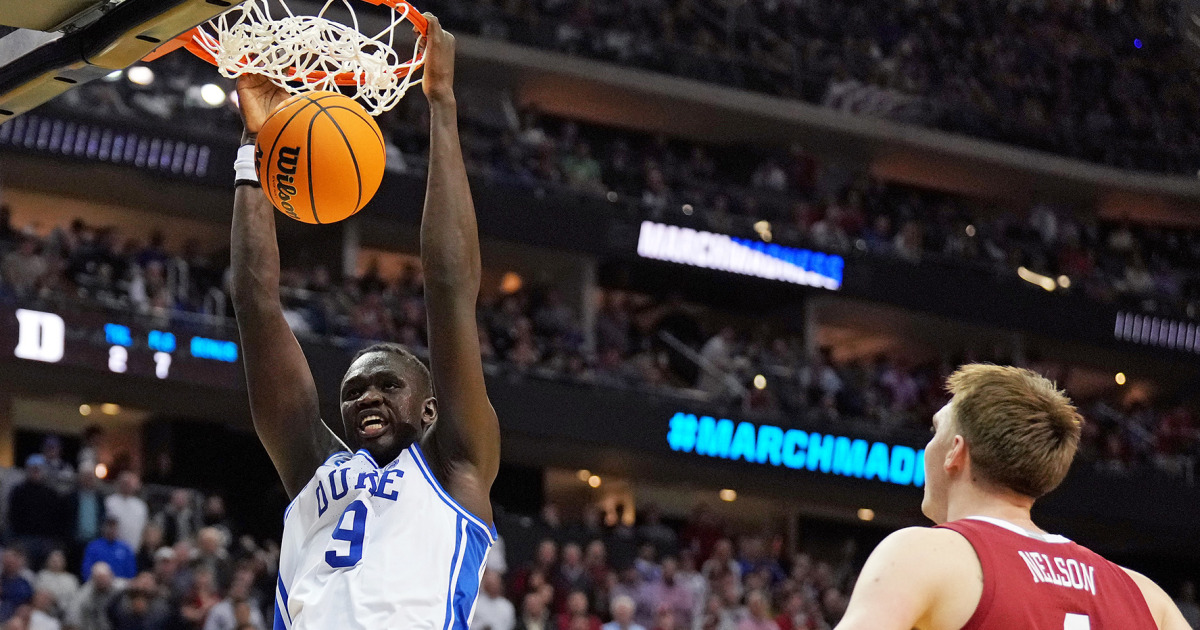
When Khaman Maluach’s freshman season at Duke University ended in April, the biggest question about the 7-foot-2 big man’s ability to play in the NBA had nothing to do with his shooting, size or skill.
It had everything to do with his passport.
His enormous wingspan and potential made Maluach, who was born in South Sudan and raised in Uganda, the youngest player at last summer’s Paris Olympics, playing for the South Sudanese national team while sharing the court with U.S. stars such as Kevin Durant and Bam Adebayo. Months later, after an all-conference season at Duke, there appeared little keeping him with nimble feet and shot-blocking prowess from the NBA.
Yet on April 5, hours before the Blue Devils lost in the national semifinals of the NCAA men’s basketball tournament and nearly three months before the NBA draft, that future appeared in flux. All visas held by South Sudanese passport holders were being revoked, the State Department announced.
Questions immediately arose about whether Maluach would be eligible to be selected. But thanks to a little-known division of the NBA few have heard of, he’s set to walk across the Barclays Center stage in Brooklyn, New York, on Wednesday night.
“People always ask me: ‘What do you do at the NBA? What do international basketball operations do?’” Troy Justice, the NBA’s senior vice president and head of international basketball, said in an interview. “And we say we make dreams come true. We give people an opportunity that wouldn’t have it otherwise.”
For more than three decades, the NBA has made its mission exporting basketball to the world. In 1992, as a “Dream Team” of NBA players dominated the Olympics in Barcelona, Spain, and became a billboard for the league’s star power globally, the league had just 21 international players. By last fall, a record-tying 125 — from a record-tying 43 countries — accounted for nearly one-third of the league. The league “expects that to continue to grow and expand,” Justice said.
The demographic changes have reshaped the league. Though 48 of the first 49 Most Valuable Player award winners in NBA history hailed from the United States, 10 of the last 21 MVP awards have gone to foreign-born stars, including each of the last seven. When the Thunder’s NBA championship parade passed through the streets of Oklahoma City on Tuesday, the title trophy was held by players from seven countries, including Canadian-born MVP Shai Gilgeous-Alexander.
As the NBA has brought basketball to the world, the often-thorny logistics of bringing the world’s players to the NBA have fallen to the league’s arm of international basketball operations. Its staff of 38, operating out of offices in 14 countries, have expertise in immigration law and visa issues, as well as relationships with governments around the world, that have allowed the league to grow those global ambitions.
“What we’re seeing right now is at a time in which all the domestic leagues, NBA and WNBA included, are expanding their international footprint, the population of the world is growing and immigration processes are becoming more complicated,” said Travis Murphy, an immigration consultant to the NBA and former diplomat. “And so it really is kind of this perfect storm of the global growth of leagues seeking to broaden their footprint, expand into more countries. At the same time, it’s more difficult than ever to travel around the world. And that’s not just international passports coming into the States. It’s also U.S. passports.”
By creating basketball “schools” for youth players, as well as establishing Basketball Without Borders camps and academies abroad for elite-level teenagers, the NBA has tried to build, in effect, a funnel to discover and then develop its next generation of players. Justice said the NBA’s international reach extends to 30 million coaches, referees and youth players annually.
Among them is Maluach.
Born in Rumbek, South Sudan, Maluach fled the country with his mother and a few siblings at a young age for Uganda, where he was raised playing primarily soccer, with the nearest basketball court from his home a 40-minute walk away. He did not begin playing basketball until 2019, at age 12, after he was spotted by a scout who worked with the NBA’s African operations. The scout called Brendan McKillop, an NBA associate vice president and head of Elite Basketball, to share that he might have found a prospect.
By 14, Maluach had earned a spot in a Senegal-based academy operated by the NBA, whose feeder program eventually placed him on rosters in the NBA’s Basketball Africa League, playing for teams based in South Sudan, Senegal and Uganda. As he improved, the NBA continued to open more doors, from participating in Basketball Without Borders camps, where he won most valuable player, to in front of NBA scouts at the league’s annual minor-league showcase and later at a showcase during its All-Star weekend last year.
At each stop, the NBA’s international operations team worked to smooth his travel from one country to the next, just as it does with all of its international players. That work continued this spring after the State Department’s action against South Sudan, as Maluach stayed in the United States to train ahead of the draft.
“We’ve been on this journey … with Khaman since age 14, and we’re going to continue on this journey with him through the rest of his career, and we’ll continue on this journey with him post his career,” Justice said. “These are lifelong commitments that we make to all of our international players.”

When Maluach arrived in the United States last summer, after having played in the Olympics, he held an F-1 visa, commonly used for international student-athletes in the United States. When that visa was no longer valid after three months, Maluach’s I-20 kept him legally in status. Because of the fluctuating policies in the United States that added South Sudan to the travel ban list, he has not been able to leave the country since President Donald Trump took office in January. Trump signed a proclamation this month banning nationals from 12 countries from entering the United States, and the State Department later reportedly signaled it was considering expanding the travel ban. South Sudan was among the countries potentially affected.
As Maluach’s lone season at Duke ended, the NBA began paperwork for him to receive a B-1/B-2 business tourist visa, which is pending, according to the league. Should Maluach be drafted Wednesday or Thursday as expected, the NBA will begin the process of acquiring either a P-1 visa — the typical professional athlete visa for the United States — or the Canadian version if he is drafted by the Toronto Raptors.
Though Maluach entered the United States legally and was never considered in danger of being deported despite the State Department’s revocation of South Sudanese visas, the Trump administration’s policies toward South Sudan have added a layer of complexity to his professional future, nonetheless. If he is drafted by one of the 29 U.S.-based NBA teams, he would still travel internationally to Canada, to face the Raptors, and potentially elsewhere for preseason or regular-season games, and that travel would require additional steps for him to re-enter the country every time he leaves. The league would start by filing a petition through U.S. Citizenship and Immigration Services that would last the length of his initial contract. But every time he would want to return to the United States, he would first be required to interview at a U.S. embassy.
Whereas the NBA once handled around 400 immigration and visa cases a year, Justice said, it now handles well over 2,000. Ensuring players’ movement around the world requires close relationships with multiple governments, starting with the United States.
Living in the United States while holding a passport from a country whose visas have been revoked or could face a travel ban creates immense uncertainty. But “it’s less of a nightmare for athletes, because there’s the blanket exemption for athletes coming to participate in major sports competitions,” said Jeff Joseph, the president of the American Immigration Lawyers Association. The NBA helped lobby the U.S. government to create its “national interest” exemption in the summer of 2020 to help its players return from abroad to take part in the restart of the season amid the pandemic, Murphy said.
The NBA has managed its relationship with the U.S. government through multiple administrations in part by acting as a diplomatic partner. It has created a “Hoops for Troops” program, and its works have involved former NBA and WNBA players in a sports envoy program sponsored by a division of the State Department.
Organizing travel has become more complicated, Murphy said, “not necessarily because of any one administration, but more just a reflection of the global immigration landscape.”
Asked how the State Department works with professional sports leagues to approve visas for foreign-born players, a spokesperson for the agency said, in part, that “every applicant for a U.S. visa undergoes extensive security screening to ensure that individuals who pose a threat to the United States, its citizens, or its national interests do not obtain visas. This comprehensive screening continues throughout the validity period of the visa.”
Though the NBA officially entered its offseason Monday, the work doesn’t end for the international operations team’s work handling visas and immigration and growing its grassroots base. Along with this week’s NBA draft, the league is hosting this week a “rising stars” tournament featuring youth players from 11 countries. Next month, its annual Summer League takes place in Las Vegas. There is also a volunteer coach program run by the Basketball Africa League and a handful of other commitments requiring the work of the international operations group.
“It’s this whole process because it very much matters where the individual is from and what passport they hold,” Murphy said. “And so it may be a Nigerian athlete that we’re trying to get into Singapore, and those requirements might be different than what it is for an American or a different nationality.
“So it’s managing that, navigating that, making sure you have the right information and then building those relationships with embassies, consulates and foreign governments, as well as our own U.S. government, to make sure that you can get things done when the time comes.”
On Tuesday, the night before Maluach was expected to be drafted and learn which city he will soon call home, Justice and others inside the NBA’s international operations staff took Maluach and a few of his siblings to dinner.
To McKillop, who first met Maluach as a raw, 14-year-old soccer player, draft night is not only a celebration for players who are selected but also “the culmination of years and years of work for our NBA Academy staff based around the world, who spend almost every minute of every day with them.”
“I don’t think Khaman would ever say this, but he has not had an easy life, going from South Sudan to Uganda, moving thousands of miles away from his family at age 14,” McKillop added. “And then he gets to this point where, especially in today’s college basketball landscape, where schools are lining up to throw hundreds of thousands of dollars at him, and as he’s having success, agents are clamoring to represent him, and when kids are put into that situation, it’s easy for them to forget who they are and where they came from.
“And that is not a concern at all when it comes to Khaman; he is as humble a young man that has ever come through this program. We are thrilled that he has this opportunity in front of him.”
An opportunity made possible, behind the scenes, by the NBA.
