

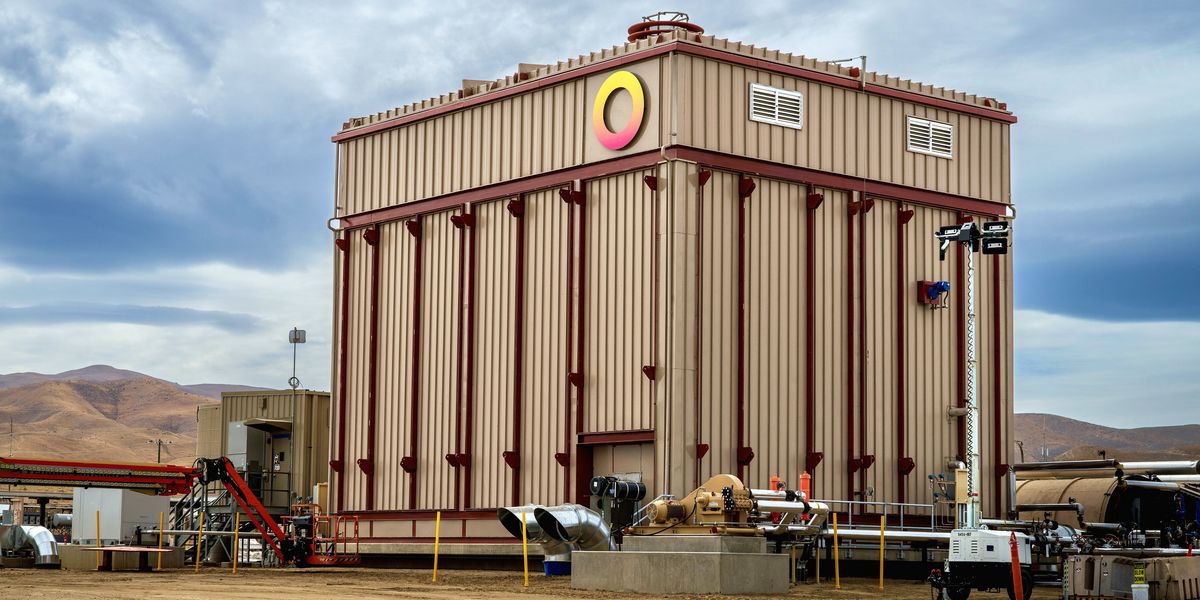
For the last 12 weeks, California start-up Rondo Energy has been operating what it’s calling the world’s largest thermal battery. Rondo’s system converts cheap renewable electricity into heat that can be discharged on demand into industrial processes.
This differs from most next-generation energy storage strategies, which provide electricity to grids in the absence of sun or wind. Instead, Rondo’s system aims to help decarbonize emissions-heavy sectors like steelmaking and cement.
The system works like a toaster crossed with a blast furnace. Electricity from solar arrays heat iron wires similar to those in a toaster oven. These warm hundreds of tonnes of refractory bricks to temperatures up to 1,500 °C. After four to six hours of charging a day, the heat can be discharged as air or steam, without combustion or emissions.
To discharge heat, a circulating air blower is turned on, pushing air up through the brick stack and heating it to over 1,000 °C before releasing it through an outlet. The heat delivery rate can be controlled by adjusting the air flow. The battery can discharge steam instead of heat by injecting water into an attached chamber that the heated air passes through before leaving the battery through the outlet.
The real challenge in thermal energy storage is not storing heat; it’s being able to charge rapidly and then deliver heat continuously at the same temperature, says John O’Donnell, Rondo Energy’s chief innovation officer. The structure of Rondo’s heat battery, which O’Donnell describes as “a 3D checkerboard of brick and open chambers,” keeps temperatures uniform and enables rapid charging. “We can turn charging circuits on and off as fast as you can turn your toaster on and off,” O’Donnell says. “So we can be agile.”
In Rondo’s first project, its 100-megawatt-hour battery is supplying heat for an enhanced oil recovery facility operated by Holmes Western Oil Corp. in Kern County, California. The battery, which is about the size of a small office building, is powered by an off-grid, 20-MW solar array built for this purpose. It converts the clean electricity into heat, and then generates steam that is injected into oil wells, heating the oil so that it thins out and flows more easily, increasing production.
Holmes Western Oil previously accomplished this with a gas-fired boiler. Cutting it will save Holmes just under 13,000 tonnes of CO2 emissions annually while also lowering costs, according to Rondo. “Making steam for oil fields is the second largest portion of industrial heat in the state,” says O’Donnell.
Rondo’s choice to deploy its first commercial-scale, emissions-reducing battery for the extraction of a fossil fuel stirred some controversy. Critics argue that deploying clean tech to improve or prolong fossil fuel production is counter-productive.
Thermal Batteries for Clean Industrial Heat
Several other companies are developing thermal batteries with industrial heat applications. Antora Energy makes modular carbon-block heat batteries that can reach over 1,500 °C and are being deployed at pilot industrial sites. EnergyNest is doing early commercial installations of its concrete-based thermal modules, and is partnering with Siemens Energy to scale across Europe. Calectra’s ultra-high-temperature systems are in the pilot phase, and EarthEn Energy launched its modular low-temperature heat batteries in July.
These companies are focused on heat because it’s central to producing staples such as steel, cement, food and chemicals. Many of these manufacturing processes run continuously and maintain high temperatures for weeks or months at a time, ranging from 72 °C for pasteurizing milk to over 1,000 °C for making steel or cement.
The cheapest, most efficient way to produce consistent heat has long been with fossil fuels; nothing burns as slow and hot as coal or natural gas. Their energy density, reliability, and low cost have made them hard to replace. However, industrial heat accounts for about 18 percent of greenhouse gas emissions and more than 20 percent of global energy consumption. So innovators aiming to decarbonize these industrial sectors have their work cut out for them.
But solar power is getting cheaper. In 2024, California’s solar fields generated almost as much electricity as its gas plants. “Because of what the wind and solar industry have done, we now have intermittent grid prices that are cheaper than fuel in a lot of places in the world,” says O’Donnell. Some locations generate so much clean power that the grid can’t absorb it all, forcing negative electricity prices for a few hours a day.
How Can Thermal Batteries Scale?
Thermal batteries supplying heat face several challenges. In order for them to scale, industrial customers must buy renewable electricity wholesale at times of day when it’s cheap, which requires dynamic real-time pricing. Many states only allow industrial customers to buy power at fixed daily rates. “We are really eager to see the regulatory framework get modernized,” O’Donnell says.
The price of natural gas plays a role, too. It’s relatively inexpensive in the United States thanks to shale gas from fracking, but if its price increases due to exports or other factors, batteries like Rondo’s could become a cheaper source of heat. This is already the case in European countries such as Germany, where the price of natural gas has skyrocketed in the last three and a half years.
Plus, heat batteries could be difficult to integrate into existing industrial infrastructure. Not every facility has space for a battery the size of an office building and a dedicated solar array. The batteries’ high up-front costs and the fact that they’re still a largely unproven technology will make some would-be customers reluctant to give them a try.
Nonetheless, heat batteries like Rondo’s are a promising solution for decarbonizing the industrial sector. “The thermal storage market is absolutely capable of accelerating to create meaningful impact,” says Blaine Collison, executive director of the Renewable Thermal Collaborative, a coalition focused on decarbonizing thermal energy. “When I look at some of the fundamental characteristics of the technology—relatively straightforward materials, ability to off-take renewable electricity, modularity—I see scale.”
This article was updated on October 31, 2025.
From Your Site Articles
Related Articles Around the Web
