

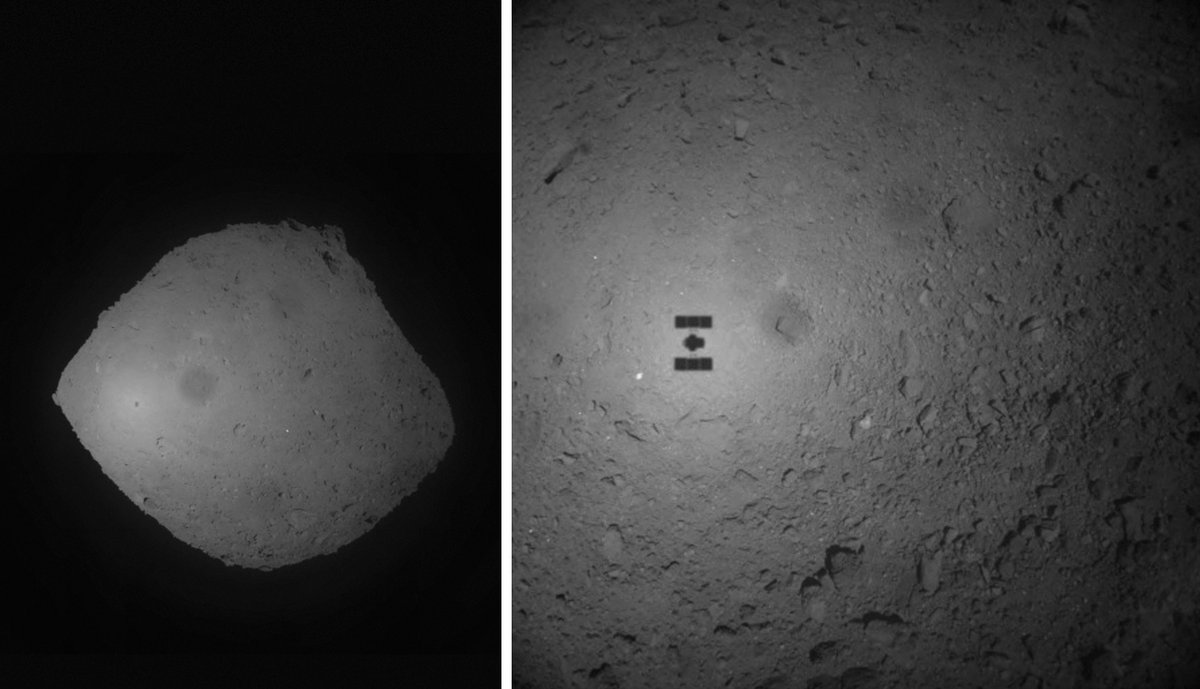
Most carbon-rich meteorites are studded with the remnants of molten droplets from the birth of the solar system. These ubiquitous millimeter-size beads of rock, called chondrules, come from the disk of material that surrounded the newborn sun 4.6 billion years ago. Yet the asteroid Ryugu, or at least the parts sampled by Japan’s Hayabusa2 spacecraft, contains almost none of them. Research published recently in Science suggests Ryugu may be so incredibly old that it formed before the chondrules did, making it part of the very first generation of planetesimals—small bodies that act as planetary precursors—to form in the solar system.
To determine Ryugu’s age, researchers probed the samples for a mineral called dolomite, which can carry radioactive manganese that slowly turns into chromium; the proportions of related elements let researchers calculate when in the early solar system the dolomite formed. They also measured the balance of heavy and light oxygen atoms in minerals that had crystallized in the samples. Cool water loads a growing crystal with more of the heavy form, and that preference fades as the water warms, so the contrast between neighboring minerals reveals how hot the water was. Based on these two metrics, the team found one Ryugu grain containing dolomite that formed at about 92 degrees Celsius some 4.565 billion years ago.
The heat required to form the dolomite came from within the asteroid’s parent body and would have taken at least a million years to build, says study co-author Ann Nguyen, a planetary scientist at NASA’s Johnson Space Center in Houston. Accounting for that necessary heating process, the researchers’ simulations suggest the asteroid came together less than two million years after the solar system’s first solids—before most chondrules.
On supporting science journalism
If you’re enjoying this article, consider supporting our award-winning journalism by subscribing. By purchasing a subscription you are helping to ensure the future of impactful stories about the discoveries and ideas shaping our world today.
The finding fits theories that planets and other bodies in the solar system were built in waves as a mixture of fine dust, ice, organic matter and specks of stardust circling the newborn sun clumped together into ever larger objects. The first generation of planetesimals appeared within about a million years of the first solid grains, and later ones came a few million years afterward, when chondrules were ubiquitous. If the study’s results are correct, Ryugu could be a leftover of that first wave. Planet building, it seems, began almost as soon as the solar system did, and some asteroids still preserve its raw ingredients.
“This study is really interesting and has a high impact for the field,” says Myriam Telus, a planetary scientist at the University of California, Santa Cruz, who was not involved in the work. She notes, though, that other dating methods have put the first chondrules earlier in the solar system’s history and that the manganese-chromium dating system the researchers used still needs to be refined. Regardless, it’s clear Ryugu formed very early in the system’s history, the scientists agree.
Next Nguyen and her colleagues will apply their methods to asteroid Bennu, sampled by NASA’s OSIRIS-REx mission, and Nguyen hopes to report the results soon. Comparing Bennu with Ryugu “will help us constrain whether they could have come from the same parent asteroid,” Nguyen adds—and whether the two could be siblings from the dawn of the solar system.
Subscribe to Support Independent Journalism
Great science journalism requires human expertise, time, effort and creativity. And it costs money. That’s why I and the journalists here at Scientific American hope you’ll join our community.
When you subscribe, you are supporting staff and freelance journalists who are passionate about telling science stories that are true, important and compelling. Our editors and reporters are often experts in their fields, which means they understand the nuances of big discoveries and can untangle the breakthroughs from the hype. With a subscription, you are also supporting rigorous fact-checking to ensure the words we publish are precise and accurate. And you’re supporting original illustrations, graphics and photos that bring you closer to an advanced laboratory, an ice sheet in Antarctica or a space mission in orbit. You’re helping us craft other types of high-quality journalism as well: Our newsletters are carefully written, edited and curated by staffers you have or will come to know and love. Our Science Quickly podcast is based on original reporting, collaboration with editors and scientists and exacting production.
Subscriptions keep this engine running so we can continue to deliver thoughtful, rigorous and independent science journalism to you. In an era of viral misinformation, this work is crucial. If you value what we do, I hope you’ll consider joining us as a subscriber
