

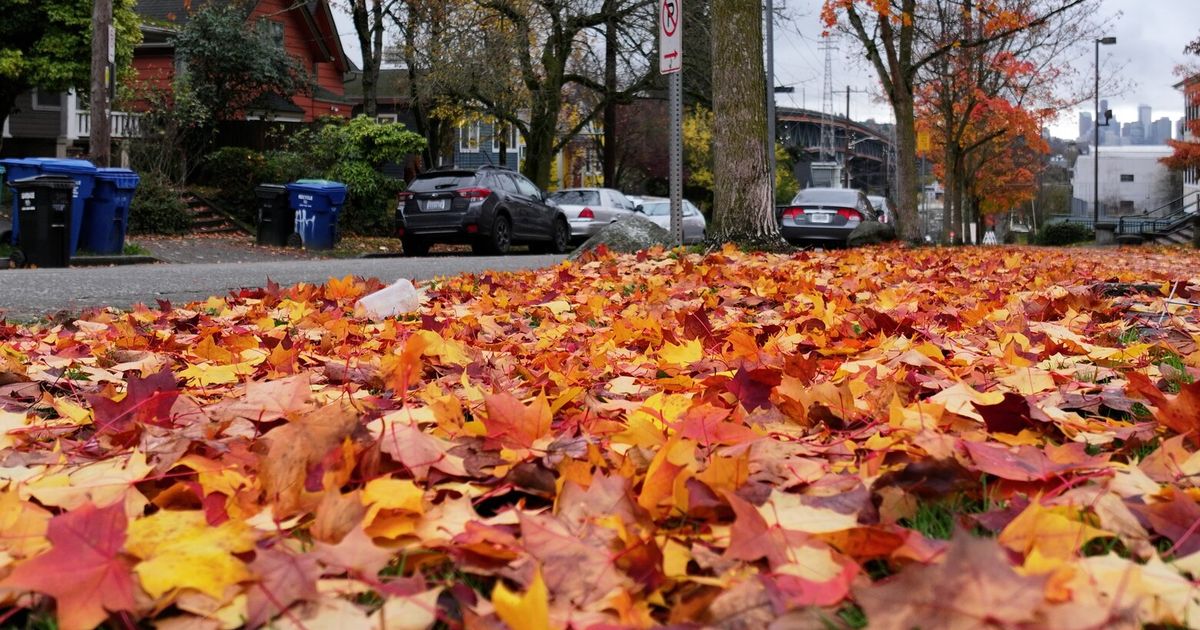
The season of the wet leaves is the advance guard of the Big Dark. Those blazes of red, yellow and orange that gloriously decorated my trees in October’s dry sunshine now make a dull brown wet carpet all over my yard and deck. Some fell in graceful looping dances as the days cooled and shortened, but the rains of November knocked most of them to the ground. They have arrayed themselves on the grass, on the driveway, on the wooden steps of my deck, most in soggy layers, a few as lonely singletons.
Some of the leaves have escaped my rake; they have other plans. They accumulate on the gravel path from the garage and on the wooden boards of the deck. They wait to get a ride on the rubber soles of sneakers or Crocs, wet from November’s cottony gray skies.
I scrape my feet on the outdoor bristle mat that says “welcome.” Some of the leaves remain there, but some — many, in fact — fail to recognize that the welcome doesn’t apply to them. They hitch a ride inside, wet sticking to wet. I scuff my feet again, this time on the indoor mat, the one that carries no cheery welcome. The mat holds onto some leaves, but not all of them.
I take off my outdoor shoes and put on indoor slippers. Scattered around the doormat are persistent interlopers that have clung unseen to my shoes during earlier outside walks. Alder leaves with their jagged edges, now turned a discouraged yellow with holes and dark spots. Brown oak leaves with their multiple rounded lobes. Most persistent of all are the five-pointed maple leaves, not the dinner plate-size big leaf maples but the leaves from Japanese maples, small as the lid for an 8-ounce latte.
As I warm up and dry off in the house, so do the leaves. Taking advantage of other opportunities (the dog’s feet), they drift away from the mat and farther into the house. I turn on the kitchen light and they, or parts of them, have preceded me. A solitary crumpled brown fragment rests in front of the sink; another one has almost edged itself under the stove.
Other leaves have taken different routes. Sitting in the living room to watch a football game, I notice an entire maple leaf between the coffee table and the TV screen. Can I blame the dog for this?
The bedroom closet lies at the opposite end of the house, as far from the front door as I or a leaf can travel. Yet one has made its way there, a small brown maple leaf, exposed under the glare of an incandescent bulb, lodged between summer sandals and old sneakers. How did it get this far? I look at a shoe, one I didn’t take off at the front door. Another maple leaf, its five points perfectly intact and moist, clings to its sole.
I can’t ignore it, so I sweep it up, and its fate becomes my decision: into the trash, or back outside with its comrades, perhaps to become compost for spring planting or perhaps to attempt a return to my closet.
Some combination of rain and snow will keep the leaves soggy for months. They will still be underfoot and wet when daffodils push through them and their replacements emerge on the branches over our heads. And when Seattleites again see the blue of a summer sky and a robin’s egg, wet leaves will be only a memory.
