

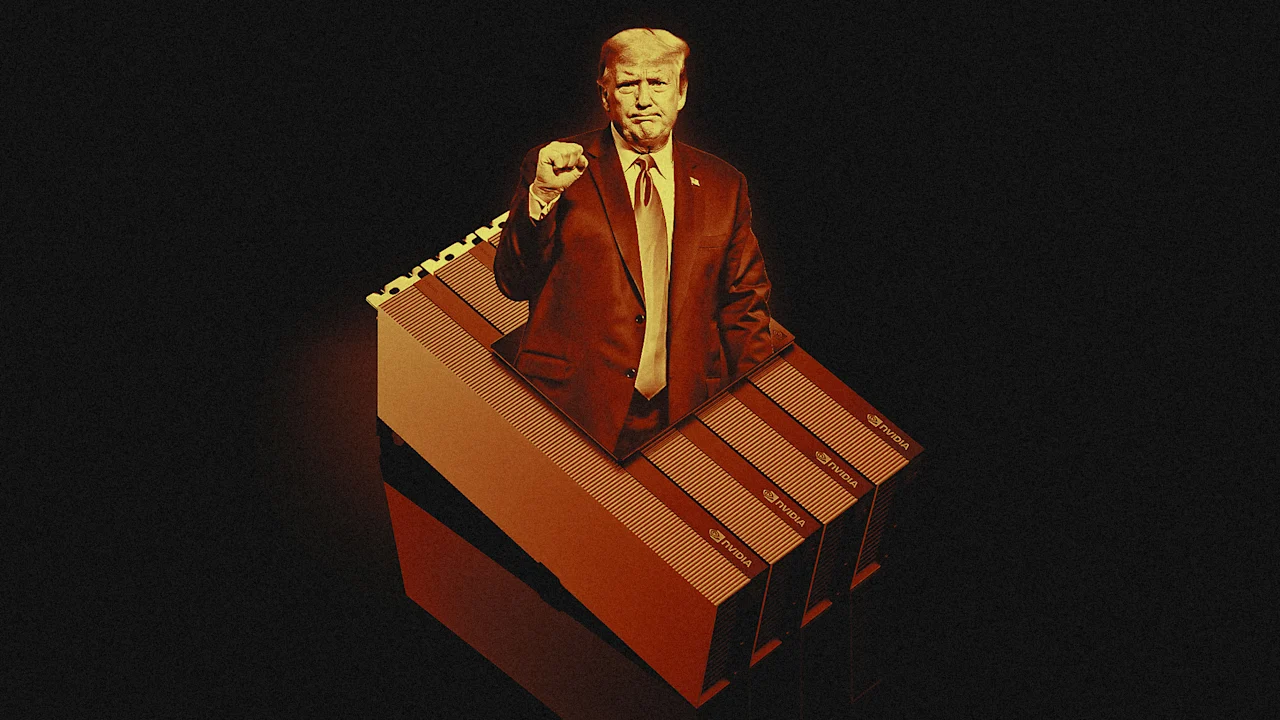
A week is a long time in politics. But in Donald Trump’s world, even a day can feel like an eon. On Tuesday last week, the United States approved the export of Nvidia’s H200 GPUs—the second-most advanced computer chips powering the generative AI revolution—to markets that include China.
The decision was granted with caveats. Supplies could be forestalled if the U.S. began running short, for one thing. But it was an approval. Then, 24 hours later, the White House levied a 25% tariff against the same chips at the point they’re imported into the United States.
That matters because, under the rules Trump instigated on Tuesday, all those H200 chips that could be exported to mainland China after being fabricated in Taiwan must first make their way to the United States to be tested before being re-exported to customers. That adds up to a bigger bill for Chinese tech companies wanting to import cutting edge chips into their country. (To avoid this, China is building up its domestic AI chip development and manufacturing capacity, and recently issued its own counter‑ban on the import and use of H200 chips.) But it also causes chaos for the chipmakers themselves. Because AI hardware is now the backbone of national competitiveness, even small shifts in U.S. trade policy ripple across trillion‑dollar markets and global supply chains.
The latest chopping and changing is a total overhaul of the normal way of doing business, says Willy Shih, professor of management practice at Harvard Business School. “Business, like sports, is conducted on a playing field, where there are rules and regulations, and also norms,” he says.
“These days, with the tariff situation changing almost every day, I tell people to imagine being a coach of a football team, and the rules change every minute,” Shih jokes. “That’s what it feels like.” The impact on markets from such uncertainty can be significant, he adds. “When you see people hold up investments waiting for some stability, that’s why. It’s hard to make long-term investment commitments when the rules could change tomorrow.”
Because companies don’t know the price they’re going to have to pay to bring tariffs into their factories, they’re often reluctant to splash the cash on new purchases. A series of chip-adjacent companies has previously complained about lower-than-expected orders because of unpredictable tariff policy. European lithography firm ASML missed expectations in the first quarter of 2025 by more than $1 billion thanks to tariff uncertainty, their CEO said at the time. And markets reflected the chaos of Trump’s tariff about-turn this year immediately: Nvidia dropped more than 3% after the 25% levy was introduced, suggesting investors were jittery about the repeated policy pivots.
The issue is that it isn’t just buyers who are making those long-term commitments on spending. Chip manufacturers rely on trying to understand future demand in order to build out their production capacity—something that can be imperilled with quick-moving changes to tariffs implemented by Trump. “My general belief is that most, or frankly all, semiconductor management and actual visibility of what is going on with demand is precisely zero,” says Stacy Rasgon, managing director and senior analyst at Bernstein. “They have absolutely no idea. All they see are the orders in front of their face.”
Being able to rampup or rampdown production capacity in such a geopolitical environment makes things even more challenging. And Nvidia’s H200 chips are particularly tricky to make, meaning that the company—alongside other manufacturers of major chips affected by the Trump tariff changes—has to think carefully about how it plans buildout of factories and capacities. Less than a month ago, Nvidia was asking its suppliers if they could step up demand to account for H200 demand totalling 185% of the firm’s current stock levels.
The situation puts more pressure on the people running chip companies, says Srividya Jandhyala, professor of management at ESSEC Business School, and changes the skills they need to navigate the constant changes. “As companies find themselves and their products squarely in the midst of geopolitical tensions, the job description of their top managers has changed,” he says, pointing to the way that Nvidia CEO Jensen Huang has had to mutate how he works. “His job today is about being an effective corporate diplomat, crisscrossing the world to convince policymakers that his company’s products have a place in the vision policymakers have for their countries,” Jandhyala says.
But that vision may have to contend with rapidly shifting realities in a world where Donald Trump’s whims dictate international trade.
