

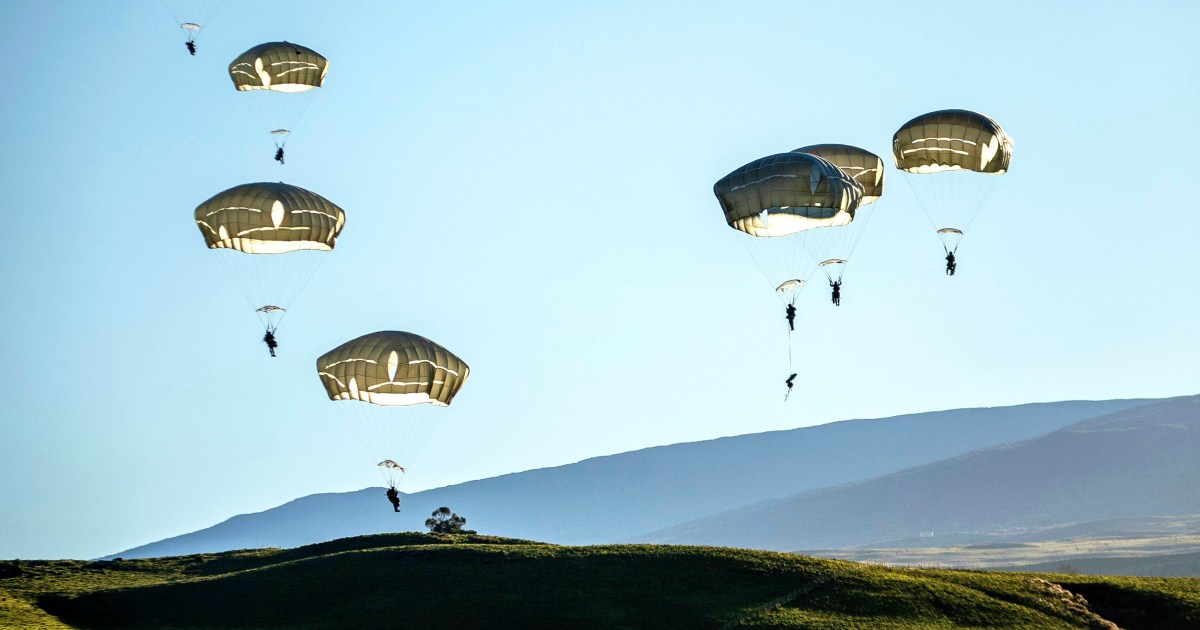
HONOLULU — A high-altitude plateau on the Big Island is the only place in Hawaii where thousands of ground forces can practice firing live munitions. It’s also a place many Native Hawaiians consider the spiritual heart of the island.
The U.S. military wants to keep training at this spot, called Pohakuloa, so it’s ready to quickly send troops to Asia and the Pacific. Its importance to the U.S. is only growing as China becomes more assertive, particularly regarding Taiwan.
But the Army’s lease for state lands beneath a key part of the training range expires in 2029. Native Hawaiians upset with the U.S. military’s history of damaging Hawaiian lands with target practice and fuel leaks want the Army out.
“They have bombed and contaminated not just our land but our waters,” said Healani Sonoda-Pale, a community organizer with the Hawaiian sovereignty group Ka Lahui Hawaii. “When does this end?”
A problematic history
The military controls about 5% of Hawaii’s land, including bases for all branches. It has programs and staff to protect endangered and threatened species, prevent fires, and plant native plants.
But past incidents have made many Native Hawaiians skeptical.
The Navy turned the island of Kahoolawe, off Maui, into a bombing range after the 1941 attack on Pearl Harbor. The Navy returned it in 1994 after years of protests. But subsequent cleanup efforts have been incomplete. Live grenades and bombs remain scattered across a quarter of the island.
Memories are still fresh from when the Navy spilled jet fuel into Pearl Harbor’s drinking water from a network of underground fuel storage tanks and pipes in 2021. The leak prompted 6,000 people to seek medical care for rashes, nausea and other ailments and contaminated a Honolulu aquifer. The disaster occurred after admirals spent years dismissing community calls to move the tanks. On Tuesday, Honolulu’s water utility sued the Navy seeking to recoup an estimated $1.2 billion that it has had to spend because of the spill.
Also on Oahu, environmental advocates say Army live-fire training in Makua Valley sparked wildfires and destroyed native forestland and sacred cultural sites. A legal settlement stopped such training in 2004.
The cultural significance of Pohakuloa
Pohakuloa consists of rocky plains, hills and brush about 6,200 feet (1,900 meters) above sea level between the Big Island’s tallest volcanoes, Mauna Kea and Mauna Loa. It hosts endangered species including the Hawaiian catchfly shrub.
Early Hawaiians ventured across the plateau to reach a Mauna Kea quarry that produced high-quality basalt for stone tools and to travel between coastal towns.
In 2022, Army staff discovered ancient wooden “kii,” or figures, in a lava tube, an underground passageway created by molten rock. Consultants said the figures are from human burials, and state preservationists say they’re among Hawaii’s most significant archaeological finds.
Pohakuloa Training Area spans more than 200 square miles (518 square kilometers). The section in question is only 17% of that total, but it’s critically located in between two larger federal parcels. Troops fire munitions from the state-owned parcel onto federal lands.
The land’s importance for training and deterrence
Other live-fire training areas in Hawaii are too small to accommodate battalions and brigades.
Commanders say it would take too long to send troops, trucks and helicopters to the U.S. mainland for drills.
“What we anticipate in a future fight is that we will not have the time to recover that equipment and to position ourselves back into the region,” said Maj. Gen. James Bartholomees, U.S. Army Pacific chief of staff.
Pohakuloa training, he said, allows troops to “move from Hawaii into the Indo-Pacific, into key terrain, to be prepared to meet our adversaries, or more importantly, to deter them.”
The Marine Corps, Navy and Air Force exercise there, as do allied and partner militaries. The Hawaii National Guard accounts for one-quarter of Pohakuloa’s training. County fire and police departments use it too.
Negotiations to exchange land
The Army prepared an environmental impact statement, including public feedback, that analyzed how the military’s continued use of the land would affect plants, animals and cultural heritage.
On May 9, the state land board rejected it after hearing hours of often emotional testimony in opposition. Among other issues, the board cited inadequate inventory of unexploded ordnance and insufficient inventory of ancient burials and associated artifacts.
The Army is considering whether to appeal. It could also negotiate a land exchange with the state instead.
Such talks can’t begin until the Army finalizes its environmental study with a decision about its plans. The defense secretary’s office then must sign off on acquiring land.
Alice Roberts, U.S. Army Pacific’s program manager for training land retention, said the service has had some informal conversations, including trying to understand the state’s swap criteria.
Buying the land would be a “a big hurdle,” for the Army, she said, because two-thirds of the state House and Senate would need to approve such a transaction.
U.S. Rep. Jill Tokuda, a Democrat, said the Army must double down on being good stewards and make up for the military’s past mistakes.
Tokuda wants the military to help increase Hawaii’s housing supply, given that service members occupy 14% of Oahu’s housing stock and that high housing costs are driving residents out. She said it could bolster Hawaii’s water and sewer infrastructure.
Hawaii Gov. Josh Green suggested in an interview with Hawaii News Now that the military could take the land through eminent domain, but Tokuda said she hasn’t heard anyone in the military or President Donald Trump’s administration mention that.
A call for a cleanup
Kaialiʻi Kahele, the chairperson of the Office of Hawaiian Affairs, which advocates for Native Hawaiians, wants to see what federal lands the Army would offer. He wants to know whether it would be willing to reduce the impact of its training, and what sort of clean up and community benefits it would provide.
“We have to get to a point where you do training and then you clean up your mess,” said Kahele, a former congressman who served more than 20 years in the Hawaii Air National Guard and is now in the Air Force Reserve.
“That should be the model of training that respects aina, respects this place and its culture and its people,” he said, using the Hawaiian word for land.
