

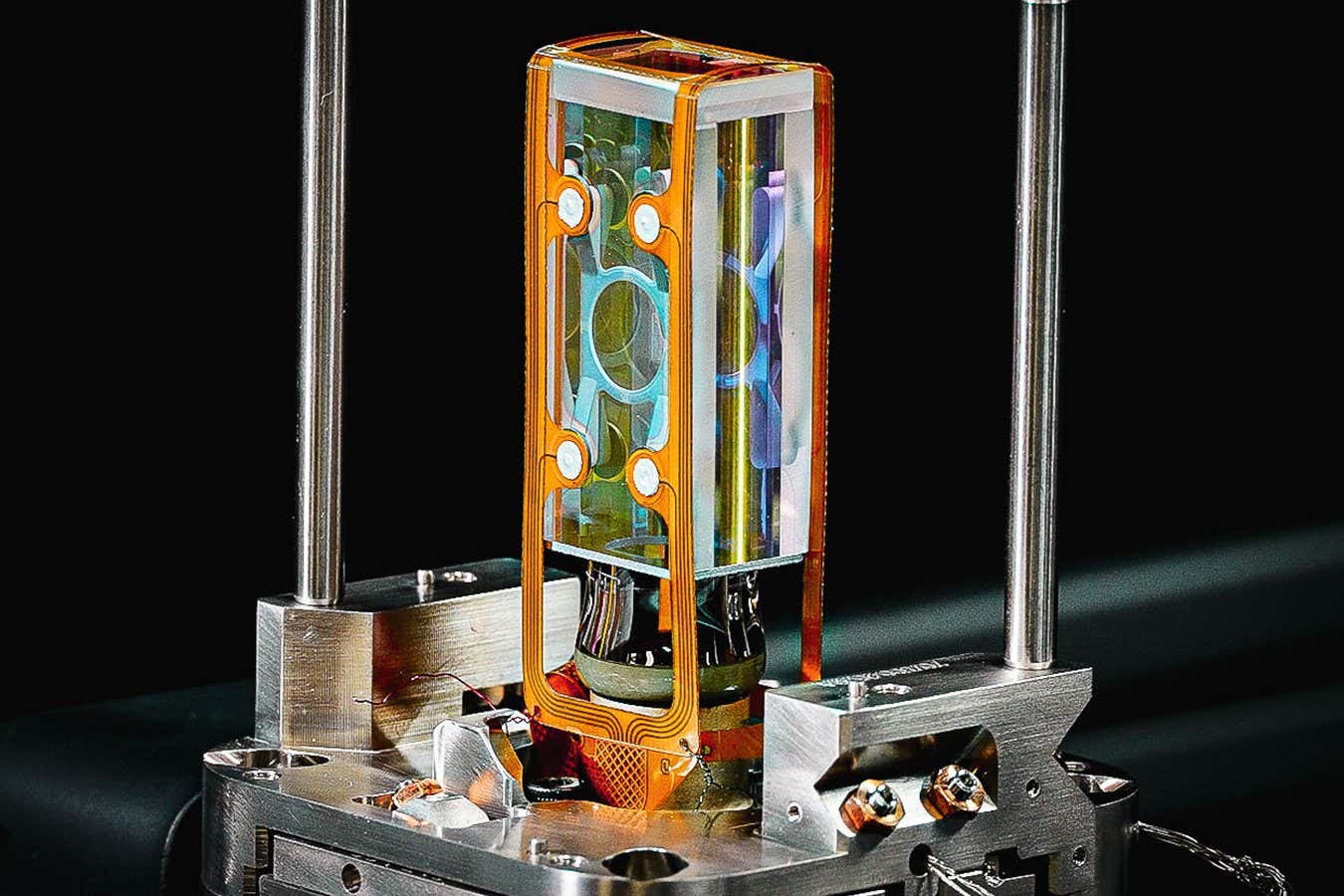
A central part of a quantum computer built by the company Infleqtion
Infleqtion
The US government wants to get hold of a quantum computer good enough to contribute to scientific breakthroughs in just two years. It will use it to try to accelerate the research and development of new materials, pharmaceuticals and molecules useful in agriculture and manufacturing.
Once a dream of theoretical physicists, quantum computers are now undoubtedly real, but have yet to prove unambiguously useful or to have broad commercial value. Their computational power depends on their size – how many components called qubits they comprise – and how reliable they are. Existing devices are still too small and too error-prone.
The US Department of Energy’s Quantum Genesis initiative is targeting 2028 for when this will change. The initiative is launching a competition and plans to build a national quantum supercomputing facility. It is part of the larger Genesis Mission, which is also giving researchers money.
By 2028, the DoE wants quantum computers to be powerful enough to start contributing to open problems in chemistry, materials science, plasma physics and high-energy physics. “I have a lot of confidence that the building blocks exist… we don’t need a massive breakthrough,” says Darío Gil, under secretary for science at the DoE.
Gil says that his confidence is based on recent progress across quantum computing, from how well individual qubits can be built to what he qualifies as phenomenal progress in algorithms that quantum computers use to catch and correct their own errors. Additionally, he thinks that using AI will play a role in reaching the 2028 milestone, for instance, by helping researchers optimise how quantum computers are controlled.
“2028 is quite ambitious but not impossible,” says Juliette Peyronnet at the quantum computing company Alice & Bob. Paul Stimers at the Quantum Industry Coalition says that several quantum computing firms previously announced plans to deliver a scientifically useful, error-proof quantum computer by 2028 or within a few years of that mark.
This announcement from the DoE comes on the heels of President Donald Trump signing two executive orders related to quantum technology, as well as a $2 billion investment into several quantum computing companies from the US Department of Commerce.
Some quantum technologies named in the executive orders, such as quantum sensors, have already reached commercial viability, so it is fairly certain that they will soon be deployed more broadly, for instance, in space through collaboration with NASA. Quantum computing has garnered more attention in part because quantum computers could become powerful encryption-breaking machines, but they may also face comparatively bigger challenges on the road to 2028.
Gil acknowledges that the leap from existing devices to quantum computers that will need to be hundreds or thousands of times larger will require lots of learning. “The reality of it will be dealing with complexity [increase] from [building] a device to a chip to a system,” he says. Additionally, issues may arise with supply chains, which are still fragile because of how exotic many of the components needed for novel quantum devices are, says Stimers.
The US isn’t alone in moving to support and accelerate quantum technology development. The UK, for instance, aims to acquire large-scale quantum computers beyond 2030 through the ProQure program. Quantum computing is also one of the two technologies, alongside artificial intelligence, at the centre of China’s next five-year national development strategy. Notably, targeting 2028 makes for the shortest timeline among the three. “It’s aggressive,” says Gil.
Topics:
