

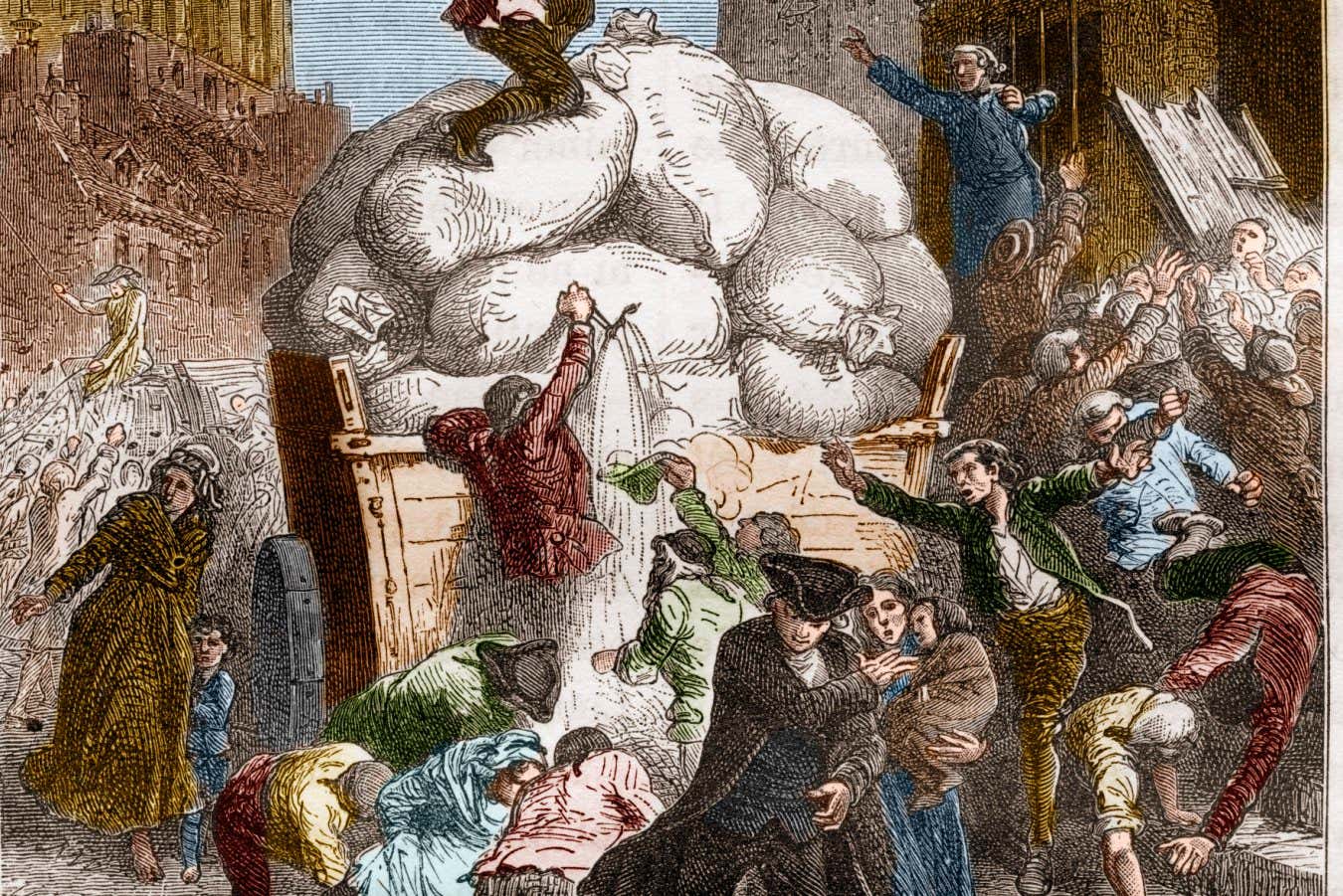
An illustration of an uprising that preceded the French Revolution
Stefano Bianchetti/Corbis via Getty Images
Severe volcanic eruptions and changes in the activity of the sun may have set the scene for some of the world’s most famous rebellions, including the French Revolution.
It has long been known that tough environmental conditions such as drought, deforestation and extremes of heat and cold can lead to social chaos, failed harvests and even disease.
One of the most severe periods of weather experienced over the last millennia, known as the Little Ice Age, gripped parts of the northern hemisphere, especially Europe and North America, from about 1250 to 1860. During this period of anomalous cold, when temperatures dropped by an average of up to 1.75°C and precipitation fell by as much as half, agriculture was thrown into chaos.
David Kaniewski at the University of Toulouse in France and his colleagues scoured the literature to identify 140 rebellions during this interval that were large enough to register in the historical record.
For their study, they compared the records of these various social crises with records of solar activity, volcanic eruptions and climate change, along with swings in the price of grain and bread, to see if there was any connection between them and extreme weather associated with the Little Ice Age.
“We looked at whether spikes in unrest aligned with environmental change and the challenges it poses for societies,” says Kaniewski.
The team found that particularly cold phases of the Little Ice Age correlated with significant increases in the number of rebellions.
“We also found that major volcanic eruptions, which temporarily cool the climate, were followed by social chaos at levels that were statistically significant,” says Kaniewski. “Sunspot records, which track the activity of the sun and its cycles, showed that fewer sunspots, linked to cooler global temperatures, coincided with more uprisings.”
When temperatures fell by between 0.6°C and 0.7°C, whether through volcanic activity or a decrease in the number of sunspots, there were 0.72 more rebellions per year on average, with similar results for rainfall reductions.
But the team found the strongest correlation when comparing the number of rebellions or revolutions with the price of wheat and barley. Steep price rises led to an additional 1.16 rebellions per year.
Kaniewski says when harvests failed, famines loomed, prices rose and people were far more likely to rebel. However, the team also found that some nations, such as England, which undoubtedly also experienced weather turmoil during this period, adapted and rode out the crises better than others.
The researchers think that while climate didn’t directly lead to rebellion, environmental conditions led to cascades of events that led to food shortages, evidenced in increasing grain prices. This, in turn, could encourage people to rise up against authority.
“Scarcity of food is like a parched forest after a long drought,” says Kaniewski. “When you add political or social grievances, then it can ignite revolt.”
One of the most extreme periods of upheaval followed the eruption of Iceland’s Laki volcano in June 1783, which led to higher levels of sulphur dioxide in the atmosphere and had a cooling effect on the climate. The team discovered that following this period, from 1788 to 1798, there was a peak of 1.4 rebellions annually, including the tumult of the French Revolution.
Kaniewski says that understanding the Little Ice Age may offer a glimpse into the challenges facing humanity with future climate predictions: “Today’s climate change could be far more disruptive.”
Tim Flannery at the Australian Museum in Sydney, however, says the link between climate change and rebellion and revolution, as demonstrated in this study, is a matter of correlation, not cause.
“It’s just as likely that people will fall into chaos, migrate, commit suicide or whatever else during a stressful period, as start a revolt,” Flannery says. “I’m not saying it’s wrong, but I don’t think it represents much of a step forward from what we knew before, and there needs to be a much deeper analysis.”
Jeremy Moss at the University of New South Wales in Sydney says that when considering the harms that people and natural systems are likely to experience because of climate change, direct effects are only part of the equation. “Often just as important is how and why people and natural systems become vulnerable to those hazards, and what we do in response to such vulnerabilities,” Moss says.
Topics:
