

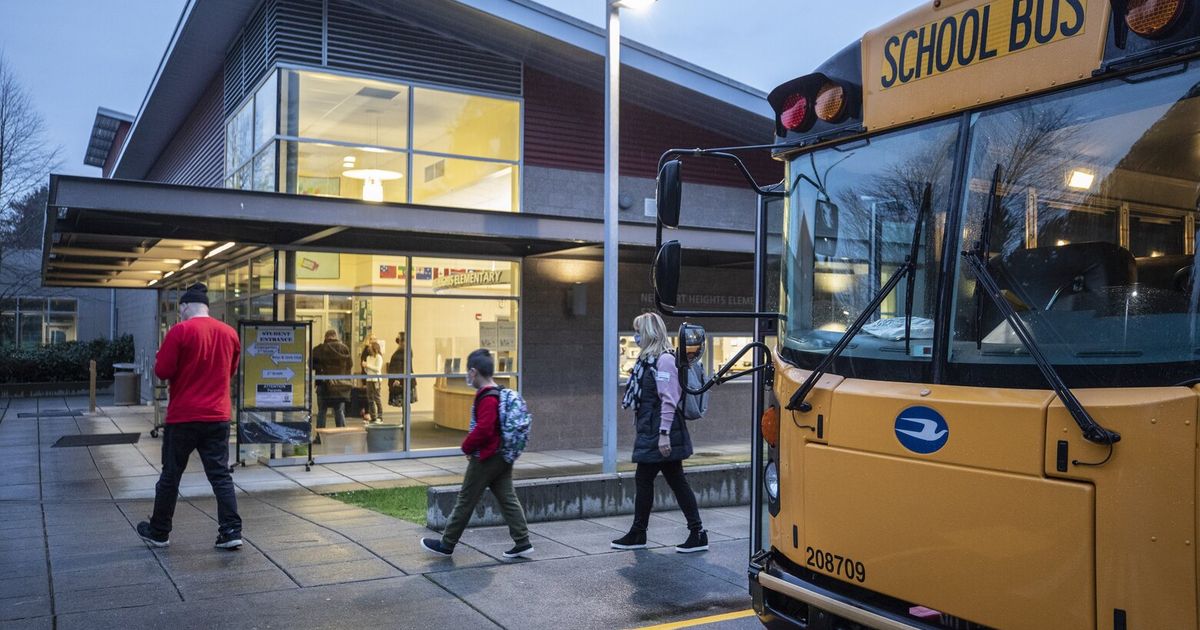
Last week, the latest fallout from the Washington Legislature’s taxing spree earlier this year landed. Hard. On the state’s school districts.
That’s at a time when several are struggling with finances so severe they are in binding conditions requiring state supervision. Bellevue School District is the largest one.
In the waning days of the legislative session, the Democratic revenue-raisers threw some spaghetti against the wall and introduced a bill to expand the state’s sales tax to services. It stuck — and stayed until ESSB 5814 got the votes to pass.
Part of $9.4 billion in new taxes the Legislature imposed over four years, this law is expected to raise about $1.1 billion.
This was such a rush job that school district leaders were surprised they would have to pony up the tax on such things as hiring temporary staff, information technology services and live presentations. Education leaders thought they would be exempted, like hospitals.
Since the state is supposed to fully fund basic education — an often-disputed threshold — it’s almost like the state taxing itself.
For the Northshore School District, the new tax bill could add about $1.8 million in additional expenses to its $464 million general fund and cost the capital projects fund $400,000 for taxes on engineering and architecture services, Times education reporter Denisa R. Superville reported last week.
The Department of Revenue seems to be trying to catch up, issuing some temporary though detailed guidance for how the tax might apply. It won’t be final till after the Legislature’s next session, which convenes in January. School leaders are hoping to be exempted or at least have more clarification.
Higher education leaders are also scrambling to understand how they might be affected. Hiring temporary security for sporting events or graduation is taxed. But as with the Northshore district, expertise needed for capital construction projects would also add to the costs for taxpayers or force cutbacks in other areas.
The state Board for Community and Technical Colleges expects colleges will have to pay taxes on online advertising. The revenue department’s temporary guidance suggests they won’t have to pay taxes on noncredit classes, such as community education, said Choi Halladay, the state board’s deputy executive director of business operations.
But temporary means temporary. And state revenue forecasters are already estimating revenue projections are down about a half billion, with lawmakers already warning of a serious deficit. Who knows how that will shake out?
Sadly, it didn’t have to be this way. SB 5814 was introduced on the 94th day of the Legislature’s 105-day session — it was rushed through hearings in the House and Senate. Those agencies, businesses, nonprofits and consumers affected had little chance to weigh in — none, if they didn’t have lobbyists.
I re-watched some of the deliberations this week in the House Finance Committee, where the chair acknowledged the bill needed more work but urged members to approve it and send it on its way. In debates on both the House and Senate floors, the bill was changed in material ways, imposing new ideas that never got a hearing.
Yes, add a little sausage-making to the spaghetti sauce. Imagine the vetting this bill would have gotten if it were introduced on the first day of the session. There would be fewer costly surprises.
When the Washington Legislature convened last January, The Times editorial board praised new Gov. Bob Ferguson’s inaugural address that seemed to push back on a Democratic leadership primed to raise a raft of taxes.
Most Dems were ticked but minority Republicans were tickled, especially with Ferguson’s pledge to reach across the aisle.
A few weeks later, he held a news conference in front of several executive branch managers with a sobering list of proposed cuts and included a proposal that state employees take furlough days to help mend the budget gap. The latter didn’t happen. At least he batted down a wealth tax that the former state attorney general was skeptical would stand up in court.
The Times editorial board urged the governor to call lawmakers back for a special session to fix, among other things, ESSB 5814.
Nevertheless, Ferguson put his signature on this $1.1 billion tax package, as well as signing off on another $8.3 billion in new taxes. All while the casualty list was high for many vulnerable Washingtonians and important programs. The budget slashed assistance for foster kids, college-bound students, financial aid and hospitals.
In January, lawmakers return to Olympia to write and approve a supplemental budget. We will see if they will commit to more transparency and careful legislating for their constituents rather than to an ideological agenda.
