

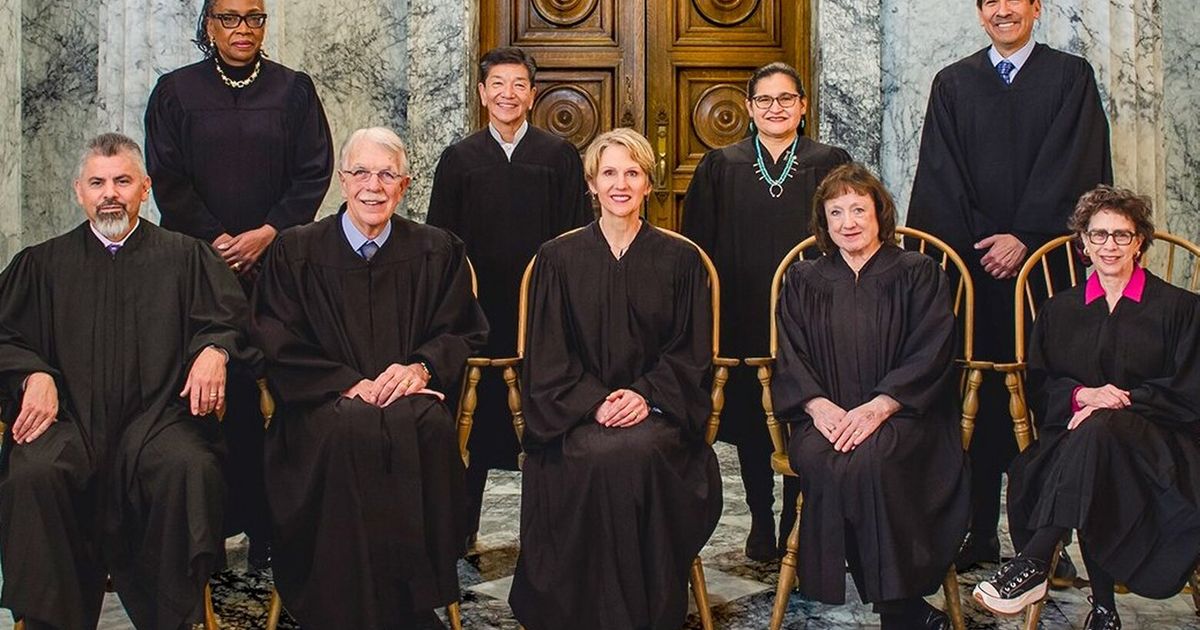
Thank you, state Supreme Court Justice Salvador Mungia. The state’s newest justice stood alone against his eight colleagues who want to keep secret the backroom wheeling and dealing that goes into state employee contract negotiations.
Meanwhile his eight colleagues ruled that early negotiation agreements must remain secret until the state Legislature has funded the contracts in its budget. That usually happens near the end of the next legislative session — well after the benefits of any scrutiny are passed.
Though this question was raised during the 2022 negotiations, this most recent year’s collective bargaining negotiations and budget wrangling provide a case in point. More transparency earlier in the process, such as last summer or fall, could have mitigated some severe state budget cuts and the huge tax increases. But, the state employees got to keep their raises — 5% over two years.
Citizen Action Defense Fund sued the state in 2022 after the state Office of Financial Management refused to provide copies of the initial bargaining positions of the state and the state employees union. OFM contended it didn’t have to provide the documents until the Legislature funded the contracts.
A Thurston Superior Court rightly ruled against the state, saying a signed preliminary agreement was subject to public disclosure. But an appeals court overturned that ruling and the state high court affirmed, 8-1.
The Supreme Court majority concluded the negotiations fall under a “deliberative process exemption” from the state Public Records Act.
Significantly, Justice Mungia’s robust dissent is steeped in the values of the Public Records Act, enacted by voters in 1972:
“The people have the right to know what their government is doing. That value is the basis for the Public Records Act (PRA). The presumption is that the public is entitled to information their government holds. Withholding information is the exception, and this court’s responsibility is to construe any exemption under the PRA as narrowly as reasonably possible so that information is disclosed and not withheld.”
Amen.
Justice Mungia’s dissent rejected the majority contention that the negotiation process ends only when the budget law is passed.
“Instead, the issue in this case is when did the negotiation process end between the Washington State Office of Financial Management (OFM) and the labor unions representing state employees (Union). That deliberative process ended by October 1, 2022, when OFM and the Union reached an agreement.”
Let’s talk about this latest round of contract negotiations and the subsequent legislative consideration. And what more transparency could have meant to the process.
In September, Gov. Jay Inslee’s administration concluded major contract negotiations with state employee unions, even though clouds gathered over the state revenue horizon. The Democrat-controlled Legislature purposely had ignored state economic forecasters and overspent.
To make the deal float — 5% raises over two years — the outgoing governor left a multibillion shortfall for his successor to handle and suggested a huge and legally untested wealth tax. Long story short, lawmakers lamented the breathtaking shortfall of their own making and pushed for a taxapolooza of increases — even while state revenues were growing.
At least, Gov. Bob Ferguson tried to push back. He proposed a number of cuts, including suggesting state employees take one furlough day a month over 24 months. Senate Democrats proposed something similar, but state employee unions were having none of it. Ferguson’s bottom line: He would not sign a budget that relied on the wealth tax.
In the end, state employees got to keep their raises. Meanwhile, lawmakers made deep cuts to many programs, including food banks, child care, college readiness for at-risk kids, a program to help foster children stay on track academically and some layoffs. And they raised taxes — about $9 billion over four years — raising taxes on businesses, extending the sales tax to more services, expanding the capital gains tax and eliminating some exemptions.
More public scrutiny of the budget negotiation process earlier could have raised some of these concerns and warned of threats to vital programs earlier. Especially in a state with one-party control of the Legislature and the governor’s mansion, more ways to keep tabs on backroom machinations can only be a good thing.
Here’s an opportunity for the new governor. Regardless of the high court’s recent mistaken ruling, Ferguson can make a different decision about how his administration’s OFM will consider such requests. During his campaign, he pledged not to invoke executive privilege as governor, after all.
At the very least, the governor, a smart lawyer himself, should read Justice Mungia’s dissent. The newest justice’s understanding of the intent of the Public Records Act — and his commitment to it — is encouraging.
