

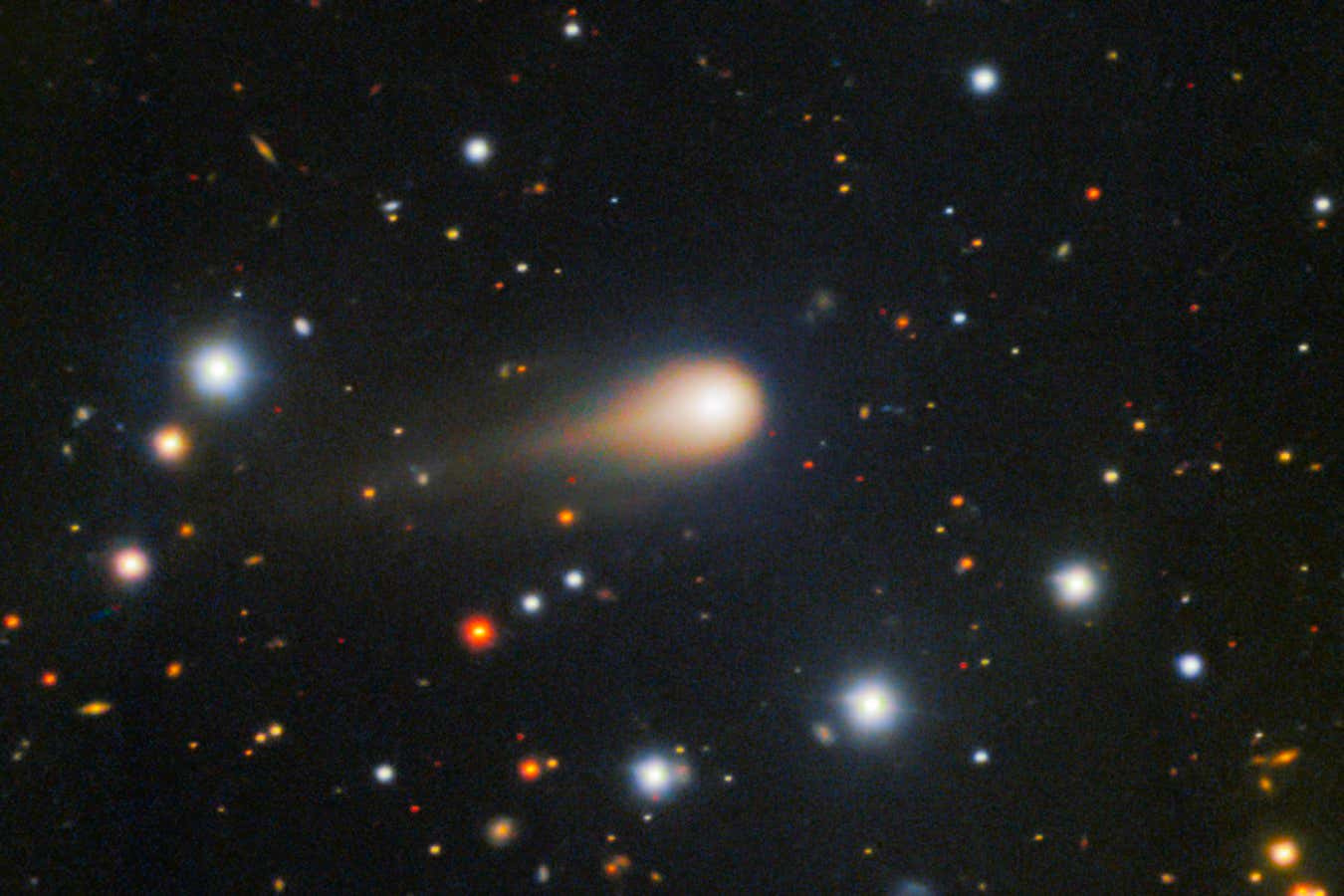
A deep image of 3I/ATLAS captured by the International Gemini Observatory in Chile, showing the coma of gas and dust around the comet
International Gemini Observatory/NOIRLab/NSF/AURA/Shadow the Scientist
3I/ATLAS, the interstellar comet passing through our solar system, might have been radically transformed by cosmic rays over billions of years, changing its appearance so thoroughly that we may never be able to work out where it came from.
Since astronomers first spotted 3I/ATLAS in July, they have detailed some puzzling properties. These include levels of carbon dioxide in its coma – a plume of gas and dust – that are at least 16 times higher than typical comets in our solar system, making it one of the most CO2-rich comets ever seen.
Some astronomers hoped that this might be an indication of the exotic star system that 3I/ATLAS originated from (or, improbably, extraterrestrial involvement), but there could be a much simpler explanation.
Romain Maggiolo at the Royal Belgian Institute for Space Aeronomy in Uccle and his colleagues argue that the high CO2 levels are best explained by the outer part of 3I/ATLAS having been radically altered by high-energy particles known as cosmic rays over billions of years.
“Somehow, this process has been a bit overlooked or taken as a secondary process, because it’s very slow. But in the end, for objects like comets or interstellar objects, it has a strong effect,” says Maggiolo.
The researchers compared the observations of 3I/ATLAS to laboratory studies where cosmic rays are fired at ice made of water and carbon monoxide, which is thought to be like the ice that forms on comets. These studies find that this process creates abundant CO2, as well as leaving behind a red-looking residue that is high in carbon, which astronomers have also observed on the comet.
“Very slowly, [cosmic rays] will break molecules and produce reactive radicals, fragments of molecules that will recombine, and so they will slowly change the chemical composition of the [comet’s] ice,” says Maggiolo.
This would be a significant blow to our hopes of understanding where these comets come from, he says, as the cosmic rays could have destroyed crucial evidence. Previously, astronomers believed interstellar comets like 3I/ATLAS were extremely well preserved, acting as cold fossils that contain key information about other star systems, but we may need to be more cautious about how much information we can glean from them.
The possibility of visiting the comet with a satellite to sample material directly has been ruled out due to its high speed through our solar system. But there is one glimmer of hope for discerning 3I/ATLAS’s true nature.
The comet is currently passing close to the sun, out of view from Earth, but is set to reappear in December. This close pass could melt enough ice in its outer layer to reveal material underneath that has been protected from cosmic rays, says Maggiolo. But that depends on how much ice it has already lost since it entered our solar system and the thickness of its icy crust, which we don’t currently know, he says.
Cyrielle Opitom at the University of Edinburgh, UK, says upcoming observations, both with the James Webb Space Telescope and ground-based telescopes, will be crucial to look for more pristine material below the comet’s surface. “We have a very exciting few months coming,” she says.
Experience the astronomical highlights of Chile. Visit some of the world’s most technologically advanced observatories and stargaze beneath some of the clearest skies on earth. Topics:
The world capital of astronomy: Chile
