

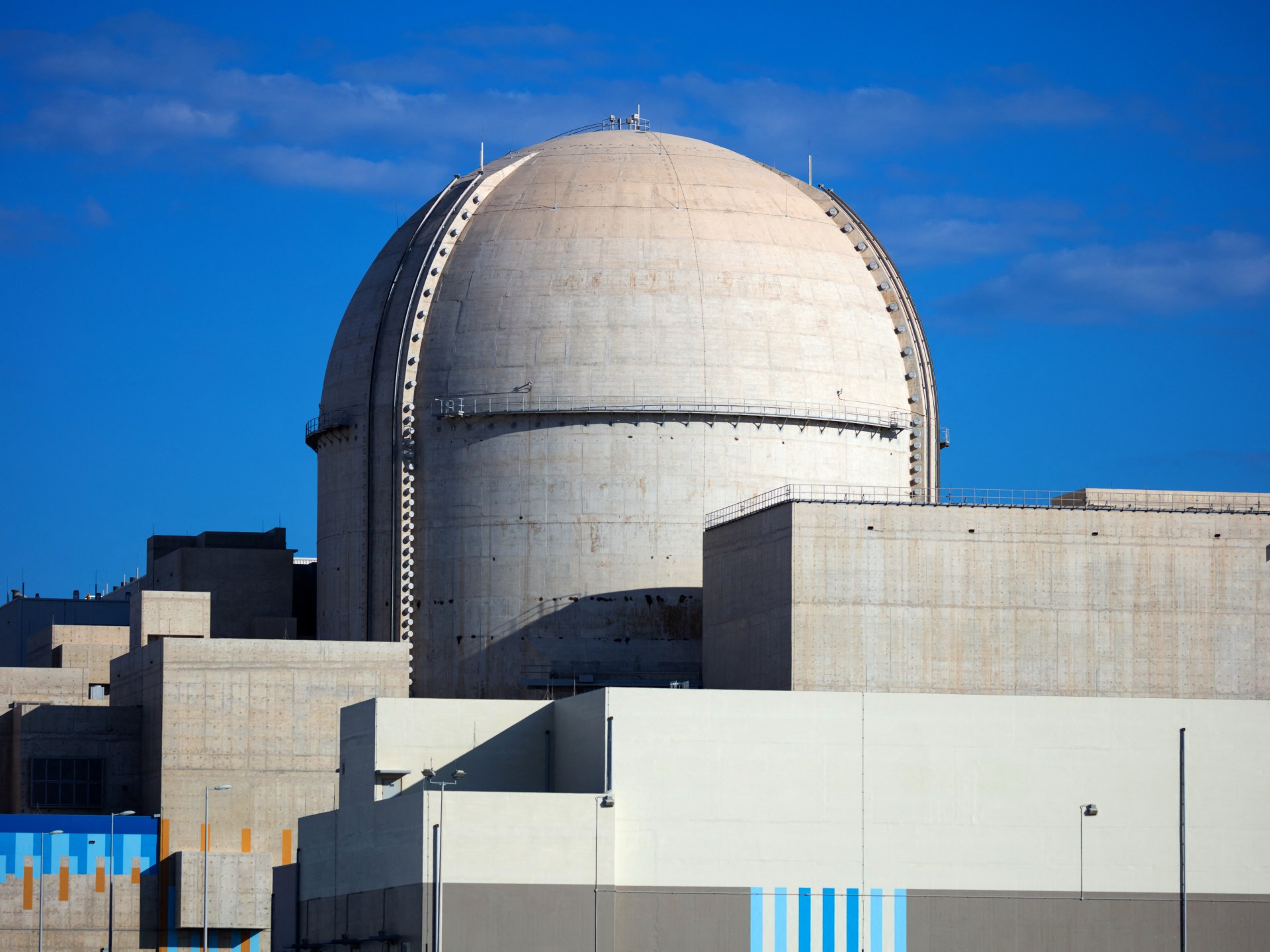
A drone attack that caused a fire close to the Barakah Nuclear Energy Plant in the United Arab Emirates has raised further concerns about nuclear security and military escalation in the Gulf as discussions of peace between Iran and the United States hang in the balance.
Barakah was the first nuclear power station to be built on the Arabian Peninsula. Here is what we know about it:
What is the Barakah Nuclear Energy Plant?
Barakah is a nuclear energy plant located in Al Dhafra, the largest municipal region of the emirate of Abu Dhabi. It is the UAE’s only nuclear power plant.
Construction of the plant began in 2012, and its first reactor became commercially operational in 2021.
The plant is located close to the border with Saudi Arabia, about 225km (140 miles) west of the UAE’s capital city, Abu Dhabi.
The facility features four pressurised water reactors, the most common type of nuclear power reactor. The model used here is the advanced power reactor 1400, a pressurised water reactor design developed in South Korea. Each reactor of this type has the capacity to produce 1,400 megawatts (MW), which is enough to power roughly 1 million homes.
According to the Emirates Nuclear Energy Corporation (ENEC), the plant’s reactors produce 40 terawatt-hours (TWh) each year, which is equivalent to about 25 percent of the UAE’s electricity needs. The website for the London-based World Nuclear Association also confirmed that Barakah, when fully operational, meets 25 percent of the UAE’s electricity needs.
According to a September report by the Abu Dhabi media office, Barakah had produced 40TWh of clean energy over “the past 12 months”.
Since nuclear power plants produce a lower amount of carbon dioxide emissions than conventional power plants, the ENEC said Barakah saves up to 22.4 million tonnes of carbon emissions each year, equivalent to removing 4.8 million cars from the roads.
What happened in the attack on Sunday, and how has the UAE responded?
Authorities in Abu Dhabi said a single drone strike caused a blaze to break out at an electrical generator outside the Barakah plant’s inner perimeter in the Al Dhafra region on Sunday. No injuries were reported, and officials said radiation levels remained normal.
The UAE’s nuclear regulator said operations at the Barakah facility had not been affected. “All units are operating as normal,” it said in a social media post.
In a statement, the UAE’s Ministry of Defence said two more drones had been “successfully” intercepted and the drones had been launched from the “western border”. It did not give more details.
The UAE’s Ministry of Foreign Affairs posted a statement on X on Sunday saying the country condemned “the unprovoked terrorist attack” in “the strongest terms”.
The statement added: “The UAE emphasised that it will not tolerate any threat to its security and sovereignty under any circumstances, and that it reserves its full, sovereign, legitimate, diplomatic, and military rights to respond to any threats, allegations, or hostilities in a manner that ensures the protection of its sovereignty, national security, territorial integrity, and the safety of its citizens, residents, and visitors, in accordance with international law.”
There was no immediate claim of responsibility, and the statements by the ministries did not publicly blame any country.
But Anwar Gargash, an adviser to the UAE’s president, wrote in an X post on Sunday: “The terrorist targeting of the Barakah clean nuclear power plant, whether carried out by the principal perpetrator or through one of its agents, represents a dangerous escalation and a dark scene that violates all international laws and norms, in criminal disregard for the lives of civilians in the UAE and its surroundings.”
Gargash’s post appeared to blame Iran and its proxy network of allied armed groups in the region, which Tehran calls the “axis of resistance”.
The launch point of the drones remained unclear, but on Sunday, Saudi Arabia also reported it had intercepted three drones that had been launched from Iraq, where some Iran-allied groups operate. If Iranian Shahed-136 drones, which have an estimated range of 2,000km to 2,500km (1,240 to 1,550 miles), were fired from Iraqi territory, both Saudi Arabia and the UAE would fall well within their reach.
Other reactions
Neighbouring Gulf states Saudi Arabia and Qatar condemned the attack on the Barakah plant.
The Ministry of Foreign Affairs of Kuwait also issued a statement denouncing the attack, which it called “heinous”.
The Indian Ministry of External Affairs condemned the attack, calling it “unacceptable”, saying it represented “a dangerous escalation” and urging a return to diplomacy.
Has Iran responded to the incident?
Iran has not claimed responsibility for the drone attacks, and there has been no public statement from Iran about the incident at Barakah.
However, in the aftermath of the drone attacks, United States President Donald Trump wrote in a Truth Social post: “For Iran, the Clock is Ticking, and they better get moving, FAST, or there won’t be anything left of them. TIME IS OF THE ESSENCE!”
Iranian Ministry of Defence spokesperson Reza Talaei-Nik said on Sunday that the military is “fully prepared” to confront any new aggression from the US and Israel.
Iran has previously warned that countries where US military assets are deployed or Israeli-linked interests are located are viewed as legitimate targets.
Iran has also accused the UAE of strengthening ties with Israel while reports have emerged that Israeli Prime Minister Benjamin Netanyahu made a “secret” visit to the Gulf state during the US-Israel war on Iran. The UAE has denied this.
US Ambassador to Israel Mike Huckabee also said last week that Israel had deployed Iron Dome air defence systems and personnel to the UAE to help defend against possible Iranian attacks.
What has the IAEA said?
The International Atomic Energy Agency (IAEA), the global nuclear watchdog, said Sunday’s incident in the UAE had forced one reactor to rely temporarily on emergency diesel generators.
IAEA chief Rafael Grossi expressed “grave concern” and warned that military activity threatening nuclear facilities was “unacceptable”.
How serious could a strike on a nuclear facility be?
Attacks on nuclear power plants are especially worrying because they can risk damaging critical safety systems or reactors, which could release radioactive material into the atmosphere, not only over the country targeted but also across neighbouring states. Radiological material, specifically the hazardous isotope Caesium-137, could be released into the atmosphere.
The release of radioactive material could result in environmental contamination and poses major risks to public health. Water, if contaminated, becomes undrinkable while farmland and fisheries could become unsafe for decades, depending on the isotope released.
Short-term, acute exposure to radioactivity can cause burns and acute radiation sickness, which can be life-threatening.
Prolonged exposure, even to smaller doses, can increase the risk of illnesses such as cancer, especially thyroid cancer and leukaemia. Children and pregnant women are especially vulnerable.
Over the course of the US-Israel war on Iran, energy infrastructure has become a target.
Iran’s only functioning nuclear plant, the Bushehr power plant, has come under repeated attacks in the war. There are fears that damage at Bushehr could contaminate water across the entire Gulf region, most of which lacks groundwater and relies heavily on the desalination of seawater. Desalination plants are not specifically built to filter radioactive material, and not all plants currently are fitted with the technologies required to do so.
