

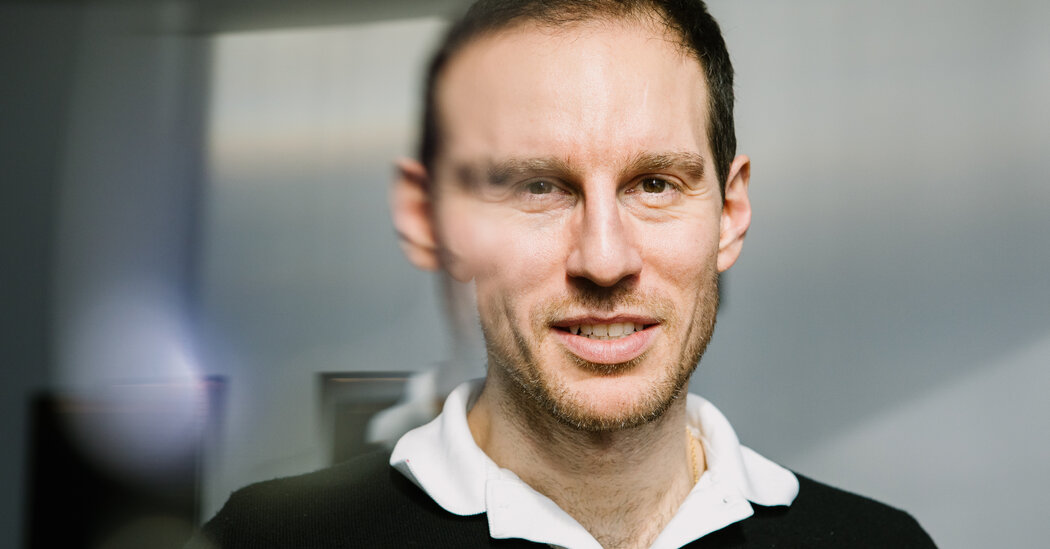
The words “optimal” and “optimize” derive from the Latin “optimus,” or “best,” as in “make the best of things.” Alessio Figalli, a mathematician at the university ETH Zurich, studies optimal transport: the most efficient allocation of starting points to end points. The scope of investigation is wide, including clouds, crystals, bubbles and chatbots.
Dr. Figalli, who was awarded the Fields Medal in 2018, likes math that is motivated by concrete problems found in nature. He also likes the discipline’s “sense of eternity,” he said in a recent interview. “It is something that will be here forever.” (Nothing is forever, he conceded, but math will be around for “long enough.”) “I like the fact that if you prove a theorem, you prove it,” he said. “There’s no ambiguity, it’s true or false. In a hundred years, you can rely on it, no matter what.”
The study of optimal transport was introduced almost 250 years ago by Gaspard Monge, a French mathematician and politician who was motivated by problems in military engineering. His ideas found broader application solving logistical problems during the Napoleonic Era — for instance, identifying the most efficient way to build fortifications, in order to minimize the costs of transporting materials across Europe.
In 1975, the Russian mathematician Leonid Kantorovich shared the Nobel in economic science for refining a rigorous mathematical theory for the optimum allocation of resources. “He had an example with bakeries and coffee shops,” Dr. Figalli said. The optimization goal in this case was to ensure that on a daily basis every bakery delivered all its croissants, and every coffee shop got all the croissants desired.
“It’s called a global wellness optimization problem in the sense that there is no competition between bakeries, no competition between coffee shops,” he said. “It’s not like optimizing the utility of one player. It is optimizing the global utility of the population. And that’s why it’s so complex: because if one bakery or one coffee shop does something different, this will influence everyone else.”
The following conversation with Dr. Figalli — conducted at an event in New York City organized by the Simons Laufer Mathematical Sciences Institute and in interviews before and after — has been condensed and edited for clarity.
How would you finish the sentence “Math is … ”? What is math?
For me, math is a creative process and a language to describe nature. The reason that math is the way it is is because humans realized that it was the right way to model the earth and what they were observing. What is fascinating is that it works so well.
Is nature always seeking to optimize?
Nature is naturally an optimizer. It has a minimal-energy principle — nature by itself. Then of course it gets more complex when other variables enter into the equation. It depends on what you are studying.
When I was applying optimal transport to meteorology, I was trying to understand the movement of clouds. It was a simplified model where some physical variables that may influence the movement of clouds were neglected. For example, you might ignore friction or wind.
The movement of water particles in clouds follows an optimal transport path. And here you are transporting billions of points, billions of water particles, to billions of points, so it’s a much bigger problem than 10 bakeries to 50 coffee shops. The numbers grow enormously. That’s why you need mathematics to study it.
What about optimal transport captured your interest?
I was most excited by the applications, and by the fact that the mathematics was very beautiful and came from very concrete problems.
There is a constant exchange between what mathematics can do and what people require in the real world. As mathematicians, we can fantasize. We like to increase dimensions — we work in infinite dimensional space, which people always think is a little bit crazy. But it’s what allows us now to use cellphones and Google and all the modern technology we have. Everything would not exist had mathematicians not been crazy enough to go out of the standard boundaries of the mind, where we only live in three dimensions. Reality is much more than that.
In society, the risk is always that people just see math as being important when they see the connection to applications. But it’s important beyond that — the thinking, the developments of a new theory that came through mathematics over time that led to big changes in society. Everything is math.
And often the math came first. It’s not that you wake up with an applied question and you find the answer. Usually the answer was already there, but it was there because people had the time and the freedom to think big. The other way around it can work, but in a more limited fashion, problem by problem. Big changes usually happen because of free thinking.
Optimization has its limits. Creativity can’t really be optimized.
Yes, creativity is the opposite. Suppose you’re doing very good research in an area; your optimization scheme would have you stay there. But it’s better to take risks. Failure and frustration are key. Big breakthroughs, big changes, always come because at some moment you are taking yourself out of your comfort zone, and this will never be an optimization process. Optimizing everything results in missing opportunities sometimes. I think it’s important to really value and be careful with what you optimize.
What are you working on these days?
One challenge is using optimal transport in machine learning.
From a theoretical viewpoint, machine learning is just an optimization problem where you have a system, and you want to optimize some parameters, or features, so that the machine will do a certain number of tasks.
To classify images, optimal transport measures how similar two images are by comparing features like colors or textures and putting these features into alignment — transporting them — between the two images. This technique helps improve accuracy, making models more robust to changes or distortions.
These are very high-dimensional phenomena. You are trying to understand objects that have many features, many parameters, and every feature corresponds to one dimension. So if you have 50 features, you are in 50-dimensional space.
The higher the dimension where the object lives, the more complex the optimal transport problem is — it requires too much time, too much data to solve the problem, and you will never be able to do it. This is called the curse of dimensionality. Recently people have been trying to look at ways to avoid the curse of dimensionality. One idea is to develop a new type of optimal transport.
What’s the gist of it?
By collapsing some features, I reduce my optimal transport to a lower-dimensional space. Let’s say three dimensions is too large for me and I want to make it a one-dimensional problem. I take some points in my three-dimensional space and I project them onto a line. I solve the optimal transport on the line, I compute what I should do, and I repeat this for many, many lines. Then, using these results in dimension one, I try to reconstruct the original 3-D space by a sort of gluing together. It is not an obvious process.
It kind of sounds like the shadow of an object — a two-dimensional, square-ish shadow provides some information about the three-dimensional cube that casts the shadow.
It is like shadows. Another example is X-rays, which are 2-D images of your 3-D body. But if you do X-rays in enough directions you can essentially piece together the images and reconstruct your body.
Conquering the curse of dimensionality would help with A.I.’s shortcomings and limitations?
If we use some optimal transport techniques, perhaps this could make some of these optimization problems in machine learning more robust, more stable, more reliable, less biased, safer. That’s the meta principle.
And, in the interplay of pure and applied math, here the practical, real-world need is motivating new mathematics?
Exactly. The engineering of machine learning is very far ahead. But we don’t know why it works. There are few theorems; comparing what it can achieve to what we can prove, there is a huge gap. It is impressive, but mathematically it is still very difficult to explain why. So we cannot trust it enough. We want to make it better in many directions, and we want mathematics to help.
