

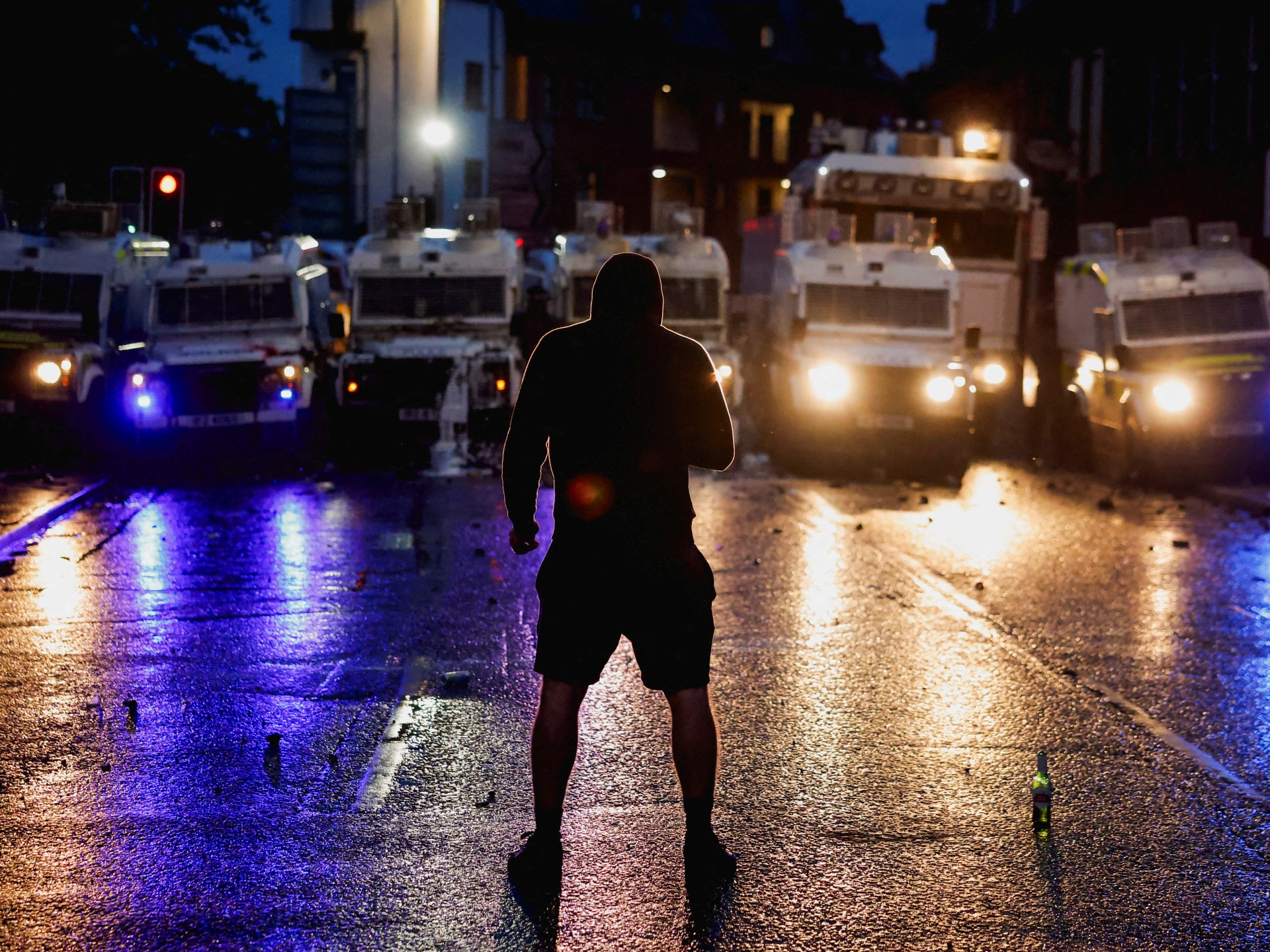
Anti-immigration protests have escalated into clashes with police in several towns in Northern Ireland this week, marking a new wave of unrest to hit the United Kingdom.
Disorder in towns across the region continued for a fourth night on Thursday. In Portadown, County Armagh, a crowd used bricks and masonry from a derelict building to throw at police.
About 40 officers have been injured, and 15 arrests have been made.
Protests began in Ballymena, a town of about 31,000 people located 40km (25 miles) northwest of the city of Belfast, on Monday when two Romanian 14-year-old boys were arrested on suspicion of sexually assaulting a teenage girl.
The most intense violence took place on Tuesday in Ballymena, when hundreds of masked rioters attacked police and set buildings and cars on fire. A smaller crowd threw rocks, fireworks and petrol bombs at police on Wednesday, as police officers responded with water cannon.
Masked rioters also set fire to a leisure centre in Larne, about 30km (19 miles) away from Ballymena, on the coast, where some immigrant families had been given shelter following the unrest in Ballymena.
Violence also spilled over to the cities of Belfast, Coleraine, Newtownabbey, Carrickfergus, Antrim and Lisburn.
What happened in Ballymena?
Riots in Ballymena erupted after the Romanian teenagers appeared in Coleraine Magistrates’ Court on Monday on sexual assault charges, which they denied. A Facebook post advertised a “peaceful protest to show our anger at what cannot and will not be tolerated in this town”.
The planned gathering began in Ballymena at 7:30pm (18:30 GMT). A crowd assembled at Clonavon Terrace in the town, where the alleged assault had taken place, and police officers presided over a largely peaceful demonstration.
Police said several masked individuals later broke away from the group and began erecting barricades and attacking private properties housing immigrants. They also attacked police officers with smoke bombs, fireworks, bottles and bricks, leading to clashes which have continued for several days since.
Some residents placed UK flags or signs in their windows reading “British household” and “locals live here” in a bid to avoid being targeted.
Sky News reported seeing ethnic minority residents of the town “packing up suitcases and leaving their homes”.
One mother of two, Mika Kolev, told the BBC her home had been damaged by rioters on Tuesday night. She said she intended to leave her home with her family and is considering moving back to Bulgaria.
“This is my house, I pay rent,” she said. “I feel like this is my country, this is my city. My daughter was born here. It’s very scary.”
Who are the rioters?
The identity of the hundreds of people – many masked and hooded – who attacked immigrant households and businesses was not immediately clear.
In the past, this sort of violence has usually taken place in towns like Ballymena, which are a stronghold of UK unionism. However, there were media reports that Catholics had also joined the protests this time.
Northern Ireland endured decades of conflict between unionists – largely Protestants who want it to remain within the UK – and nationalists – primarily Catholics who wanted to reunite with the rest of Ireland.
Paramilitary groups played a significant role in the sectarian conflict known as the Troubles, which lasted for about 30 years from the late 1960s to 1998, when the Good Friday Agreement established a power-sharing arrangement.
The agreement, however, has faced opposition from some unionist groups, and some grievances remain unresolved.
“Some working-class unionist areas feel as if they’ve lost out during the peace process,” sociologist John Nagle, who lectures at Queen’s University in Belfast, told Al Jazeera. “I think the sort of grievances about the peace process are being grafted onto the wider concerns about immigration.”
The Police Service of Northern Ireland (PSNI) said at this stage there was no evidence of unionist paramilitary involvement in the recent violence in the town. However, a report published last month by the independent human rights group Committee on the Administration of Justice (CAJ) points to a connection.
The study, titled Mapping Far Right Activity Online in Northern Ireland, analysed seven incidents of anti-immigrant protests that have taken place in Northern Ireland since 2023.
Daniel Holder, the organisation’s director, said the latest unrest followed a “fairly familiar pattern”.
“What we noticed … is that they’re all being called and taking place in areas where there is significant loyalist activity,” and are featuring a “degree of paramilitary control”, he told Al Jazeera.
Holder also said such riots have mostly taken place during the summer, coinciding with the loyalist marching season, a tradition among Protestant and Loyalist communities that runs from Easter Monday to September.
He struck a note of caution over accounts suggesting the involvement of Catholic nationalists in the unionist stronghold of Ballymena and said the notion of a broader “coming together” of the two historic rivals was unlikely.

What are the main issues driving the unrest?
Immigration appears to be the main concern for protesters. Since 2015, more than 1,800 Syrian refugees have been settled in Northern Ireland via the Syrian Vulnerable Persons Resettlement Scheme, which was renamed the Vulnerable Persons Relocation Scheme (NIRRS) in 2020.
General immigration has been on the rise as well.
Democratic Unionist Party (DUP) assembly member Paul Frew told the BBC that tensions over this have been rising for some time in Ballymena and people were “frightened about illegal immigration”.
Anger about austerity policies – and the retraction of welfare programmes – since the global financial crisis of 2008 has compounded concerns about immigration.
Grievances over poor housing conditions and housing shortages, in particular, have been used to scapegoat migrants and to favour a narrative of “mass uncontrolled migration that simply is not factually true”, Holder said.
The CAJ report, he said, found no clear correlation between the areas where violence has flared up in Northern Ireland since 2023 and poverty rates or high immigration rates.
“When you look at the pattern of where attacks are taking place, they’re not in the most deprived areas,” Holder said. “What this points to is that attacks involve particular far-right elements, including some elements of loyalist paramilitary organisations, rather than this being tied to either migration levels or deprivation.”
Does Northern Ireland have high rates of immigration?
Official figures from the Northern Ireland Assembly show that it is the least diverse part of the UK, with 3.4 percent of the population identifying as part of a minority ethnic group, compared with 18.3 percent in England and Wales and 12.9 percent in Scotland.
According to the most recent census data in 2021, immigration to Northern Ireland is relatively low, but it is rising. The percentage of the population born outside of the UK rose from 6.5 percent in 2011 to 8.6 percent in 2021.
How have Northern Irish leaders responded to the violence?
Some ministers have been accused of fanning the flames of unrest.
Several ministers condemned the violence in strong terms. First Minister Michelle O’Neill said the “racist and sectarian attacks on families” were “abhorrent and must stop immediately”.
Finance Minister John O’Dowd described the attackers as “racist thugs”, while Justice Minister Naomi Long said the violence was “completely unjustified and unjustifiable”. Chief Constable Jon Boutcher, who leads the Police Service of Northern Ireland, said, “Hate-fuelled acts and mob rule do nothing but tear at the fabric of our society.”
On Thursday, Communities Minister Gordon Lyons rejected calls for him to resign over a social media post in which he revealed the location of the leisure centre in Larne that was later attacked.
Tyler Hoey, a Democratic Unionist Party councillor and local representative, condemned the violence but also accused the UK government of taking “busloads” of unvetted migrants to the area.
Sociologist John Nagle, who lectures at Queen’s University in Belfast, told Al Jazeera that several unionist politicians condemned the riots while repeating the unfounded claim that Ballymena had become “a dumping ground” for migrants.
“Although the government has quickly come out to denounce the protests, to some extent that has been caveated by some politicians who are trying to use this as a way to highlight their opposition towards migration and refugees,” Nagle said.
Are most people in Northern Ireland concerned about rising immigration?
Sociologist Ruth McAreavey, who lectures at Newcastle University, said general surveys show that Northern Ireland has become more welcoming towards migrants over time and less likely to want to see reduced levels of immigration.
The Northern Ireland Life and Times Survey found that 94 percent of respondents in 2024 said they would be willing to accept a person from a minority ethnic group in their area, compared with only 53 percent who said they would feel comfortable in 2005.
However, McAreavey said fast-paced demographic changes have taken place within a “socially conservative place” as it navigates global economic upheavals, including the decline of its predominantly industrial economy, most notably in the shipbuilding and textile sectors.
“There is a level of discontent that people are taking to the streets,” McAreavey said, adding that this was compounded by austerity measures that rolled back the welfare state.
“The lack of those resources does not help for the incorporation of different social groups into society and to help achieve social cohesion,” she said. “People feel they’re not in control and things are happening to them, as opposed to a more natural, organic change.”
